

Microsoft SC-300 Real 2022 Braindumps Mock Exam Dumps
SC-300 Exam Questions | Real SC-300 Practice Dumps
Microsoft SC-300 Exam Syllabus Topics:
| Topic | Details |
|---|---|
| Topic 1 |
|
| Topic 2 |
|
| Topic 3 |
|
| Topic 4 |
|
NEW QUESTION 33
You have a custom cloud app named App1 that is registered in Azure Active Directory (Azure AD).
App1 is configured as shown in the following exhibit.
Use the drop-down menus to select the answer choice that completes each statement based on the information presented in the graphic.
NOTE: Each correct selection is worth one point.
Answer:
Explanation:
Reference:
https://docs.microsoft.com/en-us/azure/active-directory/manage-apps/assign-user-or-group-access-portal
NEW QUESTION 34
You have a Microsoft 365 E5 tenant.
You purchase a cloud app named App1.
You need to enable real-time session-level monitoring of App1 by using Microsoft Cloud app Security.
Which four actions should you perform in sequence? To answer, move the appropriate actions from the list of actions to the answer area and arrange them in the correct order.

Answer:
Explanation:
1 - Publish App 1 in Azure Active Directory (Azure AD)
2 - FROM Microsoft Cloud App Security , modify the Connected apps settings for App 1 .
3 - From Microsoft Cloud App Security , create a session policy.
4 - Create a conditional access policy that has session controls configured.
Reference:
https://docs.microsoft.com/en-us/cloud-app-security/proxy-deployment-any-app
https://docs.microsoft.com/en-us/cloud-app-security/session-policy-aad
NEW QUESTION 35
You have a Microsoft 365 tenant.
You configure a conditional access policy as shown in the Conditional Access policy exhibit. (Click the Conditional Access policy tab.)
You view the User administrator role settings as shown in the Role setting details exhibit. (Click the Role setting details tab.)
You view the User administrator role assignments as shown in the Rote assignments exhibit. (Click the Role assignments lab.)
For each of the following statement, select Yes if the statement is true. Otherwise, select No.
NOTE: Each correct selection is worth one point.
Answer:
Explanation:
NEW QUESTION 36
Your company has an Azure Active Directory (Azure AD) tenant named Contoso.com. The company has a business partner named Fabrikam, Inc.
Fabrikam uses Azure AD and has two verified domain names of fabrikam.com and litwarein.com Both domain names are sued for Fabrikam email addresses.
You create a connected organization for Fabrikam.
You need to ensure that the package1 will be accessible only to users who have fabrikam.com email addresses.
What should you do? To answer, select the appropriate options in the answer area.
NOTE: Each correct selection is worth one point.
Answer:
Explanation: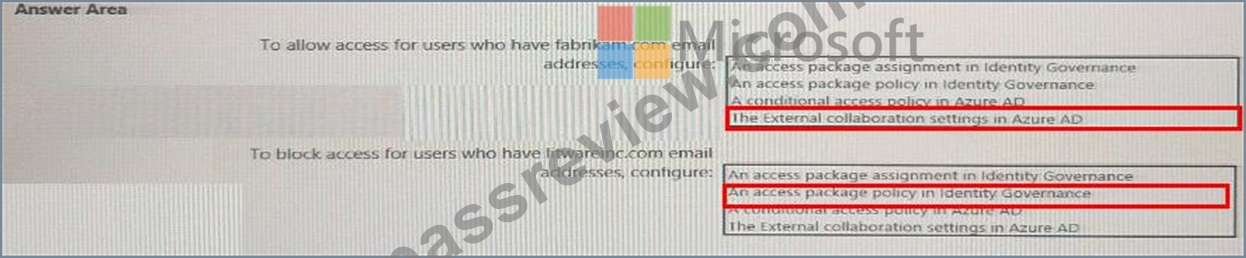
NEW QUESTION 37
You have an Azure Active Directory (Azure AD) tenant.
You need to review the Azure AD sign-ins log to investigate sign ins that occurred in the past.
For how long does Azure AD store events in the sign-in log?
- A. 90 days
- B. 30 days
- C. 365 days
- D. 14 days
Answer: B
NEW QUESTION 38
You have a Microsoft 365 tenant.
The Azure Active Directory (Azure AD) tenant syncs to an on-premises Active Directory domain. The domain contains the servers shown in the following table.
The domain controllers are prevented from communicating to the internet.
You implement Azure AD Password Protection on Server1 and Server2.
You deploy a new server named Server4 that runs Windows Server 2019.
You need to ensure that Azure AD Password Protection will continue to work if a single server fails.
What should you implement on Server4?
- A. Azure AD Application Proxy
- B. the Azure AD Password Protection proxy service
- C. Azure AD Connect
- D. Password Change Notification Service (PCNS)
Answer: B
Explanation:
Reference:
https://docs.microsoft.com/en-us/azure/active-directory/authentication/howto-password-ban-bad-on-premisesdeploy
NEW QUESTION 39
You need to meet the authentication requirements for leaked credentials.
What should you do?
- A. Configure Azure AD Password Protection.
- B. Enable password hash synchronization in Azure AD Connect.
- C. Configure an authentication method policy in Azure AD.
- D. Enable federation with PingFederate in Azure AD Connect.
Answer: B
Explanation:
Reference:
https://docs.microsoft.com/en-us/azure/security/fundamentals/steps-secure-identity
Topic 1, Litware, Inc
Identity Environment
The network contains an Active Directory forest named litware.com that is linked to an Azure Active Directory (Azure AD) tenant named litware.com. Azure AD Connect uses pass-through authentication and has password hash synchronization disabled.
Litware.com contains a user named User1 who oversees all application development. Litware implements Azure AD Application Proxy.
Fabrikam has an Azure AD tenant named fabrikam.com. The users at Fabrikam access the resources in litware.com by using guest accounts in the litware.com tenant.
Cloud Environment
All the users at Litware have Microsoft 365 Enterprise E5 licenses. All the built-in anomaly detection polices in Microsoft Cloud App Security are enabled.
Litware has an Azure subscription associated to the litware.com Azure AD tenant. The subscription contains an Azure Sentinel instance that uses the Azure Active Directory connector and the Office 365 connector. Azure Sentinel currently collects the Azure AD sign-ins logs and audit logs.
On-premises Environment
The on-premises network contains the severs shown in the following table.
Both Litware offices connect directly to the internet. Both offices connect to virtual networks in the Azure subscription by using a site-to-site VPN connection. All on-premises domain controllers are prevented from accessing the internet.
Delegation Requirements
Litware identifies the following delegation requirements:
* Delegate the management of privileged roles by using Azure AD Privileged Identity Management (PIM).
* Prevent nonprivileged users from registering applications in the litware.com Azure AD tenant-
* Use custom catalogs and custom programs for Identity Governance.
* Ensure that User1 can create enterprise applications in Azure AD. Use the principle of least privilege.
Licensing Requirements
Litware recently added a custom user attribute named LWLicenses to the litware.com Active Directory forest. Litware wants to manage the assignment of Azure AD licenses by modifying the value of the LWLicenses attribute. Users who have the appropriate value for LWLicenses must be added automatically to Microsoft 365 group that he appropriate license assigned.
Management Requirement
Litware wants to create a group named LWGroup1 will contain all the Azure AD user accounts for Litware but exclude all the Azure AD guest accounts.
Authentication Requirements
Litware identifies the following authentication requirements:
* Implement multi-factor authentication (MFA) for all Litware users.
* Exempt users from using MFA to authenticate to Azure AD from the Boston office of Litware.
* Implement a banned password list for the litware.com forest.
* Enforce MFA when accessing on-premises applications.
* Automatically detect and remediate externally leaked credentials
Access Requirements
Litware wants to create a group named LWGroup1 that will contain all the Azure AD user accounts for Litware but exclude all the Azure AD guest accounts.
Monitoring Requirements
Litware wants to use the Fusion rule in Azure Sentinel to detect multi-staged that include a combination of suspicious Azure AD sign-ins followed by anomalous Microsoft Office 365 activity.
NEW QUESTION 40
You have a Microsoft 365 tenant.
All users have computers that run Windows 10. Most computers are company-owned and joined to Azure Active Directory (Azure AD). Some computers are user-owned and are only registered in Azure AD.
You need to prevent users who connect to Microsoft SharePoint Online on their user-owned computer from downloading or syncing files. Other users must NOT be restricted.
Which policy type should you create?
- A. an Azure AD conditional access policy that has session controls configured
- B. an Azure AD conditional access policy that has client apps conditions configured
- C. a Microsoft Cloud App Security app discovery policy that has governance actions configured
- D. a Microsoft Cloud App Security activity policy that has Microsoft Office 365 governance actions configured
Answer: A
Explanation:
Reference:
https://docs.microsoft.com/en-us/cloud-app-security/proxy-intro-aad
NEW QUESTION 41
Your network contains an Active Directory forest named contoso.com that is linked to an Azure Active Directory (Azure AD) tenant named contoso.com by using Azure AD Connect.
Attire AD Connect is installed on a server named Server 1.
You deploy a new server named Server? that runs Windows Server 2019.
You need to implement a failover server for Azure AD Connect. The solution must minimize how long it takes to fail over if Server1 fails.
Which three actions should you perform in sequence? To answer, move the appropriate actions from the list of actions to the answer area and arrange them in the correct order.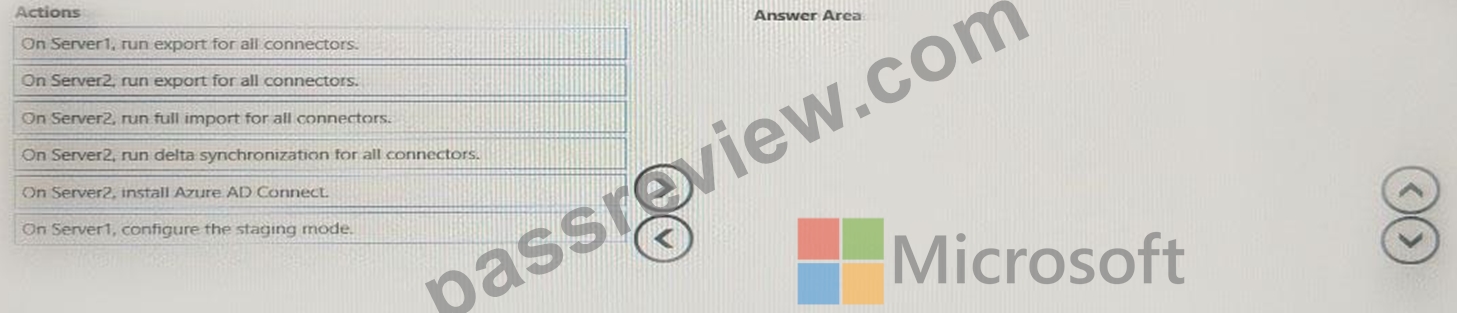
Answer:
Explanation:
NEW QUESTION 42
You have an Azure Active Directory (Azure AD) tenant that contains the objects shown in the following table.
Which objects can you add as members to Group3?
- A. User2 only
- B. User2, Group1, and Group2 only
- C. User1, User2, Group1 and Group2
- D. User1 and User2 only
- E. User2 and Group2 only
Answer: A
Explanation:
Reference:
https://bitsizedbytes.wordpress.com/2018/12/10/distribution-security-and-office-365-groups-nesting/
NEW QUESTION 43
Your network contains an on-premises Active Directory domain that sync to an Azure Active Directory (Azure AD) tenant. The tenant contains the shown in the following table.
All the users work remotely.
Azure AD Connect is configured in Azure as shown in the following exhibit.
Connectivity from the on-premises domain to the internet is lost.
Which user can sign in to Azure AD?
- A. User1 only
- B. User1, User2, and User3
- C. User1 and User 3 only
- D. User1, and User2 only
Answer: A
NEW QUESTION 44
You have an Azure Active Directory (Azure AD) tenant that contains an administrative unit named Department1.
Department1 has the users shown in the Users exhibit. (Click the Users tab.)
Department1 has the groups shown in the Groups exhibit. (Click the Groups tab.)
Department1 has the user administrator assignments shown in the Assignments exhibit. (Click the Assignments tab.)
The members of Group2 are shown in the Group2 exhibit. (Click the Group2 tab.)
For each of the following statements, select Yes if the statement is true. Otherwise, select No.
NOTE: Each correct selection is worth one point.
Answer:
Explanation:
Explanation
Reference:
https://docs.microsoft.com/en-us/azure/active-directory/roles/administrative-units
NEW QUESTION 45
You have an Azure Active Directory (Azure AD) tenant that contains the following group:
Name: Group1
Members: User1, User2
Owner: User3
On January 15, 2021, you create an access review as shown in the exhibit. (Click the Exhibit tab.)
Users answer the Review1 question as shown in the following table.
For each of the following statements, select Yes if the statement is true. Otherwise, select No.
NOTE: Each correct selection is worth one point.
Answer:
Explanation:
Reference:
https://docs.microsoft.com/en-us/azure/active-directory/governance/review-your-access
NEW QUESTION 46
You have an Azure Active Directory (Azure AD) tenant that has multi-factor authentication (MFA) enabled.
The account lockout settings are configured as shown in the following exhibit.
Use the drop-down menus to select the answer choice that completes each statement based on the information presented in the graphic.
NOTE: Each correct selection is worth one point.
Answer:
Explanation:
NEW QUESTION 47
You have an Azure Active Directory (Azure AD) tenant that contains a user named User1 and the groups shown in the following table.
In the tenant, you create the groups shown in the following table.
Which members can you add to GroupA and GroupB? To answer, select the appropriate options in the answer area.
NOTE: Each correct selection is worth one point.
Answer:
Explanation:
Reference:
https://bitsizedbytes.wordpress.com/2018/12/10/distribution-security-and-office-365-groups-nesting/
NEW QUESTION 48
You need to meet the technical requirements for the probability that user identifies were compromised.
What should the users do first, and what should you configure? To answer, select the appropriate options in the answer area.
NOTE: Each correct selection is worth one point.
Answer:
Explanation:
NEW QUESTION 49
Note: This question is part of a series of questions that present the same scenario. Each question in the series contains a unique solution that might meet the stated goals. Some question sets might have more than one correct solution, while others might not have a correct solution.
After you answer a question in this section, you will NOT be able to return to it. As a result, these questions will not appear in the review screen.
You have a Microsoft 365 tenant.
You have 100 IT administrators who are organized into 10 departments.
You create the access review shown in the exhibit. (Click the Exhibit tab.)
You discover that all access review requests are received by Megan Bowen.
You need to ensure that the manager of each department receives the access reviews of their respective department.
Solution: You add each manager as a fallback reviewer.
Does this meet the goal?
- A. Yes
- B. No
Answer: B
Explanation:
Reference:
https://docs.microsoft.com/en-us/azure/active-directory/governance/create-access-review
NEW QUESTION 50
You need to locate licenses to the A. Datum users. The solution must need the technical requirements.
Which type of object should you create?
- A. An OU
- B. A Dynamo User security group
- C. A distribution group
- D. An administrative unit
Answer: B
NEW QUESTION 51
You create the Azure Active Directory (Azure AD) users shown in the following table.
On February 1, 2021, you configure the multi-factor authentication (MFA) settings as shown in the following exhibit.
The users authentication to Azure AD on their devices as shown in the following table.
On February 26, 2021, what will the multi-factor auth status be for each user?
A)
B)
C)
D)
- A. Option B
- B. Option D
- C. Option C
- D. Option A
Answer: A
NEW QUESTION 52
You have an Azure Active Directory (Azure AD) tenant named contoso.com.
You plan to bulk invite Azure AD business-to-business (B2B) collaboration users.
Which two parameters must you include when you create the bulk invite? Each correct answer presents part of the solution NOTE: Each correct selection is worth one point.
- A. redirection URL
- B. password
- C. username
- D. email address
- E. shared key
Answer: A,D
Explanation:
Reference:
https://docs.microsoft.com/en-us/azure/active-directory/external-identities/tutorial-bulk-invite
NEW QUESTION 53
You have a Microsoft 365 tenant.
All users have mobile phones and laptops.
The users frequently work from remote locations that do not have Wi-Fi access or mobile phone connectivity. While working from the remote locations, the users connect their laptop to a wired network that has internet access.
You plan to implement multi-factor authentication (MFA).
Which MFA authentication method can the users use from the remote location?
- A. SMS
- B. a notification through the Microsoft Authenticator app
- C. an app password
- D. Windows Hello for Business
Answer: D
Explanation:
In Windows 10, Windows Hello for Business replaces passwords with strong two-factor authentication on PCs and mobile devices. This authentication consists of a new type of user credential that is tied to a device and uses a biometric or PIN.
After an initial two-step verification of the user during enrollment, Windows Hello is set up on the user's device and Windows asks the user to set a gesture, which can be a biometric, such as a fingerprint, or a PIN. The user provides the gesture to verify their identity. Windows then uses Windows Hello to authenticate users.
Reference:
https://docs.microsoft.com/en-us/azure/active-directory/authentication/concept-authentication-methods
https://docs.microsoft.com/en-us/windows/security/identity-protection/hello-for-business/hello-overview
NEW QUESTION 54
You need to meet the technical requirements for the probability that user identifies were compromised.
What should the users do first, and what should you configure? To answer, select the appropriate options in the answer area.
NOTE: Each correct selection is worth one point.
Answer:
Explanation:
NEW QUESTION 55
You have a Microsoft 365 tenant named contoso.com.
Guest user access is enabled.
Users are invited to collaborate with contoso.com as shown in the following table.
From the External collaboration settings in the Azure Active Directory admin center, you configure the Collaboration restrictions settings as shown in the following exhibit.
From a Microsoft SharePoint Online site, a user invites [email protected] to the site.
For each of the following statements, select Yes if the statement is true. Otherwise, select No.
NOTE: Each correct selection is worth one point.
Answer:
Explanation:
NEW QUESTION 56
You have an Azure Active Directory (Azure Azure) tenant that contains the objects shown in the following table.
* A device named Device1
* Users named User1, User2, User3, User4, and User5
* Five groups named Group1, Group2, Group3, Ciroup4, and Group5
The groups are configured as shown in the following table.
How many licenses are used if you assign the Microsoft Office 365 Enterprise E5 license to Group1?
- A. 0
- B. 1
- C. 2
- D. 3
Answer: D
NEW QUESTION 57
You need to create the LWGroup1 group to meet the management requirements.
How should you complete the dynamic membership rule? To answer, drag the appropriate values to the correct targets. Each value may be used once, more than once, or not at all. You many need to drag the split bar between panes or scroll to view content.
NOTE: Each correct selection is worth one point.
Answer:
Explanation:
NEW QUESTION 58
......
Schedule exam
Languages: English, Japanese, Chinese (Simplified), Korean
Retirement date: none
This exam measures your ability to accomplish the following technical tasks: implement an identity management solution; implement an authentication and access management solution; implement access management for apps; and plan and implement an identity governance strategy.
Skills measured
- Implement an authentication and access management solution (25-30%)
- Implement an identity management solution (25-30%)
- Implement access management for apps (10-15%)
- Plan and implement an identity governance strategy (25-30%)
Verified SC-300 Exam Dumps Q&As - Provide SC-300 with Correct Answers: https://getfreedumps.passreview.com/SC-300-exam-questions.html