

All Obstacles During SK0-005 Exam Preparation with SK0-005 Real Test Questions
Fully Updated Free Actual CompTIA SK0-005 Exam Questions
CompTIA SK0-005, also known as the CompTIA Server+ certification exam, is designed to validate the knowledge and skills of IT professionals who are responsible for server administration. CompTIA Server+ Certification Exam certification exam covers a wide range of server-related topics, including installation, configuration, maintenance, security, disaster recovery, and troubleshooting. SK0-005 exam is intended for individuals with at least 18 to 24 months of experience in server administration and is vendor-neutral, which means that it covers a broad range of server technologies from various vendors.
CompTIA SK0-005, also known as the CompTIA Server+ Certification exam, is a vendor-neutral certification that is designed to validate the knowledge and skills of IT professionals who work with servers. SK0-005 exam covers a range of topics related to server hardware, software, storage, networking, and security, and is designed to ensure that professionals have the necessary skills to maintain, troubleshoot, and manage servers in a variety of environments.
NEW QUESTION # 16
A system administrator has been alerted to a zero-day vulnerability that is impacting a service enabled on a server OS. Which of the following would work BEST to limit an attacker from exploiting this vulnerability?
- A. Enabling a NIDS
- B. Enabling antivirus protection
- C. Closing open ports
- D. Installing the latest patches
Answer: D
Explanation:
The best way to limit an attacker from exploiting a zero-day vulnerability that is impacting a service enabled on a server OS is to install the latest patches. Patches are updates that fix bugs, improve security, or add features to software. Installing patches can help prevent attackers from exploiting known vulnerabilities that have been fixed by the software vendor. A zero-day vulnerability is a vulnerability that is unknown to the vendor or the public until it is exploited by an attacker. Therefore, installing patches as soon as they are available can reduce the window of opportunity for attackers to exploit zero-day vulnerabilities. Reference:
https://www.ibm.com/cloud/learn/patch-management
NEW QUESTION # 17
Which of the following technologies would allow an administrator to build a software RAID on a Windows server?
- A. Logical volume management
- B. UEFI
- C. Dynamic disk
- D. GPT
Answer: C
Explanation:
Explanation
Dynamic disk is a technology that allows an administrator to build a software RAID on a Windows server.
Dynamic disk is a type of disk management that supports creating volumes that span multiple disks, stripe data across disks, mirror data between disks, or use parity for fault tolerance. Dynamic disk can be used to create RAID 0 (striping), RAID 1 (mirroring), RAID 5 (striping with parity), or spanned volumes on Windows servers. Logical volume management is a technology that allows creating and resizing logical volumes on Linux servers. GPT (GUID Partition Table) is a standard for defining the partition structure on a disk. UEFI (Unified Extensible Firmware Interface) is a specification for the interface between the operating system and the firmware. References: https://www.howtogeek.com/school/using-windows-admin-tools-like-a-pro/lesson2/
https://www.howtogeek.com/howto/40702/how-to-manage-and-use-lvm-logical-volume-management-in-ubuntu
https://www.howtogeek.com/193669/whats-the-difference-between-gpt-and-mbr-when-partitioning-a-drive/
https://www.howtogeek.com/56958/htg-explains-how-uefi-will-replace-the-bios/
NEW QUESTION # 18
Due to a recent application migration, a company's current storage solution does not meet the necessary requirements tor hosting data without impacting performance when the data is accessed in real time by multiple users. Which of the following is the BEST solution for this Issue?
- A. Add extra memory to the server where data is stored.
- B. Compress the data to increase available space.
- C. Install local external hard drives for affected users.
- D. Deploy a new Fibre Channel SAN solution.
Answer: D
Explanation:
A Fibre Channel SAN solution is a type of storage area network (SAN) that uses high-speed optical fiber cables to connect servers and storage devices. A SAN allows for hosting data without impacting performance when the data is accessed in real time by multiple users, as it provides fast data transfer rates, low latency, high availability, and scalability12. A local external hard drive (A) would not be suitable for multiple users, as it would limit the accessibility and security of the data. Adding extra memory to the server (B) would not solve the problem of data access performance, as it would not increase the bandwidth or reduce the congestion of the network. Compressing the data would not improve the performance either, as it would add extra overhead and complexity to the data processing and retrieval. References: 1
https://www.techradar.com/best/best-cloud-storage 2
https://solutionsreview.com/data-storage/the-best-enterprise-data-storage-solutions/
NEW QUESTION # 19
A server administrator just installed a new physical server and needs to harden the OS. Which of the following best describes the OS hardening method?
- A. Configure the boot order.
- B. Disable unneeded hardware.
- C. Set a BIOS password.
- D. Apply security updates.
Answer: D
Explanation:
Applying security updates is one of the common operating system hardening methods that can help protect the OS from cyberattacks and vulnerabilities. Security updates are released by the OS developer to fix bugs, patch security holes, and improve performance. By installing the latest updates, the server administrator can ensure that the OS is up to date and secure12.
NEW QUESTION # 20
A company needs a media server set up that provides the highest availability with a minimum requirement of at least 10TB. The company purchased five HDDs, each with a 4TB capacity. Which of the options would provide the highest fault tolerance and meet the requirements?
- A. RAID 0
- B. RAID 6
- C. RAID 10
- D. RAID 5
Answer: B
Explanation:
RAID 6 is a RAID level that uses disk striping with two parity blocks distributed across all member disks. It can tolerate the failure of up to two disks without losing any dat a. RAID 6 can provide a minimum of 10TB of usable storage space with five 4TB disks, as the formula for calculating the RAID 6 capacity is (n-2) x Smin, where n is the number of disks and Smin is the smallest disk size. In this case, the RAID 6 capacity is (5-2) x 4TB = 12TB.
References:
CompTIA Server+ Certification Exam Objectives1, page 8
RAID Levels and Types Explained: Advantages and Disadvantages2
RAID Levels & Fault Tolerance3
NEW QUESTION # 21
Which of the following licenses would MOST likely include vendor assistance?
- A. Version compatibility
- B. Open-source
- C. Subscription
- D. Maintenance and support
Answer: C
Explanation:
Subscription - Maintenance and support are normally a part of a license and not listed as a license type itself - Neither is version compatability. Open-source is free and doesn't normally offer any kind of support except communities.
NEW QUESTION # 22
A server administrator receives the following output when trying to ping a local host:
Which of the following is MOST likely the issue?
- A. Firewall
- B. DNS
- C. DHCP
- D. VLAN
Answer: A
Explanation:
A firewall is a network device or software that filters and controls the incoming and outgoing traffic based on predefined rules. A firewall can block or allow certain types of packets, ports, protocols, or IP addresses. The output of the ping command shows that the local host is unreachable, which means that there is no network connectivity between the source and the destination. This could be caused by a firewall that is blocking the ICMP (Internet Control Message Protocol) packets that ping uses to test the connectivity. References:
https://www.comptia.org/training/resources/exam-objectives/comptia-server-sk0-005-exam-objectives (Objective 2.2)
NEW QUESTION # 23
A server administrator needs to check remotely for unnecessary running services across 12 servers. Which of the following tools should the administrator use?
- A. A port scanner
- B. A sniffer
- C. Anti-malware
- D. DLP
Answer: A
Explanation:
Sniffing is the term generally used for traffic monitoring within a network, while port scanning is used to find out information about a remote network. Both sniffing and port scanning have the same objective - to find system vulnerabilities - but they take different approaches.
https://www.informit.com/articles/article.aspx?p=31964#
NEW QUESTION # 24
A server administrator is reviewing the following specifications:
VM01 Host:
CPU: 2 Physical, 4 Cores
RAM: 16GB
Storage: 16TB
Server 1 on VM01:
CPU: 1 virtual socket, 1 core per socket
RAM: 4GB
Storage: 8TB
Server 2 on VM01:
CPU: 2 virtual sockets, 2 cores per socket
RAM: 8GB
Storage: 10TB
Which of the following is described given these specifications?
- A. Scalability
- B. Virtual switch
- C. Host vs. guest
- D. Overprovisioning
Answer: D
Explanation:
Overprovisioning is a situation where the allocated resources for a virtual machine exceed the available resources of the physical host. In this case, the storage allocated for Server 1 and Server 2 on VM01 is 8TB and 10TB respectively, which adds up to 18TB. However, the storage available on the VM01 host is only
16TB, which means there is a 2TB deficit. This can cause performance issues and errors for the virtual machines.
References:
CompTIA Server+ Certification Exam Objectives1, page 8
Server Management: Server Hardware Installation and Management, Module 2, Lesson 5
NEW QUESTION # 25
Which of the following backup types should be chosen for database servers?
- A. Open file
- B. Differential
- C. Synthetic full
- D. Incremental
Answer: C
Explanation:
A synthetic full backup is a type of backup that combines a full backup with one or more incremental backups to create a new full backup without accessing the source data. This type of backup is suitable for database servers, as it reduces the backup window, minimizes the impact on the server performance, and provides faster recovery time. Verified References: [Synthetic Full Backup]
NEW QUESTION # 26
An administrator is configuring the storage for a new database server, which will host databases that are mainly used for archival lookups. Which of the following storage types will yield the fastest database read performance?
- A. 15K rpm SCSI
- B. 10K rpm SATA
- C. NAS
- D. SSD
Answer: D
Explanation:
The storage type that will yield the fastest database read performance is SSD. SSD (Solid State Drive) is a type of storage device that uses flash memory to store dat a. SSDs have no moving parts and can access data faster than traditional hard disk drives (HDDs) that use spinning platters and magnetic heads. SSDs are especially suitable for databases that are mainly used for archival lookups, as they can provide faster response times and lower latency for read operations.
References: CompTIA Server+ SK0-005 Certification Study Guide, Chapter 1, Lesson 1.2, Objective 1.2
NEW QUESTION # 27
Winch of the following is a type of replication in which all files are replicated, all the time?
- A. Synthetic full
- B. Constant
- C. Application consistent
- D. Full
Answer: B
Explanation:
Constant replication is a type of replication in which all files are replicated, all the time. Replication is a process of copying data from one location to another for backup, recovery, or distribution purposes. Constant replication is also known as real-time replication or synchronous replication. It ensures that any changes made to the source data are immediately reflected on the target data without any delay or lag. Constant replication provides high availability and consistency, but it requires high bandwidth and low latency. Application consistent replication is a type of replication that ensures that the replicated data is consistent with the state of the application that uses it. It involves quiescing or pausing the application before taking a snapshot of the data and resuming the application after the snapshot is taken. Application consistent replication provides better recovery point objectives than crash consistent replication, which does not quiesce the application before taking a snapshot. Synthetic full replication is a type of replication that involves creating a new full backup by using the previous full backup and related incremental backups. It reduces the backup window and network bandwidth consumption by transferring only changed data from the source to the target. Full replication is a type of replication that involves copying all data from the source to the target regardless of whether it has changed or not. It provides a complete backup of the data, but it requires more storage space and network bandwidth than incremental or differential replication. Reference: https://www.howtogeek.com/199068/how-to-upgrade-your-existing-hard-drive-in-under-an-hour/ https://www.howtogeek.com/202794/what-is-the-difference-between-127.0.0.1-and-0.0.0.0/ https://www.howtogeek.com/443611/how-to-encrypt-your-macs-system-drive-removable-devices-and-individual-files/
NEW QUESTION # 28
A server administrator implemented a new backup solution and needs to configure backup methods for remote sites. These remote sites have low bandwidth and backups must not interfere with the network during normal business hours. Which of the following methods can be used to meet these requirements? (Select two).
- A. Synthetic full
- B. Cloud
- C. Open file
- D. Archive
- E. Snapshot
- F. Differential
Answer: D,F
Explanation:
Archive is a method of storing historical data that is not frequently accessed or modified. Archive can reduce the amount of data that needs to be backed up and save bandwidth and storage space. Differential is a method of backing up only the data that has changed since the last full backup. Differential can also save bandwidth and storage space, as well as speed up the backup process.
Reference:
CompTIA Server+ Certification Exam Objectives1, page 12
Server Management: Server Hardware Installation and Management2, Module 2, Lesson 5
NEW QUESTION # 29
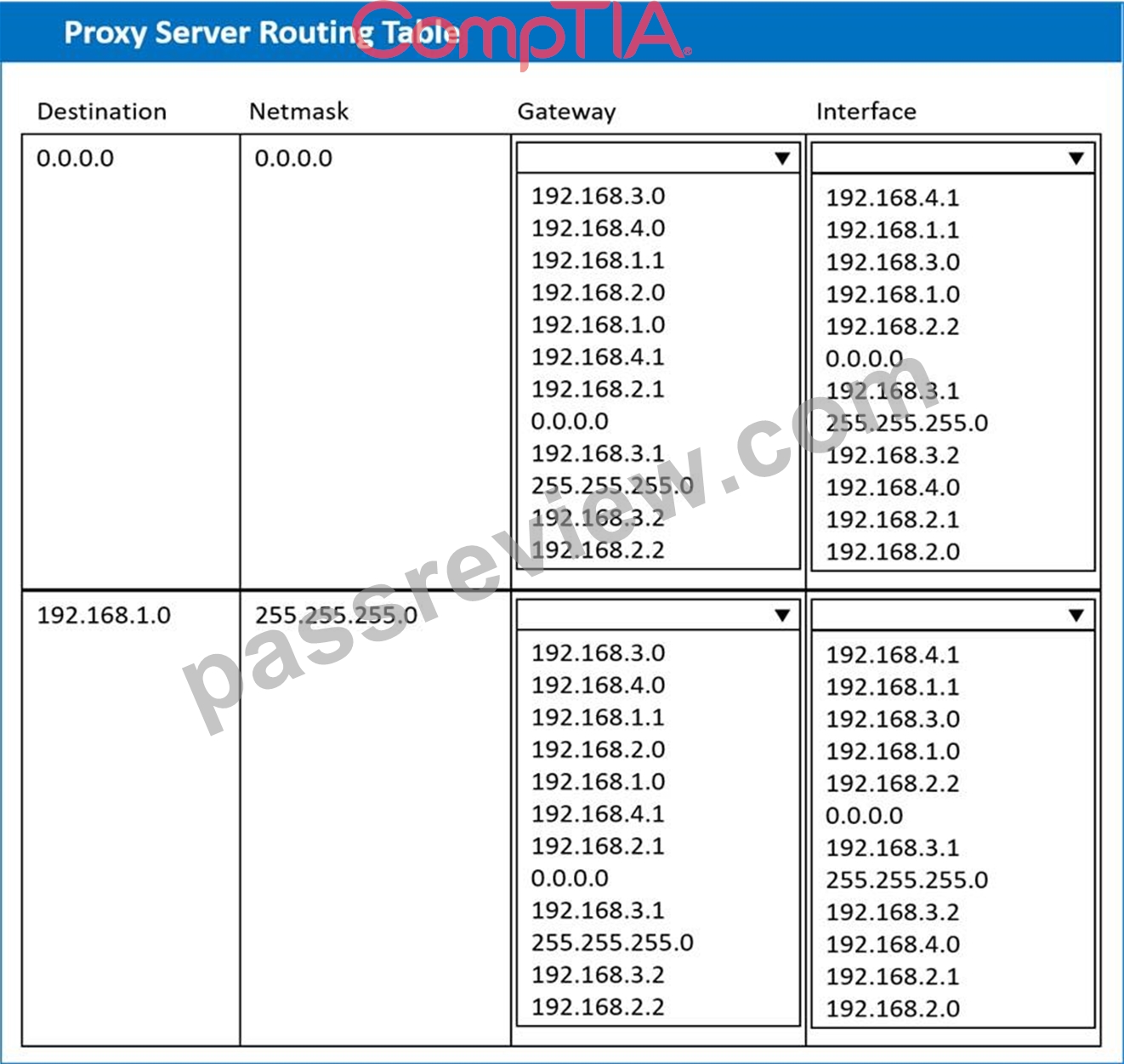
A systems administrator deployed a new web proxy server onto the network. The proxy server has two interfaces: the first is connected to an internal corporate firewall, and the second is connected to an internet-facing firewall. Many users at the company are reporting they are unable to access the Internet since the new proxy was introduced. Analyze the network diagram and the proxy server's host routing table to resolve the Internet connectivity issues.
INSTRUCTIONS
Perform the following steps:
1. Click on the proxy server to display its routing table.
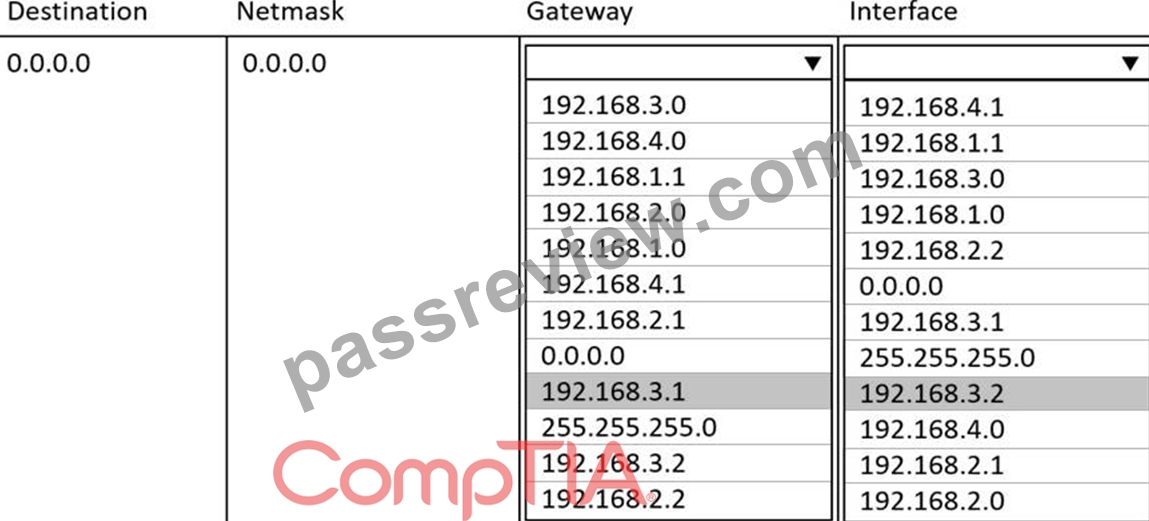
2. Modify the appropriate route entries to resolve the Internet connectivity issue.
If at any time you would like to bring back the initial state of the simulation, please click the Reset All button.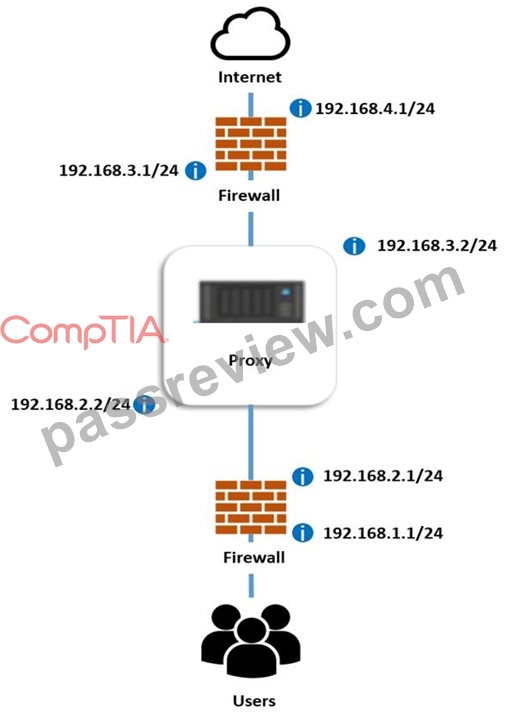
Answer:
Explanation: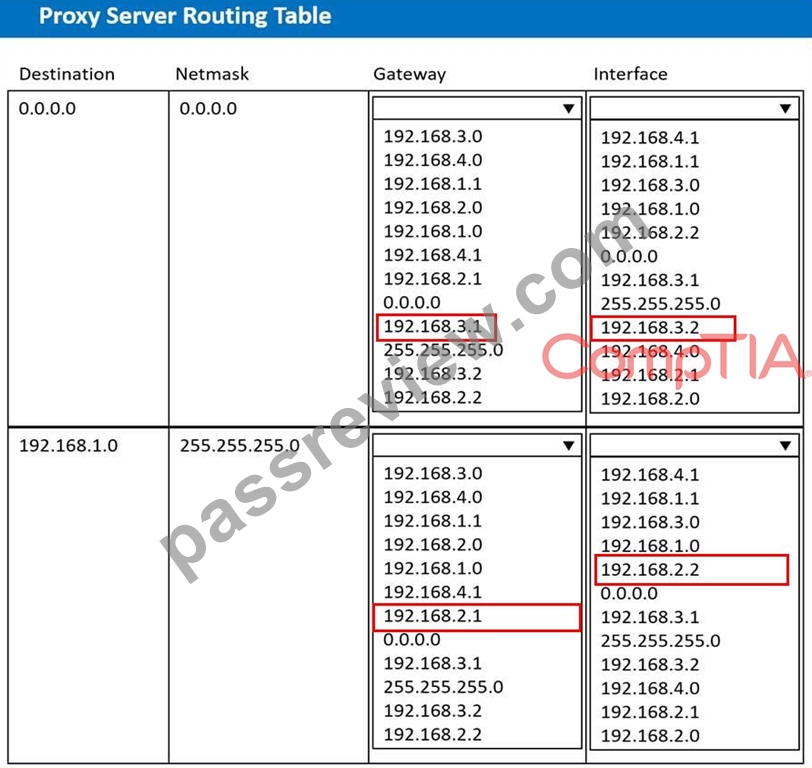
NEW QUESTION # 30
A server administrator wants to check the open ports on a server. Which of the following commands should the administrator use to complete the task?
- A. nbtstat
- B. netstat -a
- C. nslookup
- D. telnet
Answer: B
NEW QUESTION # 31
......
The CompTIA Server+ Certification Exam certification is recognized globally and is ideal for IT professionals, system administrators, and network technicians who work in server environments. CompTIA Server+ Certification Exam certification validates the expertise of individuals in managing and maintaining server hardware and software, ensuring secure server environments, and troubleshooting server issues.
Validate your SK0-005 Exam Preparation with SK0-005 Practice Test: https://getfreedumps.passreview.com/SK0-005-exam-questions.html