

Ultimate Guide to the P-SAPEA-2023 - Latest Oct 18, 2025 Edition Available Now
2025 Updated Verified Pass P-SAPEA-2023 Exam - Real Questions and Answers
SAP P-SAPEA-2023 Exam Syllabus Topics:
| Topic | Details |
|---|---|
| Topic 1 |
|
| Topic 2 |
|
| Topic 3 |
|
| Topic 4 |
|
NEW QUESTION # 23
As a result of solution mapping, business capabilities might require services which partners have implemented in SAP BTP. Which SAP components and services, if any, are required to integrate such BTP partner services with an on-premise SAP S/4HANA system (hybrid scenario)?
- A. No other components are required to make an SAP on-premise backend system securely accessible over SAP BTP SAP BTP automatically establishes secure connections in SAP backend systems.
- B. SAP HANA Cloud Connection, and the corresponding SAP Data Provisioning Agent, to make the on-premises system available to applications and services in a given SAP BTP sub account. Preferably use the SAP BTP Destination Service.
- C. SAP Cloud Connector to make the on-premises system available to applications and services in a given SAP BTP sub account. Preferably use the SAP BTP Destination Service in combination with Cloud Connector.
Answer: C
Explanation:
In a hybrid scenario, where business capabilities require services which partners have implemented in SAP BTP and an on-premise SAP S/4HANA system, the following SAP components and services are required to integrate such BTP partner services with the on-premise system:
SAP Cloud Connector: The SAP Cloud Connector is a software component that allows you to connect your on-premise SAP systems to SAP BTP. The Cloud Connector provides a secure connection between your on-premise system and SAP BTP, and it also makes your on-premise system available to applications and services in SAP BTP.
SAP BTP Destination Service: The SAP BTP Destination Service is a service that provides a single point of entry for accessing on-premise systems from SAP BTP. The Destination Service makes it easy to manage and secure connections to on-premise systems, and it also provides a way to federate data from different on-premise systems.
In order to integrate BTP partner services with an on-premise SAP S/4HANA system, you will need to install the SAP Cloud Connector on your on-premise system and register the Cloud Connector with SAP BTP. You will also need to create a destination in the SAP BTP Destination Service for your on-premise system. Once you have done this, you will be able to access the on-premise system from applications and services in SAP BTP.
It is important to note that you can also use other SAP components to integrate on-premise systems with SAP BTP. However, the SAP Cloud Connector and the SAP BTP Destination Service are the most commonly used components for this purpose.
To integrate BTP partner services with an on-premise SAP S/4HANA system, you need to use the SAP Cloud Connector, which is a reverse proxy that establishes a secure connection between your on-premise system and your SAP BTP subaccount5. The Cloud Connector acts as a bridge between your on-premise network and a trusted subaccount on SAP BTP6. It allows you to access resources in your on-premise network from applications running on SAP BTP without exposing your internal landscape to the internet7.
To simplify the configuration and consumption of the Cloud Connector connection, you can use the SAP BTP Destination Service, which is a service that allows you to define and manage destinations for accessing remote systems from applications running on SAP BTP8. A destination is a set of properties that contains information such as the URL, authentication method, proxy type, and additional parameters of a remote system9. By using the Destination Service, you can centrally manage and securely store the connection details of your on-premise system and consume them from your BTP partner services.
Verified : 5: https://help.sap.com/viewer/cca91383641e40ffbe03bdc78f00f681/Cloud/en-US/e6c7616abb5710148cfcf3e75d96d596.html | 6: https://help.sap.com/viewer/cca91383641e40ffbe03bdc78f00f681/Cloud/en-US/8d3b28a7c1644a1c9d1ee165ec0a8cf4.html | 7: https://help.sap.com/viewer/cca91383641e40ffbe03bdc78f00f681/Cloud/en-US/e54cc8fbbb571014a4d9e7f02f9fa8e4.html | 8: https://help.sap.com/viewer/cca91383641e40ffbe03bdc78f00f681/Cloud/en-US/3cb7b81115c44cf594e0e3631291af94.html | 9: https://help.sap.com/viewer/cca91383641e40ffbe03bdc78f00f681/Cloud/en-US/e54f70d327154aa0a4ba36ce7ac49c83.html
NEW QUESTION # 24
Wanderlust's CIO asks you to evaluate the SAP Enterprise Architecture Framework. At Wanderlust GmbH a non-SAP EA tool is used, How would you proceed with the request and why? Note: There are 2 correct answers to this question.
- A. I check whether the SAP Reference Business Architecture and Reference Solution Architecture Content can help to either define the scope of the architecture work or describe a target architecture structure. If they do, I suggest to use the Reference Architecture Content of SAP.
- B. I tell the CIO that the SAP EA Framework also encompasses architecture services and practices. Based on a cost-benefit analysis I consider using the services and practices that fit best the project.
- C. I tell the CIO that the SAP EA Framework cannot be used because the Wanderlust GmbH uses a non- SAP EA tool. Therefore, further evaluation is not necessary.
- D. I evaluate both the SAP EA Methodology and TOGAF ADM. I recommend the approach that fits best Wanderlust's requirements.
Answer: A,D
Explanation:
When evaluating the SAP Enterprise Architecture Framework for Wanderlust GmbH, you should proceed with the following steps:
I evaluate both the SAP EA Methodology and TOGAF ADM. I recommend the approach that fits best Wanderlust's requirements. This step is necessary because the SAP EA Methodology is based on TOGAF ADM, but extends it with additional elements and guidance specific to SAP solutions and customers4. Therefore, you need to compare and contrast the two methodologies and assess which one suits Wanderlust's needs better. For example, you may consider factors such as the complexity, scope, scale, and objectives of Wanderlust's architecture projects, as well as the availability of resources, skills, and tools.
I check whether the SAP Reference Business Architecture and Reference Solution Architecture Content can help to either define the scope of the architecture work or describe a target architecture structure. If they do, I suggest to use the Reference Architecture Content of SAP. This step is beneficial because the SAP Reference Business Architecture and Reference Solution Architecture Content provide a set of pre-defined architectures that cover common business scenarios and solution domains for SAP customers5. Therefore, you can use them as a starting point or a reference point for your architecture work, as they can help you to define the scope, requirements, capabilities, components, patterns, and best practices for your architecture solutions.
Verified : 4: https://help.sap.com/docs/SAP_ENTERPRISE_ARCHITECTURE_FRAMEWORK/60bc20e6e0a24426a817705bcb415220/144c6c88c10a493e985f71bd62f3c905.html?locale=en-US&state=PRODUCTION&version=1.0 | 5: https://help.sap.com/docs/SAP_ENTERPRISE_ARCHITECTURE_FRAMEWORK/60bc20e6e0a24426a817705bcb415220/01b0590c66854a5a94796ef0b47c8fcc.html
NEW QUESTION # 25
While trying to identify and map key stakeholders in Wanderlust, you, as the Chief Enterprise Architect, have been evangelizing the strategic business and IT objectives with business and IT departments across regions and taking in their views on the upcoming business transformation, Match the feedback from stakeholders (shown on the left) to the categorization and to some of the actions in the dropdown lists.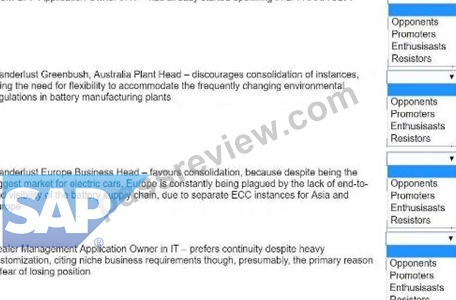
Answer:
Explanation: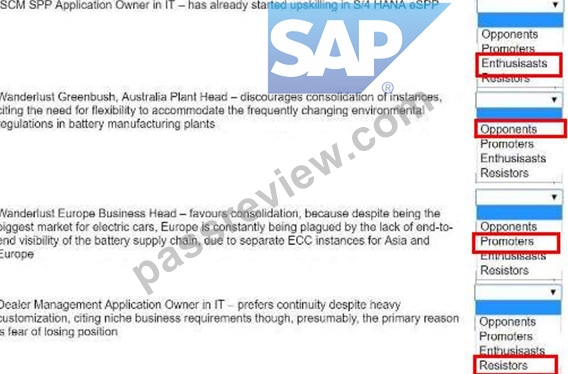
NEW QUESTION # 26
As the Chief Enterprise Architect of Wanderlust GmbH, you know that there is very little process documentation available on online marketing processes within Wanderlust. You also know that SAP has a rich End-to-End (E2E) Business Processes content repository. To take advantage of that, you have engaged an SAP Enterprise Architect. The SAP Enterprise Architect is using SAP's Business Process Model (BPM) and the Business Capability Model (BCM) while mapping processes to capabilities, how are the two models connected? Note: There are 2 correct answers to this question.
- A. Through the Business Process Module of BPM, which is directly linked to the Business Area of BCM.
- B. Through the Enterprise Domain, to which both the E2E Business Process of BPM and the Business Domain of BCM are assigned.
- C. Through the Business Activity of BPM, which is enabled by the Business Capability of BCM.
- D. Through the E2E Business Process of BPM, which is enabled by the Business Domain of BCM.
Answer: C,D
Explanation:
The connection between SAP's Business Process Model (BPM) and the Business Capability Model (BCM) lies in how the end-to-end business processes are enabled by the business domains and capabilities outlined in the BCM. Each business activity in the BPM is supported by one or more business capabilities from the BCM. This linkage ensures that the company's capabilities are directly tied to the business activities and processes, providing a clear line of sight from high-level business strategy down to operational execution.
Reference = This connection is standard in enterprise architecture where processes are designed to be supported by capabilities, ensuring that capabilities provide the necessary functions to execute the processes effectively.
NEW QUESTION # 27
Having identified the appropriate sel of Business Activities, as the Chie Enterprise Architect of Wanderlust, assisted by the sap Enterprise Architects. you have been trying to relate to Lead to Cash Business Capabilities in the SAP Reference Business Architecture content repository. In light of the two key goals outlined by the Wanderlust CIO, what are the most appropriate Business Capabilities? Note:
There are 3 correct answers to this question.
- A. Marketing Campaign Management
- B. Social Media Management
- C. Account Based Marketing, Lead Management
- D. Marketing Analytics, Recommendation Management
- E. Marketing Strategy Management, Brand Management
Answer: A,B,D
NEW QUESTION # 28
As a result of solution mapping, business capabilities might require services which partners have implemented in SAP BTP. Which SAP components and services, if any, are required to integrate such BTP partner services with an on-premise SAP S/4HANA system (hybrid scenario)?
- A. No other components are required to make an SAP on-premise backend system securely accessible over SAP BTP SAP BTP automatically establishes secure connections in SAP backend systems.
- B. SAP HANA Cloud Connection, and the corresponding SAP Data Provisioning Agent, to make the on-premises system available to applications and services in a given SAP BTP sub account. Preferably use the SAP BTP Destination Service.
- C. SAP Cloud Connector to make the on-premises system available to applications and services in a given SAP BTP sub account. Preferably use the SAP BTP Destination Service in combination with Cloud Connector.
Answer: C
Explanation:
Explanation
In a hybrid scenario, where business capabilities require services which partners have implemented in SAP BTP and an on-premise SAP S/4HANA system, the following SAP components and services are required to integrate such BTP partner services with the on-premise system:
SAP Cloud Connector: The SAP Cloud Connector is a software component that allows you to connect your on-premise SAP systems to SAP BTP. The Cloud Connector provides a secure connection between your on-premise system and SAP BTP, and it also makes your on-premise system available to applications and services in SAP BTP.
SAP BTP Destination Service: The SAP BTP Destination Service is a service that provides a single point of entry for accessing on-premise systems from SAP BTP. The Destination Service makes it easy to manage and secure connections to on-premise systems, and it also provides a way to federate data from different on-premise systems.
In order to integrate BTP partner services with an on-premise SAP S/4HANA system, you will need to install the SAP Cloud Connector on your on-premise system and register the Cloud Connector with SAP BTP. You will also need to create a destination in the SAP BTP Destination Service for your on-premise system. Once you have done this, you will be able to access the on-premise system from applications and services in SAP BTP.
It is important to note that you can also use other SAP components to integrate on-premise systems with SAP BTP. However, the SAP Cloud Connector and the SAP BTP Destination Service are the most commonly used components for this purpose.
To integrate BTP partner services with an on-premise SAP S/4HANA system, you need to use the SAP Cloud Connector, which is a reverse proxy that establishes a secure connection between your on-premise system and your SAP BTP subaccount5. The Cloud Connector acts as a bridge between your on-premise network and a trusted subaccount on SAP BTP6. It allows you to access resources in your on-premise network from applications running on SAP BTP without exposing your internal landscape to the internet7.
To simplify the configuration and consumption of the Cloud Connector connection, you can use the SAP BTP Destination Service, which is a service that allows you to define and manage destinations for accessing remote systems from applications running on SAP BTP8. A destination is a set of properties that contains information such as the URL, authentication method, proxy type, and additional parameters of a remote system9. By using the Destination Service, you can centrally manage and securely store the connection details of your on-premise system and consume them from your BTP partner services.
Verified References: 5:
https://help.sap.com/viewer/cca91383641e40ffbe03bdc78f00f681/Cloud/en-US/e6c7616abb5710148cfcf3e75d96
| 6:
https://help.sap.com/viewer/cca91383641e40ffbe03bdc78f00f681/Cloud/en-US/8d3b28a7c1644a1c9d1ee165ec0
| 7:
https://help.sap.com/viewer/cca91383641e40ffbe03bdc78f00f681/Cloud/en-US/e54cc8fbbb571014a4d9e7f02f9f
| 8:
https://help.sap.com/viewer/cca91383641e40ffbe03bdc78f00f681/Cloud/en-US/3cb7b81115c44cf594e0e363129
| 9:
https://help.sap.com/viewer/cca91383641e40ffbe03bdc78f00f681/Cloud/en-US/e54f70d327154aa0a4ba36ce7ac4
NEW QUESTION # 29
Green Elk & Company is the world's leading manufacturer of agricultural and forestry machinery. The former company slogan "Eik always runs has recently been changed to "Eik feeds the world" One of Green Elk's strategic goals is to increase its revenue in the emerging markets of China, India, and other parts of Asia by 80 % within three years. This requires a new business model that caters to significantly smaller farms with limited budgets You are the Chief Enterprise Architect and the decision was taken to implement regional S/4HANA productive systems while ensuring a high degree of standardization. Which of the following implementation approach would you consider best in this case?
- A. Big Bang
- B. Phased by Company
- C. Phased by Application
- D. Small buck
Answer: C
Explanation:
As the Chief Enterprise Architect for Green Elk & Company, the strategic goal of expanding into emerging markets with a new business model tailored for smaller farms requires a careful and considered approach to implementing S/4HANA productive systems. The best implementation approach in this scenario would be Phased by Application.
This approach allows for a gradual rollout of the S/4HANA system across different applications, which can be prioritized based on the most critical business needs and the unique requirements of each regional market. By implementing in phases, the company can ensure that each application is tailored to support the new business model effectively while maintaining a high degree of standardization across the regions.
The benefits of a Phased by Application approach include:
Risk Mitigation: By deploying one application at a time, the company can minimize the risks associated with a large-scale implementation.
Focused Attention: Each phase allows the project team to focus on specific applications, ensuring better quality and alignment with business needs.
Feedback Incorporation: After each phase, feedback can be gathered and incorporated into subsequent phases, aligning with agile principles.
Resource Optimization: Resources can be allocated more efficiently, with expertise focused on specific applications during each phase.
The other options, such as Big Bang, would involve a high-risk, all-at-once implementation, which is not suitable given the strategic and operational changes required. Small buck is not a recognized implementation strategy in the context of enterprise architecture. Phased by Company could be considered if the organizational structure was the primary concern, but given the focus on application alignment with the new business model, Phased by Application is the most appropriate.
Reference:
SAP SE. (n.d.). Implementing SAP S/4HANA: A Framework for Planning and Executing SAP S/4HANA Projects. SAP SE.
The Open Group. (2018). TOGAF Version 9.2: Enterprise Architecture Framework.
SAP SE. (n.d.). SAP Activate Methodology. SAP SE.
NEW QUESTION # 30
The online marketing channel is targeted only to individual customers, who should be able to choose any of the 50 combinations that Wanderlust offers for its electric cars. Every confirmed online order must be first checked for ready stock availability and, if unavailable, must go for production scheduling. As Chief Enterprise Architect of Wanderlust, along with the SAP Enterprise Architect, you have identified Lead to Cash (L2C) as the key E2E process. However, you have found out that the SAP Reference Business Architecture content has several Business Process Variants of the L2C process, from which you are supposed to choose one suitable variant for Wanderlust's product range and business model. Which of the following combinations of L2C Business Process Variants and business reasons are the most suitable? Note: There are 2 correct answers to this question.
- A. Variant: Lead to Cash-B2B with Make to Order/Business reason: Each corporate customer may order different variants, which can be produced only upon receipt of customer order.
- B. Variant: Lead to Cash-B2C with Make to Stock/Business reason: Each individual customer may order their preferred variant, which may be available in existing stock and met from there.
- C. Variant: Lead to Cash - Business to Consumer (B2C) with Make to Order Business reason: Each Individual customer may order their preferred variant, which can be produced upon receipt of customer order, if stock is not readily available.
- D. Variant: Lead to Cash - Business to Business (B2B) with Make to Stock Business reason: Each corporate customer may order in bulk for the same variants repeatedly, which may be available in existing stock and met from there.
Answer: B,C
Explanation:
Considering Wanderlust's product range and business model, which targets individual customers and offers a wide range of electric car combinations, the Lead to Cash-B2C with Make to Stock variant would be suitable for orders that can be met from existing stock. Similarly, the Lead to Cash-B2C with Make to Order variant would fit the business model when an individual customer orders a combination not available in stock, necessitating production scheduling. Both variants cater to the business-to-consumer (B2C) model and account for the direct sales approach to individual customers.
= These variants would be documented in SAP's Business Process Architecture content, which includes various Lead to Cash process scenarios, adjusted for different business contexts.
NEW QUESTION # 31
Tho Wanderlust CIO wants to focus loss on marketing strategy and planning, to instead prioritize marketing implement goals in mind to enhance number of leads generated:
* Run effective and highly visible campaigns (for example. on social media)
* Increase cross selling opportunities through online recommendation
AS the Chief Enterprise Architect Of Wanderlust. assisted by the SAP Enterprise Architects, you have been trying to re goals with the Business Process Modules, Segments and Activities in the Lead to Cash B2C Business Process Varia Business Architecture content repository (see graphic below).
What are relevant combinations Of business activities and goals based on the graphic below?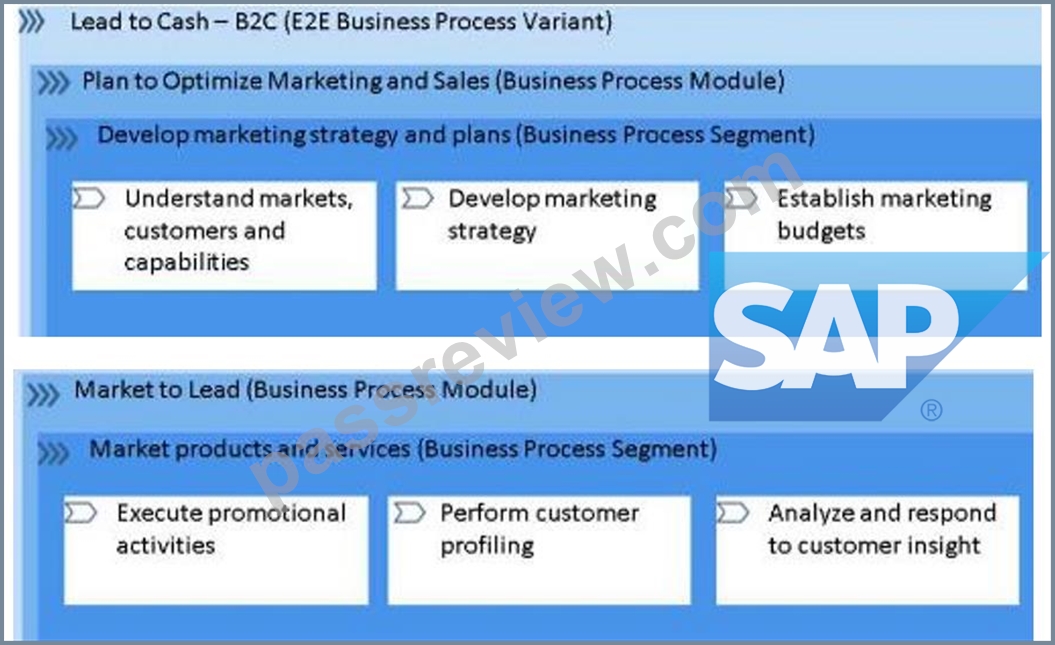
Note: There are 2 correct answers to this question.
See the Image
- A. Design and mange a customer loyalty program- increase cross selling opportunities through online recommendations.
- B. Analyse and respond to customer insight- increase cross selling opportunities through online recommendations.
- C. Develop market strategy -Run effective and high visibility campaigns.
- D. Implement promotional activities-Run effective and high visibility campaigns.
Answer: B,D
Explanation:
The business activities 'Analyze and respond to customer insight' and 'Implement promotional activities' directly relate to the CIO's goals of increasing cross-selling opportunities through online recommendations and running highly visible campaigns. Analyzing customer insights can provide data that enhances recommendation engines, leading to effective cross-selling. Implementing promotional activities, particularly in high-visibility platforms like social media, is key to driving campaign effectiveness.
= These relationships between business activities and goals would be informed by best practices in online marketing strategies, as documented within the Lead to Cash - B2C Business Process Variant.
NEW QUESTION # 32
While discussing the Smart Battery initiative in greater detail with the appropriate stakeholder, as Chief Enterprise Architect of Wanderlust, you discover that several key areas such as value proposition, cost structure, revenue streams, partners, and channels have been worked upon in isolation and therefore do not tally with each other. Which artifact would you recommend to bring all the above key dimensions together in a single window, to have a unified, consistent, holistic view of the Smart Battery initiative?
- A. Business Model Canvas
- B. Business Strategy Map
- C. Statement of Architecture Work
- D. Architecture Principles
Answer: A
Explanation:
A Business Model Canvas is a strategic management and entrepreneurial tool that allows you to describe, design, challenge, invent, and pivot your business model1. A Business Model Canvas consists of nine building blocks that cover the four main areas of a business: customers, offer, infrastructure, and financial viability2. These building blocks are:
Value Proposition: The value that you deliver to your customers and the problem that you solve for them.
Customer Segments: The different groups of people or organizations that you aim to reach and serve.
Channels: The ways that you communicate with and deliver value to your customers.
Customer Relationships: The types of relationships that you establish and maintain with your customers.
Revenue Streams: The sources of income that you generate from your value proposition.
Key Resources: The most important assets that you need to create and deliver your value proposition.
Key Activities: The most important things that you do to create and deliver your value proposition.
Key Partnerships: The network of suppliers and partners that help you create and deliver your value proposition.
Cost Structure: The most significant costs that you incur to create and deliver your value proposition.
A Business Model Canvas is a useful artifact to bring all the key dimensions of the Smart Battery initiative together in a single window, to have a unified, consistent, holistic view of the initiative. By using a Business Model Canvas, you can:
Visualize the entire business model of the Smart Battery initiative on one page.
Identify the gaps, inconsistencies, or conflicts among the different elements of the business model.
Align the value proposition, cost structure, revenue streams, partners, and channels with the customer segments and their needs.
Test and validate your assumptions and hypotheses about the business model.
Iterate and improve your business model based on feedback and data.
Verified : 1: https://www.strategyzer.com/canvas/business-model-canvas | 2: https://www.investopedia.com/terms/b/business-model-canvas.asp
NEW QUESTION # 33
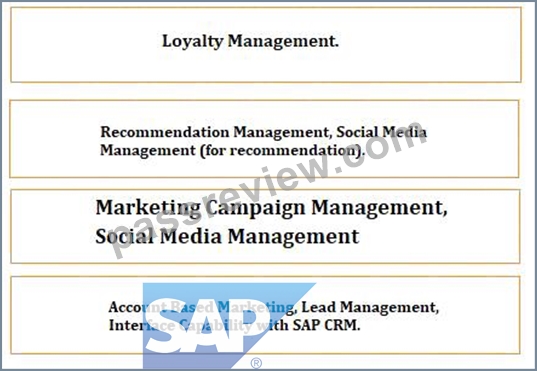
Select the most appropriate sequence of critical Business Capabilities for the Business Architecture Roadmap.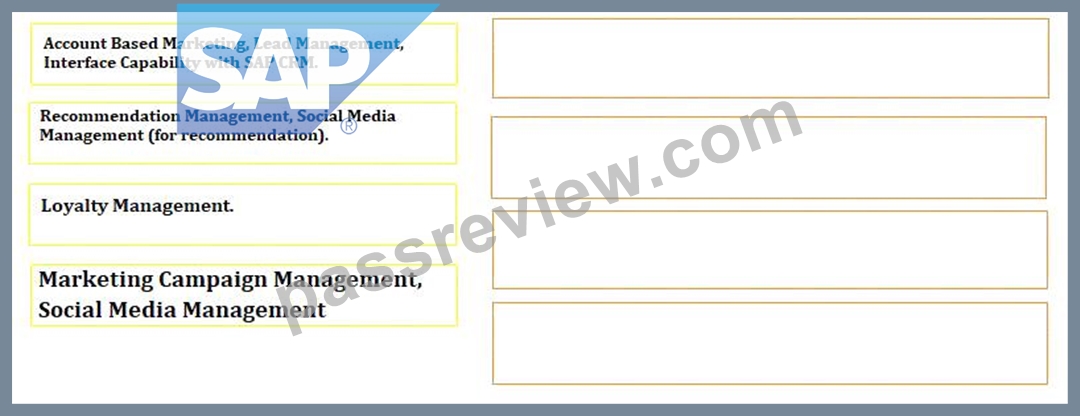
Answer:
Explanation: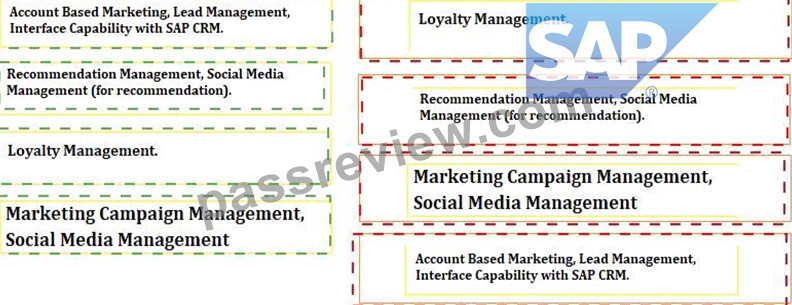
NEW QUESTION # 34
Green Elk & Company is the world's leading manufacturer of agricultural and forestry machinery. The former company slogan "Elk always runs" has recently been changed to "Elk feeds the world". One of Green Elk's strategic goals is to increase its revenue in the emerging markets of China, India, and other parts of Asia by 80 % within three years. This requires a new business model that caters to significantly smaller farms with limited budgets. You are the Chief Enterprise Architect and the CIO asks you to assess the now business model for smaller farms with smaller budgets. By applying the Sustainable Business Model Canvas, which sequence of steps is best practice?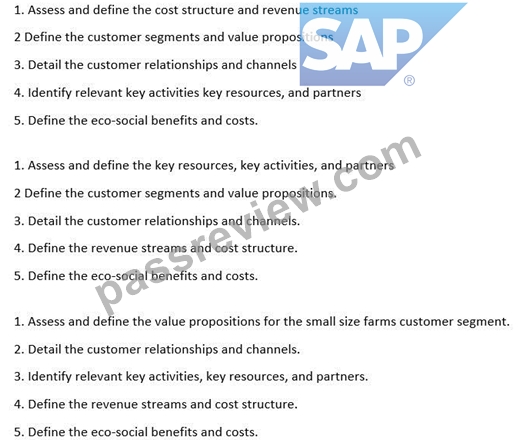
- A. 1. Assess and define the value propositions for the small size farms customer segment. /2. Detail the customer relationships and channels. /3. Identify relevant key activities, key resources, and partners. /4. Define the revenue streams and cost structure. /5. Define the eco-social benefits and costs.
- B. 1. Assess and define the key resources, key activities, and partners/2 Define the customer segments and value propositions. /3. Detail the customer relationships and channels. /4. Define the revenue streams and cost structure. /5. Define the eco-social benefits and costs.
- C. 1. Assess and define the cost structure and revenue streams/2 Define the customer segments and value propositions/3. Detail the customer relationships and channels/4. Identify relevant key activities key resources, and partners/5. Define the eco-social benefits and costs.
Answer: A
Explanation:
The Sustainable Business Model Canvas approach for assessing new business models, especially for smaller farms with smaller budgets, starts with understanding the unique value propositions tailored to the needs of small-size farm owners. This is crucial in creating offerings that resonate well with the target market's requirements and constraints. Following this, detailing customer relationships and channels becomes essential in establishing and maintaining a strong connection with the market segment, ensuring the delivery mechanism aligns with their preferences and capabilities. The next step involves identifying the key activities, resources, and partnerships necessary to deliver on the value proposition effectively, which is critical for operational execution and sustainability. Subsequently, defining the revenue streams and cost structure is paramount to ensure financial viability and strategic pricing that aligns with the target market's budgetary limitations. Lastly, delineating the eco-social benefits and costs integrates the broader impact of the business model, aligning with sustainable and ethical business practices, which is increasingly important for modern enterprises.
= This sequence is aligned with the methodologies proposed by Alexander Osterwalder in the context of business model development and specifically tailored by SAP for digital business modeling and value engineering within the SAP ecosystem. This approach encompasses strategies for optimizing business processes through value discovery workshops and the application of value management processes across various lifecycle phases (Source: SAP Enterprise Support Services documentation, Digital Business Modelling guidelines, and SAP Value Engineering methodologies).
NEW QUESTION # 35
While discussing the Smart Battery initiative in greater detail with the appropriate stakeholder, as Chief Enterprise Architect of Wanderlust, you discover that several key areas such as value proposition, cost structure, revenue streams, partners, and channels have been worked upon in isolation and therefore do not tally with each other. Which artifact would you recommend to bring all the above key dimensions together in a single window, to have a unified, consistent, holistic view of the Smart Battery initiative?
- A. Business Model Canvas
- B. Business Strategy Map
- C. Statement of Architecture Work
- D. Architecture Principles
Answer: A
Explanation:
A Business Model Canvas is a strategic management and entrepreneurial tool that allows you to describe, design, challenge, invent, and pivot your business model1. A Business Model Canvas consists of nine building blocks that cover the four main areas of a business: customers, offer, infrastructure, and financial viability2. These building blocks are:
Value Proposition: The value that you deliver to your customers and the problem that you solve for them.
Customer Segments: The different groups of people or organizations that you aim to reach and serve.
Channels: The ways that you communicate with and deliver value to your customers.
Customer Relationships: The types of relationships that you establish and maintain with your customers.
Revenue Streams: The sources of income that you generate from your value proposition.
Key Resources: The most important assets that you need to create and deliver your value proposition.
Key Activities: The most important things that you do to create and deliver your value proposition.
Key Partnerships: The network of suppliers and partners that help you create and deliver your value proposition.
Cost Structure: The most significant costs that you incur to create and deliver your value proposition.
A Business Model Canvas is a useful artifact to bring all the key dimensions of the Smart Battery initiative together in a single window, to have a unified, consistent, holistic view of the initiative. By using a Business Model Canvas, you can:
Visualize the entire business model of the Smart Battery initiative on one page.
Identify the gaps, inconsistencies, or conflicts among the different elements of the business model.
Align the value proposition, cost structure, revenue streams, partners, and channels with the customer segments and their needs.
Test and validate your assumptions and hypotheses about the business model.
Iterate and improve your business model based on feedback and data.
Verified Reference: 1: https://www.strategyzer.com/canvas/business-model-canvas | 2: https://www.investopedia.com/terms/b/business-model-canvas.asp
NEW QUESTION # 36
While trying to identify and map key stakeholders in Wanderlust, you, as the Chief Enterprise Architect, have been evangelizing the strategic business and IT objectives with business and IT departments across regions and taking in their views on the upcoming business transformation, Match the feedback from stakeholders (shown on the left) to the categorization and to some of the actions in the dropdown lists.
Answer:
Explanation: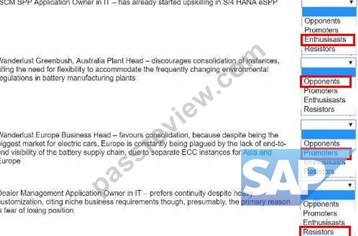
NEW QUESTION # 37
Green Elk & Company is the world's leading manufacturer of agricultural and forestry machinery. The former company slogan "Eik always runs has recently been changed to "Eik feeds the world" One of Green Elk's strategic goals is to increase its revenue in the emerging markets of China, India, and other parts of Asia by 80 % within three years. This requires a new business model that caters to significantly smaller farms with limited budgets You are the Chief Enterprise Architect and the decision was taken to implement regional S/4HANA productive systems while ensuring a high degree of standardization.
Which of the following implementation approach would you consider best in this case?
- A. Big Bang
- B. Phased by Application
- C. Small buck
- D. Phased by Company
Answer: D
Explanation:
Explanation
The best implementation approach for Green Elk & Company in this case is the phased by company approach.
This approach involves implementing S/4HANA in one company or business unit at a time, while keeping the existing ERP systems running for the rest of the organization. This approach has several advantages for Green Elk & Company, such as:
It allows them to focus on the specific requirements and challenges of each regional market, such as China, India, and other parts of Asia, and tailor the S/4HANA solution accordingly.
It reduces the risk and complexity of the implementation by limiting the scope and impact of each phase, and enabling faster testing and validation of the S/4HANA system.
It facilitates the adoption and change management of S/4HANA by providing a gradual and smooth transition for the users and stakeholders, and allowing them to learn from the experiences and best practices of each phase.
It ensures a high degree of standardization across the organization by leveraging the SAP Activate methodology, which provides a common framework, tools, and accelerators for S/4HANA implementations.
The other options (A, B, C) are not the best implementation approaches for Green Elk & Company in this case, because they have some drawbacks, such as:
Phased by application: This approach involves implementing S/4HANA by functional area or module, such as finance, logistics, or human resources. This approach is not suitable for Green Elk & Company because it would create inconsistencies and integration issues between the S/4HANA and ERP systems, and it would not address the specific needs and challenges of each regional market.
Big bang: This approach involves implementing S/4HANA for the entire organization at once, replacing all the existing ERP systems. This approach is not suitable for Green Elk & Company because it would entail a high risk and complexity of the implementation, and it would require a massive effort and investment in terms of time, resources, and change management.
Small buck: This approach involves implementing S/4HANA for a small subset of users or processes within a company or business unit. This approach is not suitable for Green Elk & Company because it would limit the benefits and value of S/4HANA, and it would not support their strategic goal of increasing their revenue in the emerging markets.
Verified References: SAP Activate Methodology, SAP S/4HANA Implementation Scenarios, SAP S/4HANA Deployment Options
NEW QUESTION # 38
Which of the following are the best architectural decisions for an extension application in S/4HANA?
- A. Use "Developer Extensibility for data-intensive ABAP extensions to S/4HANA./Use "Side-by-Side Extensibility on SAP BTP ABAP Environment" when additional SAP BTP services are intensively used and SAPUI5 user interfaces are required.
- B. Use 'Developer Extensibility" for data-intensive ABAP extensions to S/4HANA./Use "Side-by-Side Extensibility on SAP BTP. ABAP Environment" for applications that are less data-intensive and SAP BTP services that are intensively used.
- C. Use "Developer Extensibility for ABAP extensions to S/4HANA that do not require a UI component./Use "Side-by-Side Extensibility on SAP BTP, ABAP Environment" for extensions that require a SAPUI5 based user interface.
Answer: A
Explanation:
The decision for the extension model in S/4HANA should be based on the nature of the extension required. Developer Extensibility (in-app extensibility) is suitable for data-intensive extensions that need to operate within the context of S/4HANA. This is because it allows for direct access to S/4HANA's digital core and leverages the power of the HANA database. It is the recommended approach when the extension requires tight integration with core data and processes, ensuring high performance and data consistency.
On the other hand, Side-by-Side Extensibility on SAP BTP ABAP Environment is recommended when the extensions need to utilize additional SAP BTP services such as advanced analytics, machine learning, IoT services, or when creating new user experiences with SAPUI5. This decouples the extensions from the S/4HANA core, which can be beneficial in terms of flexibility, agility, and reducing the impact on the core system during upgrades.
Reference = These practices are supported by SAP's extensibility guide for S/4HANA, which explains the two extensibility models and their appropriate use cases. SAP documentation on ABAP Platform extensibility options provides further insights into when to choose each extensibility approach. SAP Best Practices for Extensibility in SAP S/4HANA guide provides a comprehensive view on how to extend the digital core effectively while maintaining system integrity and upgradeability.
NEW QUESTION # 39
......
Dumps Moneyack Guarantee - P-SAPEA-2023 Dumps Approved Dumps: https://getfreedumps.passreview.com/P-SAPEA-2023-exam-questions.html