

[Sep-2025] PMP Pre-Exam Practice Tests | Exam Questions and Answers for Project Management Professional Study Guide
Project Management Professional (2025 Version) Certification Sample Questions
The Project Management Professional (PMP) certification is one of the most recognized and respected credentials in the project management industry. Project Management Professional (2025 Version) certification is offered by the Project Management Institute (PMI), a non-profit organization that promotes professional standards in project management. The PMP certification validates an individual's knowledge and expertise in leading and managing projects, and is highly sought after by employers around the world.
Levels of PMI PMP certification program
The PMI PMP certification program offers a list of four levels which are Certification, Associate, Certified Associate (the new name for Accredited Member), and at the end Professional.
Registration Process
To register for the exam, one should pay a fee. It is $405 for PMI members and $555 for non-members. Once you settle the fee, you get an approval and confirmation email from PMI, containing your PMI Eligibility ID that would let you schedule the test at Prometric Center. You can then book your preferred exam slot. Keep in mind that the seats are limited and are usually confirmed on a first-come-first-served basis.
NEW QUESTION # 321
You are working on identifying possible risks to your project to develop a nutritional supplement. You want to develop a comprehensive list of risks that can be addressed later through qualitative and quantitative risk analysis. An information gathering technique used to identify risks is______________
- A. Probability and impact analysis
- B. Brainstorming
- C. Checklist analysis
- D. Documentation reviews
Answer: B
Explanation:
Section: Mix Questions
Explanation:
Brainstorming is a frequently used information-gathering technique for identifying risk, because it enables the project team to develop a list of potential risks relatively quickly. Project team members, or invited experts, participate in the session. Risks are easily categorized for follow-on analysis.
NEW QUESTION # 322
Drag the communication event on the left to the mam subject discussed during the event on the right.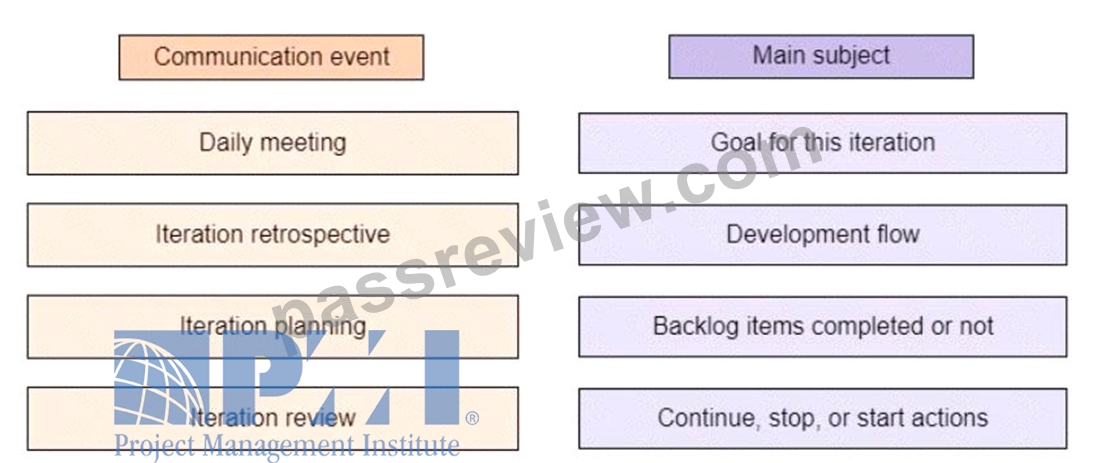
Answer:
Explanation: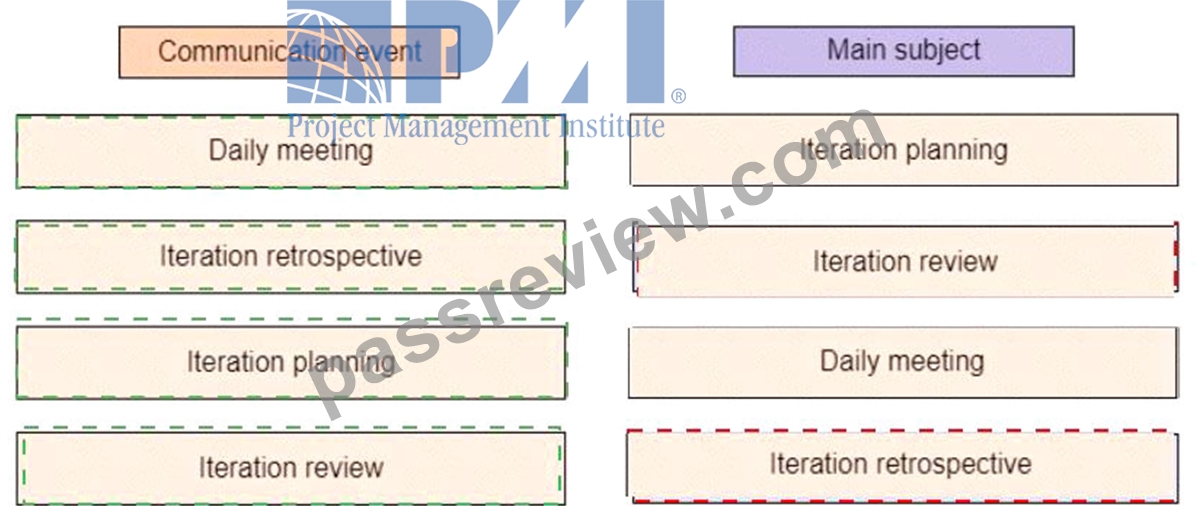
Explanation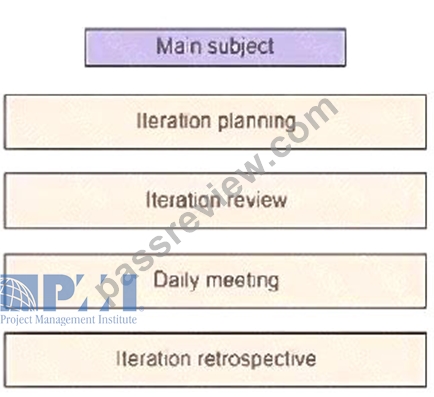
NEW QUESTION # 323
Which of the following statements about decomposition is the least true?
- A. Decomposition requires a degree of expert judgment and also requires close analysis of the project scope statement.
- B. Decomposition subdivides the major deliverables into smaller components until the work package level is reached.
- C. Decomposition involves structuring and organizing the WBS so that deliverables are always listed at level one.
- D. Decomposition is a tool and technique used to create a WBS.
Answer: C
Explanation:
Decomposition subdivides the major deliverables into smaller components. It is a tool and technique of the Create WBS process, along with WBS templates, and is used to create a WBS. Level two components might be deliverables, phases, subprojects, or some combination.
NEW QUESTION # 324
All project team members refer to the project manager for various decisions. This causes delays for some tasks, as the project manager is usually preoccupied in meetings throughout the day.
What should the project manager do to prevent these delays?
- A. Review the Pareto diagram to identify the source of delays.
- B. Meet with the team in 2 weeks to respond to all of the open tasks.
- C. Consolidate the decision-making authority to remain with the project manager.
- D. Delegate the decision-making authority of some tasks to the team.
Answer: D
Explanation:
Delegating decision-making authority to team members can help alleviate delays caused by the project manager's unavailability due to meetings or other commitments. This approach empowers team members to make decisions on certain tasks without waiting for the project manager, thus maintaining project momentum and efficiency. Effective delegation involves assigning the right tasks to the right people and providing them with the necessary authority and responsibility to complete those tasks12.
:
"Delegation and sharing of authority by the project manager" from the Project Management Institute1.
PMBOK Guide's discussion on group decision-making processes and the importance of delegation within project teams2.
NEW QUESTION # 325
What is the primary benefit of meeting quality requirements?
- A. Benchmarking
- B. Quality metrics
- C. Less rework
- D. Quality control measurements
Answer: C
NEW QUESTION # 326
Project risk is characterized by three factors: _____.
- A. Severity of impact, duration of impact and cost of impact
- B. Occurrence, frequency and cost
- C. Risk event, risk probability and the amount at stake
- D. Identification, type of risk category and probability of impact
Answer: C
NEW QUESTION # 327
A team member has experienced personal conflicts on past projects, making them nervous about working on the current project. The project manager knows this team member could add value to the project.
What should the project manager do to get the most value from this team member?
- A. Consult with the project sponsor to find out if it is allowed to share personal information with the entire team.
- B. Consult with human resources (HR) and check company policies on what is allowed to advise the team member.
- C. Advise the team member to focus on the current project and consider the past conflicts as lessons learned.
- D. Advise the team member not to share personal information from past projects with the entire team.
Answer: C
NEW QUESTION # 328
Which of the following time robbers end up creating additional work for the project manager and the project office?
- A. Over directing people
- B. Unreasonable time constraints
- C. Changes without notification or direction
- D. Failure to delegate
- E. All of the other alternatives apply
Answer: E
NEW QUESTION # 329
Which of the following best describes the Plan-Do-Check-Act cycle?
- A. Also called the Deming Cycle, it's a method of making small changes and measuring the impact before you make wholesale changes to a process.
- B. Made popular by Phillip Crosby in the 1980s, it's a way of measuring your product versus its requirements
- C. Invented by JosephJuran, it's a way of tracking how soon defects are found in your process.
- D. It means that you plan your project, then do it, then test it, and then release it.
Answer: A
Explanation:
The Plan-Do-Check-Act cycle is a way of making small improvements and testing their impact before you make a change to the process as a whole. It comes from W. Edwards Deming's work in process improvement.
NEW QUESTION # 330
A company has made multiple staff and operational changes over the last several years, significantly improving the company culture. A project manager was recently assigned to report to a new project supervisor. The project manager notices the supervisor's style of leadership is about getting the job done in the shortest possible time regardless of operational and worker impacts. This is causing some complaints from workers.
How should the project manager handle this situation?
- A. Discuss the company culture with the supervisor to clarify expectations.
- B. Request that the new supervisor be assigned to another project.
- C. Explain to the workers that they need to listen to the supervisor.
- D. Review the overall organizational culture of the company again.
Answer: A
Explanation:
The project manager should try to resolve the conflict between the supervisor and the workers by communicating the company culture and values, and how they affect the project objectives and stakeholder satisfaction. The project manager should also seek to understand the supervisor's perspective and goals, and find a way to align them with the project team's needs and expectations. This approach is consistent with the PMBOK Guide's recommendations on managing stakeholder engagement, conflict management, and leadership skills12. References: 1: PMBOK Guide, 6th Edition, Chapter 13: Stakeholder Management 2:
PMBOK Guide, 6th Edition, Appendix X3: Interpersonal and Team Skills
NEW QUESTION # 331
A project manager is leading a project in which key performance Indicators (KPls) are measured through earned value management (EVM). Match each measurement on the left with the correct category on the right.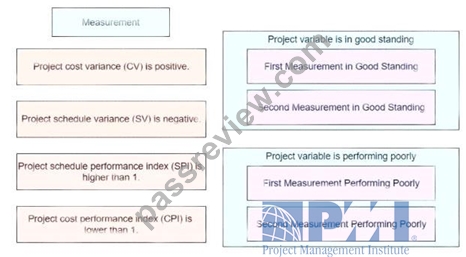
Answer:
Explanation: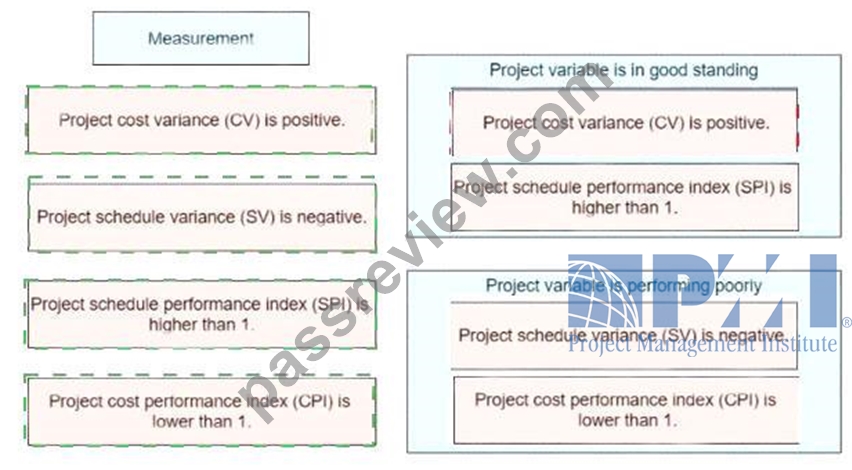
Explanation
Diagram Description automatically generated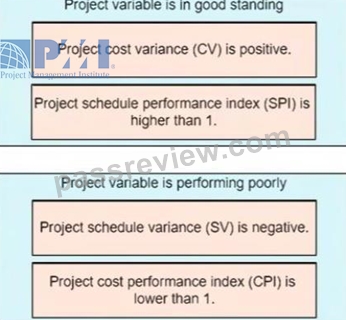
NEW QUESTION # 332
The cost of corrective action taken by the purchaser and chargeable to the supplier under the terms of the contract is:
- A. Back charge
- B. None of the other alternatives apply .
- C. Payment authorization
- D. Release payment
- E. Bid cost considerations
Answer: A
NEW QUESTION # 333
In a hybrid project, the customer decided on a major change for the project design. This change was approved and the impact on schedule and budget is known The software team leader, who is supposed to develop the software, refuses to commit to delivery dates claiming that they work using an agile approach and cannot commit to a final delivery date The hardware team depends on this software to develop their part of the product What should the project manager do?
- A. Impose the delivery dates on the software team leader and notify the functional manager about the situation
- B. Add this risk to the risk register and monitor it according to the risk management plan
- C. Ask the software team leader to use a predictive approach and commit to a delivery date
- D. Escalate this to higher management and ask for help to resolve the issue.
Answer: B
Explanation:
In a hybrid project, the project manager needs to balance the different approaches and expectations of the stakeholders and the teams. The customer's change request may have been approved based on the assumption that the software team can deliver the software in a timely manner using an agile approach. However, the software team leader's refusal to commit to a delivery date indicates a lack of alignment and collaboration between the teams and the customer. This creates a risk of schedule and scope deviations, as well as potential conflicts and dissatisfaction among the stakeholders. Therefore, the project manager should add this risk to the risk register and monitor it according to the risk management plan. The project manager should also communicate with the software team leader and the customer to clarify the expectations and the rationale behind the change request, and to explore possible ways to mitigate the risk and deliver the software that meets the customer's needs and the hardware team's dependencies. The project manager should not escalate the issue to higher management without trying to resolve it first, as this may undermine the trust and autonomy of the teams. The project manager should not impose the delivery dates on the software team leader, as this may violate the agile principles and demotivate the team. The project manager should not ask the software team leader to use a predictive approach, as this may not be feasible or suitable for the software development process and the customer's requirements. References: (Professional in Business Analysis Reference Materials source and documents)
* PMBOKGuide, 6th edition, Section 1.2.4, p. 19
* PMI Professional in Business Analysis (PMI-PBA)Examination Content Outline, Domain III:
Analysis, Task 5, p. 11
* Business Analysis for Practitioners: A Practice Guide, Section 2.4.2, p. 36
NEW QUESTION # 334
You are managing a project to redesign a retail store layout to improve customer throughput and efficiency.
Much project work must be done on site and will require the active participation of store employees who are lifelong members of a powerful union with a reputation for labor unrest. One important component of your schedule must be______________
- A. A resource capabilities matrix
- B. A resource histogram
- C. Buffers and reserves
- D. A resource calendar
Answer: D
Explanation:
Section: Mix Questions
Explanation:
Project and resource calendars identify periods when work is allowed. Project calendars affect all resources.
Resource calendars affect a specific resource or a resource category, such as a labor contract that requires certain workers to work on certain days of the week.
NEW QUESTION # 335
On a project with multiple international locations, a trend for delays has been flagged. When looking into the issue, the project manager realized that some of the key activities were scheduled over the holiday periods in the overseas offices.
What should the project manager do next?
- A. Update the schedule to reflect the holidays and share the workload among offices to mitigate schedule slippage.
- B. Update the schedule to reflect the holidays and notify the project sponsor of the delayed completion.
- C. Request that the offices in overseas locations work overtime to mitigate schedule slippages.
- D. Hire additional personnel on a temporary basis to cover the extra workload during the holiday seasons.
Answer: A
NEW QUESTION # 336
In reviewing your earned value reports you notice that your application integration testing is moving along 20% ahead of schedule. You realize that you can have them test some of the enhancements, thereby improving the quality of the product, while staying on schedule and within budget. This is an example of:
- A. Schedule change control
- B. Overall change control
- C. Earned value
- D. Performance reporting
Answer: B
NEW QUESTION # 337
Results of quality control measurements are used______________
- A. To prepare an operational definition
- B. As an input to plan quality management
- C. To prepare a control chart
- D. As an input to perform quality assurance
Answer: D
Explanation:
Section: Mix Questions
Explanation:
Quality control activities result in measurements that are used as inputs to the QA process. Such quality control measurements are used to evaluate and analyze the quality of the processes of the project against the organization's standards or specific requirements. They also compare processes used to create the measurements and validate actual measurements to determine their level of correctness.
NEW QUESTION # 338
A critical project is in the execution stage. The budget is strict, and managing the project to triple constraints is of high importance. A team member informs the project manager that there could be a significant cost overrun.
What should the project manager do next?
- A. the reasons for the cost overrun.
- B. Ensure there are enough reserves to cover the cost overrun.
- C. Capture this in the issue log, and monitor the cost overrun until project closure,
- D. Review risk thresholds to determine if it is an allowable cost overrun percentage.
Answer: A
NEW QUESTION # 339
A project manager has created an issue log to document issues communicated by project team members during weekly team meetings. This is an input of:
- A. Monitor and Control Risks.
- B. Report Performance.
- C. Plan Risk Management.
- D. Manage Stakeholder Expectations.
Answer: D
NEW QUESTION # 340
You've identified a risk event on your current project that could save $500,000 in project costs if it occurs. Your organization is considering hiring a consulting firm to help establish proper project management techniques in order to assure it realizes these savings. Which of the following is true based on this statement? (Choose the best answer.)
- A. This risk event should be mitigated to take advantage of the savings.
- B. This a risk event that should be shared to take full advantage of the potential savings.
- C. This is a risk event that should be accepted, because the rewards outweigh the threat to the project.
- D. This risk event is an opportunity to the project and should be exploited.
Answer: B
Explanation:
This risk event has the potential to save money on project costs. Sharing involves using a third party to help assure that the opportunity take place.
NEW QUESTION # 341
You are working on a construction project. You, your team, and your senior manager all feel that the work is complete. Your stakeholders have communicated their final acceptance of the project. You are now meeting with your team to update the organizational process assets with a record of knowledge gained about the project to help future project managers with their projects. This is BEST described as:
- A. Project records
- B. Work performance information
- C. Lessons learned
- D. Project management information system (PMIS)
Answer: C
Explanation:
Lessons learned are some of your most important organizational process assets. At the end of every project, you sit down with the project team and write down everything you learned about the project. This includes both positive and negative things. That way, when you or another project manager in your company plans the next project, you can take advantage of the lessons you learned on this one.
NEW QUESTION # 342
During a network upgrade for a company, the client informs the project manager that a government representative notified the client about a separate project that will affect the network upgrade. Any change in the upgrade will impact the project's cost and schedule.
What should the project manager do first?
- A. Inform the government representative about the impact of the separate project.
- B. Consult and update the risk register with the project stakeholders.
- C. Implement a change request to increase the budget and schedule.
- D. Perform an impact analysis with subject matter experts (SMEs).
Answer: D
Explanation:
The project manager should first perform an impact analysis with SMEs to assess the potential effects of the separate project on the network upgrade. This will help the project manager to determine the magnitude and probability of the risks, as well as the possible responses and contingency plans. The impact analysis is part of the Monitor Risks process, which involves tracking the identified risks, monitoring residual risks, identifying new risks, and evaluating risk process effectiveness1. Informing the government representative, implementing a change request, and updating the risk register are all possible actions that may follow the impact analysis, but they are not the first thing to do. References: 1 PMBOKGuide, 6th edition, page 452.
NEW QUESTION # 343
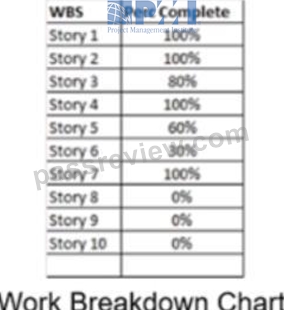
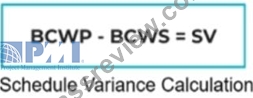
An agile project manager is evaluating the method that will be used to display the value of the work performed to date. Which method will they select to display to the project stakeholder?
- A.

- B.
- C.
- D.
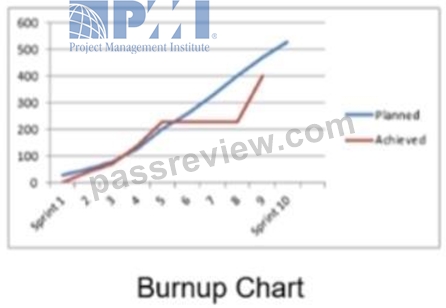
Answer: D
NEW QUESTION # 344
A functional manager is concerned that the project's quality management techniques have advanced beyond the department's capabilities and wants the project team to review all quality management activities in two full-day workshops the following week. What should the project manager do next?
- A. Indicate that this was a not a requirement identified during project planning and it is outside of the scope.
- B. Add this to the project backlog and have the product owner determine where it fits in terms of priority.
- C. Explain that the team is fully dedicated to the current sprint activities and negotiate a mutually agreeable time.
- D. Draft a project decision request to include in the scope for the current iteration and ask the sponsor to approve.
Answer: C
NEW QUESTION # 345
The last step in the stakeholder analysis process is to______________
- A. Determine the organizational culture
- B. Determine stakeholder roles, interests, and expectations
- C. Evaluate the amount of support each stakeholder could generate
- D. Assess how stakeholders probably will respond in various situations
Answer: D
Explanation:
Explanation/Reference:
Explanation:
In stakeholder analysis, the last step is to assess how key stakeholders are likely to react or respond to various situations in order to plan how to influence them to enhance their support and mitigate any potential negative impacts.
NEW QUESTION # 346
......
PMI Exam Practice Test To Gain Brilliante Result: https://getfreedumps.passreview.com/PMP-exam-questions.html