

NS0-528 Dumps Free Test Engine Player Verified Updated [Aug 17, 2026]
Q&As with Explanations Verified & Correct Answers
NEW QUESTION # 35
After setting up a new cluster peering relationship between a production site and a new DR site, the customer mentions that the communication for this peer needs to be secured to help deter "man in the middle" attacks.
What can you do on the NetApp end to secure the existing cluster peering?
- A. Modify the firewall policy settings on the Intercluster LIFs.
- B. Enable aggregate level encryption.
- C. Modify the relationship using -encryption-protocol-proposed.
- D. Enable IPsec between the sites.
Answer: C
Explanation:
To secure an existing cluster peering relationship, you can modify it to enable encryption by using the -encryption-protocol-proposed option. This ensures that intercluster SnapMirror traffic is encrypted, helping protect against man-in-the-middle attacks.
NEW QUESTION # 36
A customer wants to monitor the current utilization of storage capacity to ensure storage availability. They decide to implement quotas on some volumes.
What are three types of quotas that would satisfy the customer's requirement? (Choose three.)
- A. user
- B. group
- C. qtree
- D. volume
- E. aggregate
Answer: A,B,C
NEW QUESTION # 37
A customer must protect an ONTAP Select cluster at remote locations. They have a very limited network connection between sites for 30 remote locations and the data center. They want to be able to recover a remote site with an RPO of 60 minutes.
In this scenario, which solution accomplishes this task?
- A. FlexClone
- B. SnapMirror Synchronous
- C. MetroCluster
- D. SnapVault
Answer: D
NEW QUESTION # 38
A customer is running NetApp ONTAP 9.14.1 software and asks you to protect some data in a way that even disk zeroing cannot delete.
Which command enforces the requirement?
- A. aggregate create -snaplock-type enterprise
- B. aggregate create -snaplock-type compliance
- C. volume create -snaplock-type compliance
- D. volume create -snaplock-type enterprise
Answer: C
Explanation:
The SnapLock Compliance mode provides WORM (Write Once, Read Many) protection that is irrevocable, even by administrators, and not removable by disk zeroing or reinitialization. This satisfies stringent regulatory and tamper-proof data protection requirements.
NEW QUESTION # 39
A customer wants to enable tamper-proof Snapshot copies on volume LockingVolume, which is hosted on SVM LockingSVM. They have created the Snapshot policy, including the required retention set. However, when they apply the policy to a volume, the Snapshot copies are not locked.
Which command must the customer issue before tamper-proof Snapshot copies can be enabled?
- A. volume modify -volume LockingVolume -snapdir-access false
- B. volume modify -volume LockingVolume -anti-ransomware-state enable
- C. snaplock compliance-clock initialize -node *
- D. snaplock event-retention apply -vserver LockingSVM
Answer: C
Explanation:
To enable tamper-proof (locked) Snapshot copies using SnapLock, the SnapLock Compliance Clock must be initialized on all nodes in the cluster. Without initializing this clock, locked Snapshots cannot be created, even if the policy and retention settings are configured.
NEW QUESTION # 40
An administrator has an on-premises NetApp AFF cluster with 300TB of used volume space. 200TB of the volume data is tiered using NetApp BlueXP tiering to Amazon Simple Storage Service (Amazon S3). The administrator is tasked to configure NetApp BlueXP backup and recovery from the AFF cluster to Amazon S3.
When the first backup completes, how much data is copied from on premises to the cloud?
- A. 200TB
- B. 100TB
- C. 500TB
- D. 300TB
Answer: B
Explanation:
NetApp BlueXP backup and recovery backs up only the data that resides on-premises. In this scenario:
* Total used volume space: 300TB
* Already tiered to S3 using BlueXP tiering: 200TB
* Remaining local (hot) data: 100TB
Only this 100TB of local data will be copied during the first backup, as tiered data is not re-copied by BlueXP backup and recovery.
NEW QUESTION # 41
What is the role of data classification in a data protection solution?
- A. It helps determine the backup frequency of data
- B. It helps determine the availability of data
- C. It helps determine the storage location of data
- D. It helps determine the sensitivity of data
Answer: D
NEW QUESTION # 42
What is a SnapMirror in NetApp ONTAP?
- A. A method for encrypting data to protect it from unauthorized access
- B. A method for replicating data between NetApp ONTAP systems
- C. A method for compressing data to reduce storage space
- D. A method for archiving data for long-term storage
Answer: B
NEW QUESTION # 43
You want to verify some data in an active volume; however, the verification process makes changes to the data. You must now verify the integrity of your data without disturbing the active file system.
In this scenario, which NetApp technology would be used?
- A. SnapRestore
- B. SnapMirror
- C. FlexCache
- D. FlexClone
Answer: D
NEW QUESTION # 44
Before you use SnapMirror active sync, which NetApp tool must be used to add the NetApp ONTAP Mediator service?
- A. ONTAP Mediator server
- B. ONTAP System Manager
- C. Active IQ Unified Manager
- D. Active IQ Config Advisor
Answer: B
Explanation:
Before using SnapMirror active sync, the NetApp ONTAP Mediator must be registered and added to the cluster. This is done directly through the ONTAP System Manager, which provides a guided interface to configure and verify the Mediator service integration required for automatic failover.
NEW QUESTION # 45
What is MetroCluster in NetApp ONTAP?
- A. A high-availability solution that provides synchronous data replication between two clusters
- B. A method for encrypting data to protect it from unauthorized access
- C. A method for compressing data to reduce storage space
- D. A cloud storage solution that provides backup and recovery services
Answer: A
NEW QUESTION # 46
You have two sites running NetApp ONTAP 9.14.1 clusters that have databases connecting through FC that have a near-zero RTO requirement.
What NetApp solution would allow a failover between the sites with a near-zero RTO?
- A. BlueXP
- B. SVM data mobility
- C. SnapMirror SVM
- D. SnapMirror active sync
Answer: D
Explanation:
SnapMirror active sync provides active-active synchronous replication for SAN workloads (including FC-attached databases), ensuring zero RPO and near-zero RTO. It enables automatic failover and failback between sites, making it the ideal solution for mission-critical applications requiring continuous availability.
NEW QUESTION # 47
You have a SnapMirror relationship established between two sites and want to verify that the data on the DR site is usable without disturbing the source.
In this scenario, which three steps are required to accomplish this task? (Choose three.)
- A. Resynchronize the destination to the source volume, then update the source volume.
- B. Reverse the SnapMirror source and destination, then re-initialize SnapMirror.
- C. Resume the SnapMirror destination, then update the SnapMirror destination.
- D. Quiesce the SnapMirror destination, then break the SnapMirror destination.
- E. Configure the destination volume for data access, then access the data volume from a client.
Answer: C,D,E
NEW QUESTION # 48
A volume on a FabricPool-enabled aggregate is consuming 10 TB of the performance tier and 90 TB of the cloud tier. A SnapMirror copy needs to be created on a FabricPool-enabled peer cluster at a disaster recovery location.
In this scenario, how much data is transferred when the SnapMirror relationship is initialized?
- A. 90 TB
- B. 200 TB
- C. 100 TB
- D. 10 TB
Answer: C
NEW QUESTION # 49
You have a requirement to keep multiple yearly Snapshot copies on your SnapMirror destination volume. However, you do not want to have the Snapshot copies locked on your source volume because you do not have the required capacity.
Where do you set the schedule option to create the required Snapshot copies?
- A. secondary SnapMirror policy
- B. primary Snapshot policy
- C. primary SnapMirror policy
- D. secondary Snapshot policy
Answer: D
Explanation:
To retain multiple yearly Snapshot copies only on the SnapMirror destination, you must apply a Snapshot policy on the secondary volume. This avoids consuming space on the source volume, as these Snapshots are created and retained independently on the destination.
NEW QUESTION # 50
Exhibit: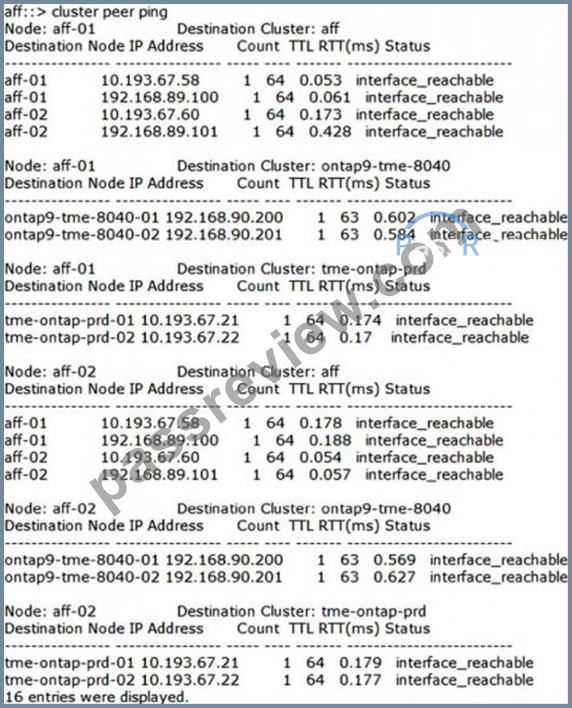
You are asked to set up a SnapMirror relationship to protect some Oracle DB volumes on both nodes of the aff-01 and aff-02 clusters. You are using the 1 Gb network and the other nodes all have free space to support the mirror.
Referring to the exhibit, which two nodes would provide the least network transfer time for the relationship? (Choose two.)
- A. aff-02 to tme-ontap-prd-02
- B. aff-01 to tme-ontap-prd-01
- C. aff-02 to ontap9-tme-8040-02
- D. aff-02 to ontap9-tme-8040-01
Answer: A,C
NEW QUESTION # 51
You experience a node outage as a result of a component failure in a high-availability (HA) pair. You replace the failed component and get thenode booted up again, but are unable to perform the giveback operation.
The onscreen error is:
"Connected to partner, Takeover is not possible: Storage failover mailbox disk state is invalid, Local node has encountered errors while reading the storage failover partner's mailbox disks. Local node missing partner disks" What are two ways to solve this problem? (Choose two.)
- A. Destroy the root aggregate.
- B. Correct the failover group configuration.
- C. Correct the shelf cabling errors.
- D. Destroy the mailboxes on both nodes.
Answer: B,C
NEW QUESTION # 52
You want to use OnCommand Workflow Automation to automatically provision secondary volumes for protection relationships.
What must you configure in OnCommand Unified Manager to accomplish this task?
- A. FabricPools
- B. FlashPools
- C. Resource Pools
- D. Storage Pools
Answer: C
NEW QUESTION # 53
You want to create an application-consistent Snapshot copy by using SnapCenter software.
What is required to accomplish this task?
- A. SnapDriven for Windows Server
- B. NetApp NFS Plug-in for VMware VAAI
- C. Plug-in for Microsoft Exchange
- D. VMware VM Tools
Answer: A
NEW QUESTION # 54
What is a backup schedule in NetApp data protection software?
- A. A set of rules for determining when backups occur
- B. A method for encrypting data to protect it from unauthorized access
- C. A method for optimizing data access
- D. A method for compressing data to reduce storage space
Answer: A
NEW QUESTION # 55
......
Network Appliance NS0-528 Exam Syllabus Topics:
| Topic | Details |
|---|---|
| Topic 1 |
|
| Topic 2 |
|
| Topic 3 |
|
| Topic 4 |
|
| Topic 5 |
|
Verified NS0-528 dumps Q&As Latest NS0-528 Download: https://getfreedumps.passreview.com/NS0-528-exam-questions.html