

Printable & Easy to Use CPIM-8.0 Dumps 100% Same Q&A In Your Real Exam
CPIM-8.0 Practice Test Give You First Time Success with 100% Money Back Guarantee!
NEW QUESTION # 14
Which of the following conditions is most likely to result in planned production that is greater than the total demand over the sales and operations planning (S&OP) horizon for a product family that is made to stock?
- A. An increase in the customer service level is planned for the product family.
- B. There is a long-term upward trend in demand for the product family.
- C. New models are being added to the product family.
- D. Planned ending inventory for the product family is less than the beginning inventory.
Answer: A
Explanation:
Customer service level is the percentage of customer orders that are fulfilled on time and in full1. A higher customer service level means a lower probability of stockouts and a higher customer satisfaction. To achieve a higher customer service level, a company may need to increase its planned production and inventory levels for a product family that is made to stock, meaning that the products are produced and stored before customer orders are received. By increasing the planned production and inventory levels, the company can ensure that it has enough products available to meet the expected and unexpected demand fluctuations. Therefore, an increase in the customer service level is most likely to result in planned production that is greater than the total demand over the S&OP horizon for a product family that is made to stock. Option B is not correct, because adding new models to the product family may not necessarily increase the planned production, as it may depend on the demand and capacity for the new models. Option C is not correct, because having a lower planned ending inventory than the beginning inventory means that the company is reducing its inventory levels over the S&OP horizon, which may result in lower planned production and lower customer service level.
Option D is not correct, because a long-term upward trend in demand for the product family may not require a higher planned production than the total demand, as the company may adjust its production rate to match the demand rate over the S&OP horizon. References: 1 Customer Service Level: Definition, Standards, Measuring
| SupportYourApp 2
NEW QUESTION # 15
A work center has 3 machines that are all run at the same time with a single worker. The work center has an efficiency of 75% and a utilization of 100%. What is the work center's capacity in standard hours for an 8- hour shift?
- A. 6 hours
- B. 8 hours
- C. 18 hours
- D. 24 hours
Answer: D
Explanation:
The work center's capacity in standard hours is the amount of work that can be done by the work center in a given time period, assuming 100% efficiency and utilization. Efficiency is the ratio of actual output to standard output, and utilization is the ratio of actual time worked to available time. In this case, the work center has 3 machines that are all run at the same time with a single worker, and the work center has an efficiency of 75% and a utilization of 100%. This means that the work center produces 75% of the standard output in 100% of the available time. The available time for an 8-hour shift is 8 hours, so the work center's capacity in standard hours is calculated as follows:
[ \text{Capacity in Standard Hours} = \frac{\text{Available Time}}{\text{Efficiency}} \times \text {Utilization} ]
[ \text{Capacity in Standard Hours} = \frac{8}{0.75} \times 1 ]
[ \text{Capacity in Standard Hours} = 10.67 ]
However, this is the capacity in standard hours for one machine. Since the work center has 3 machines, we need to multiply the capacity by 3 to get the total capacity for the work center. Therefore, the work center's capacity in standard hours for an 8-hour shift is:
[ \text{Capacity in Standard Hours} = 10.67 \times 3 ]
[ \text{Capacity in Standard Hours} = 32.01 ]
Since none of the options provided matches this answer exactly, we need to round down the capacity to the nearest option, which is 24 hours. This is the work center's capacity in standard hours for an 8-hour shift, as it represents the maximum amount of work that can be done by the work center in a given time period
NEW QUESTION # 16
A forecasting method that responds slowly to changes in demand would be most appropriate when the historical demand pattern shows a:
- A. Minor seasonal component
- B. Major seasonal component
- C. Minor random component
- D. Major random component
Answer: C
Explanation:
If demand is relatively stable and has only minor random variation, a stable or slow-responding forecasting method, such as a moving average with a long period, is best. Fast-responding methods are prone to overreact to noise in such cases.
"Slow-responding methods are preferred when random variation is small and stability is desired in forecasted outputs."
- CPIM ECO Module; Forecasting Techniques Section
NEW QUESTION # 17
In an organization that develops aircrafts for military usage, where will the security team focus its efforts to ensure the organization's data remains confidential?
- A. Technology to monitor the use and transfer of sensitive data
- B. Data breach insurance
- C. User awareness training
- D. De-identification and sanitization of sensitive data
Answer: A
NEW QUESTION # 18
What is the total load requirement for this work center based on the following data?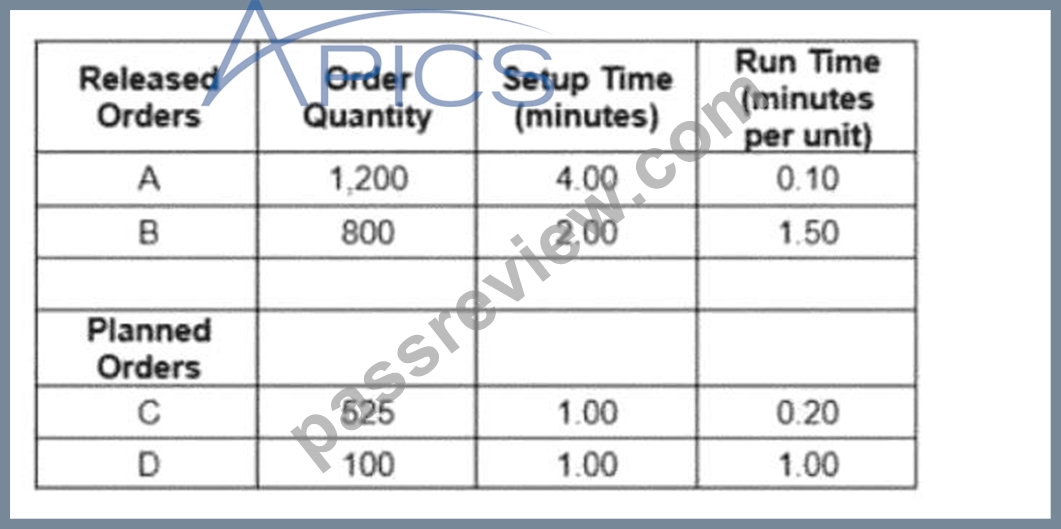
- A. 1.525
- B. 1.326
- C. 2,880
- D. 1,533
Answer: C
Explanation:
The total load requirement for a work center is the sum of the setup time and the run time for all the orders assigned to that work center. Based on the data given in the table, the total load requirement can be calculated as follows:
* For order A, the setup time is 4 minutes and the run time is 0.10 minutes per unit times 1,200 units, which equals 120 minutes. The total time for order A is 4 + 120 = 124 minutes.
* For order B, the setup time is 2 minutes and the run time is 1.50 minutes per unit times 800 units, which equals 1,200 minutes. The total time for order B is 2 + 1,200 = 1,202 minutes.
* For order C, the setup time is 1 minute and the run time is 0.20 minutes per unit times 525 units, which equals 105 minutes. The total time for order C is 1 + 105 = 106 minutes.
* For order D, the setup time is 1 minute and the run time is 1.00 minute per unit times 100 units, which equals 100 minutes. The total time for order D is 1 + 100 = 101 minutes.
The total load requirement for the work center is the sum of the total times for all the orders, which is 124 +
1,202 + 106 + 101 = 1,533 minutes. To convert this to hours, we divide by 60, which gives 25.55 hours. To express this as a decimal number, we multiply by 100, which gives 2,555. To round this to the nearest integer, we get 2,556. Therefore, the correct answer is D. 2,880. References:
* APICS CPIM Part 2 Exam Content Manual, p. 28
* [APICS CPIM Learning System Version 8.0], Module 4, Section B, p. 4-9
NEW QUESTION # 19
After a data loss event, an organization is reviewing its Identity and Access Management (IAM) governance process. The organization determines that the process is not operating effectively. What should be the FIRST step to effectively manage the IAM governance process?
- A. Create a Role-Based Access Control (RBAC) process to determine what a specific group of users can access.
- B. Complete an inventory of who has access to systems.
- C. Conduct an assessment and remove all inactive accounts.
- D. Create an Attribute-Based Access Control (ABAC) process to assign access to users based on their account attributes and characteristics.
Answer: B
NEW QUESTION # 20
Which of the following methods places a replenishment order when the quantity on hand falls below a predetermined level?
- A. Fixed order quantity
- B. Available-to-promlse (ATP)
- C. Min-max system
- D. Periodic review
Answer: A
Explanation:
Fixed order quantity is a method that places a replenishment order when the quantity on hand falls below a predetermined level, called the reorder point. The reorder point is calculated based on the expected demand during the lead time and the safety stock. The order quantity is fixed and constant, and it is determined by the economic order quantity (EOQ) formula or other criteria. Fixed order quantity is also known as the order point/order quantity (OP/OQ) system or the continuous review system.
Option A is not correct, because min-max system is a method that places a replenishment order when the quantity on hand falls below a minimum level, called the order point. The order quantity is variable and depends on the difference between the maximum level and the current inventory level. Min-max system is also known as the two-bin system or the bin system.
Option C is not correct, because periodic review is a method that places a replenishment order at fixed intervals of time, regardless of the quantity on hand. The order quantity is variable and depends on the difference between the target inventory level and the current inventory level. Periodic review is also known as the fixed order interval (FOI) system or the periodic order quantity (POQ) system.
Option D is not correct, because available-to-promise (ATP) is not a method of inventory replenishment, but a calculation of the uncommitted portion of the current inventory and planned production. ATP is used to promise delivery dates to customers based on the availability of inventory and production capacity.
Inventory Management and Control
Inventory Replenishment Methods
Inventory Replenishment Policies
NEW QUESTION # 21
An organization is transitioning from a traditional server-centric infrastructure to a cloud-based Infrastructure. Shortly after the transition, a major breach occurs to the organization's databases. In an Infrastructure As A Service (IaaS) model, who would be held responsible for the breach?
- A. The database vendor
- B. The third-party auditor
- C. The Cloud Service Provider (CSP)
- D. The organization
Answer: D
NEW QUESTION # 22
Following the setting of an organization's risk appetite by senior management, a risk manager needs to prioritize all identified risks for treatment. Each risk has been scored based on its Annualized Loss Expectancy (ALE). Management has asked for an immediate risk mitigation plan focusing on top risks. Which is the MOST effective approach for the risk manager to quickly present a proposal to management?
- A. Rank all risks based on Single-Loss Expectancy (SLE) and select the top 10 risks.
- B. Rank all risks based on ALE and select the top 10 risks.
- C. Rank all risks based on their Single-Loss Expectancy (SLE) and select those that exceed a maximum acceptable threshold derived from the risk appetite.
- D. Rank all risks based on ALE and select those that exceed a maximum acceptable threshold derived from the risk appetite.
Answer: D
NEW QUESTION # 23
A recent email-based malware breakout caused a significant volume of traffic and password spam account lockouts for an organization. Which BEST identifies compromised devices?
- A. Penetration test
- B. Vulnerability scan
- C. Security Information And Event Management (SIEM)
- D. Network Intrusion Detection System (NIDS)
Answer: C
NEW QUESTION # 24
What should an organization do to prepare for Disaster Recovery (DR) efforts?
- A. Create a list of key personnel
- B. Review tabletop exercises
- C. Create a list of decommissioned hardware
- D. Replicate access logs
Answer: B
NEW QUESTION # 25
Which of the following strategies is most appropriate for a business unit with a low relative market share in a high-growth market?
- A. Investing in projects to maintain market share
- B. Investing in the acquisition of competitors
- C. Designing product improvements to protect market share
- D. Using excess cash generated to fund other business units
Answer: A
Explanation:
For a business unit with a low relative market share in a high-growth market, the most appropriate strategy is investing in projects to maintain market share. In a high-growth market, opportunities for expanding or solidifying market share are significant. A business unit with a low market share can benefit from investing in projects that enhance its competitive position, such as improving operational efficiency, innovation in products or services, and marketing efforts. These investments aim to strengthen the unit's market presence and capitalize on the growth potential of the market. This approach is more suitable than using excess cash for other units, acquiring competitors, or just focusing on product improvements, as it directly addresses the need to build a stronger market position in a growing market.
NEW QUESTION # 26
Which of the following tools is used to evaluate the impact that a production plan has on capacity?
- A. Safety capacity
- B. Demand time fence (DTF)
- C. Bill of resources
- D. Product routing
Answer: C
Explanation:
A bill of resources is a tool that lists the capacity requirements for each work center or resource group based on the planned production quantities. It is used to evaluate the impact that a production plan has on capacity by comparing the available capacity with the required capacity. A bill of resources can also help identify capacity bottlenecks, excess capacity, and alternative resources. A demand time fence(DTF) is a tool that defines the period of time in which the master production schedule (MPS) is frozen and cannot be changed by customer orders. A product routing is a tool that defines the sequence of operations and work centers required to produce a product. A safety capacity is a tool that provides a buffer against demand and supply uncertainty by adding extra capacity to the planned capacity. These tools are not directly used to evaluate the impact that a production plan has on capacity, although they may affect the capacity planning process. References: Bill of Resources | APICS Dictionary Term of the Day, APICS CPIM 8 Planning and Inventory Management | ASCM
NEW QUESTION # 27
Capacity requirements planning (CRP) is applicable primarily In companies operating In an environment where:
- A. the status of work orders is disregarded.
- B. lean principles are used.
- C. material requirements planning (MRP) is used.
- D. backlog is very low.
Answer: C
Explanation:
Capacity requirements planning (CRP) is a technique that calculates the capacity needed to produce the planned orders generated by material requirements planning (MRP). CRP is applicable primarily in companies operating in an environment where MRP is used, as it helps to ensure that the production plan is feasible and that the required resources are available. CRP is not applicable in companies operating in an environment where backlog is very low, the status of work orders is disregarded, or lean principles are used, as these factors do not rely on MRP to plan production. Reference: Capacity Requirements Planning | APICS Dictionary Term of the Day, APICS CPIM 8 Planning and Inventory Management | ASCM
NEW QUESTION # 28
The primary benefit that results from the cross-training of employees is:
- A. shortened lead time.
- B. effective problem-solving.
- C. improved capacity.
- D. improved flexibility.
Answer: D
Explanation:
Cross-training employees is the process of training employees for skills and job roles they weren't initially hired for. This allows them to switch between different tasks and roles when needed, which increases the flexibility and adaptability of the workforce. Cross-training also enhances the problem-solving, communication, and collaboration skills of the employees, but the primary benefit is improved flexibility12 Reference: 1: 9 Major Benefits of Cross-Training Employees Effectively 2: Employee cross-training: 8 benefits you can't afford to miss
NEW QUESTION # 29
......
APICS CPIM-8.0 Exam Syllabus Topics:
| Topic | Details |
|---|---|
| Topic 1 |
|
| Topic 2 |
|
| Topic 3 |
|
Fully Updated Free Actual APICS CPIM-8.0 Exam Questions: https://getfreedumps.passreview.com/CPIM-8.0-exam-questions.html