

Obtain the OGA-031 PDF Dumps Get 100% Outcomes Exam Questions For You To Pass
OGA-031 Exam Dumps Contains FREE Real Quesions from the Actual Exam
NEW QUESTION # 48
What is an external active structure element that represents a point of access where one or more services are provided to the environment?
- A. An interface
- B. A capability
- C. A collaboration
- D. An interaction
Answer: A
Explanation:
Comprehensive and Detailed in Depth Explanation:AnInterfacein ArchiMate representsan access point through which elements interact with services. It can be aBusiness Interface, Application Interface, or Technology Interface.
Interfaces serve as aboundarybetween internal and external systems, allowing controlled interactions. The ArchiMate 3.2 Specificationexplicitly states thatinterfaces expose services to the environment.
References:
* Archi User Guide
* ArchiMate 3.2 Specification
NEW QUESTION # 49
Complete the sentence. The different layers of Enterprise Architectures that can be modeled with the ArchiMate language include Business, Application, and
- A. Strategy
- B. Technology
- C. Data
- D. Information
Answer: B
Explanation:
According to the ArchiMate 3.2 Specification1, the ArchiMate core language defines a structure of generic elements and their relationships, which can be specialized in different layers. Three layers are defined within the ArchiMate core language as follows:
The Business Layer depicts business services offered to customers, which are realized in the organization by business processes performed by business actors and roles.
The Application Layer depicts application services that support the business, and the applications that realize them.
The Technology Layer comprises both information and operational technology. You can model, for example, processing, storage, and communication technology in support of the application world and Business Layers, and model operational or physical technology with facilities, physical equipment, materials, and distribution networks.
NEW QUESTION # 50
What aspect in the ArchiMate Core Framework represents elements such as business roles, and system software?
- A. Motivation
- B. Active structure
- C. Behavior
- D. Passive structure
Answer: B
Explanation:
Comprehensive and Detailed in Depth Explanation:TheActive Structureaspect of theArchiMate Core Frameworkrepresents elements thatperform behavior, such asbusiness roles(e.g., employees, partners) and system software(e.g., databases, middleware).
Active structure elements areresponsible for actionsin an enterprise. TheArchiMate 3.2 Specificationstates thatbusiness roles and system software are part of the Active Structure aspect.
References:
* Archi User Guide
* ArchiMate 3.2 Specification
NEW QUESTION # 51
What is specified by an architecture viewpoint?
- A. An Enterprise Architecture model
- B. An architecture description
- C. An architecture view on an Enterprise Architecture
- D. A model kind
Answer: C
Explanation:
According to the ISO/IEC 42010 standard1, an architecture viewpoint is a specification of the conventions for constructing and using a view. A view is a representation of a whole system from the perspective of a related set of concerns. An architecture view on an Enterprise Architecture is a representation of a part or whole of an Enterprise Architecture from the perspective of one or more stakeholders and their concerns.
The ArchiMate language provides a flexible approach in which architects and other stakeholders can use their own views on the Enterprise Architecture. In this approach, architecture views are specified by architecture viewpoints. Architecture viewpoints define abstractions on the set of models representing the Enterprise Architecture, each aimed at a particular type of stakeholder and addressing a particular set of concerns2.
NEW QUESTION # 52
Consider the following diagram: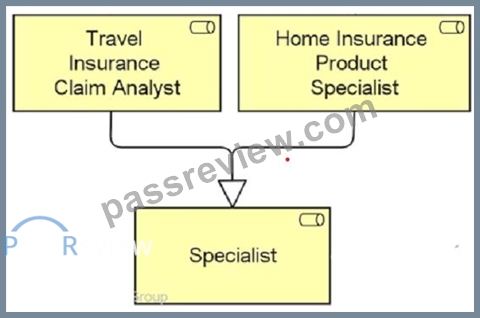
Which of the following correctly describes this diagram?
- A. The business role Specialist is an aggregation of the two business roles Travel Insurance Claim Analyst and Home Insurance Product Specialist.
- B. The business role Specialist approves all claims handled by the two business roles Travel Insurance Claim Analyst and Home Insurance Product Specialist
- C. The two business roles Travel Insurance Claim Analyst and Home Insurance Product Specialist are specializations of the business role Specialist
- D. The two business roles Travel Insurance Claim Analyst and Home Insurance Product Specialist together realize the business role Specialist.
Answer: C
Explanation:
Based on the ArchiMate 3 documents or objectives, the diagram uses a specialization relationship to indicate that the two business roles Travel Insurance Claim Analyst and Home Insurance Product Specialist are more specific versions of the business role Specialist. A specialization relationship is a type of structural relationship that indicates that an object is a specialization of another object. The notation for a specialization relationship is a solid line with an empty triangle at the end that points to the more general element.
NEW QUESTION # 53
Consider the diagram which hascolor removedfrom it: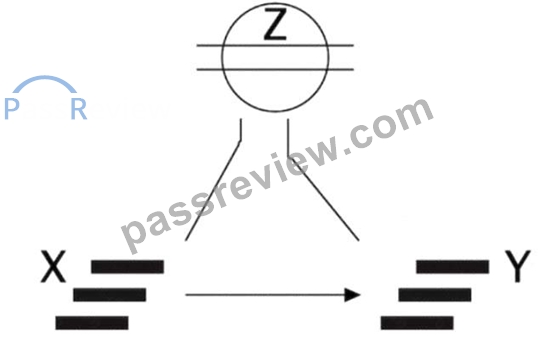
(A diagram showing two stacked horizontal bars labeledX and Y, connected by an arrow, and acircle with lines (Z) positioned between them.) What is the correct description of this diagram?
- A. Two nodes (X and Y) connected by a communication path (Z).
- B. A gap (Z) associated with two plateaus (X and Y).
- C. Two plateaus (X and Y) with a transition architecture (Z).
- D. A deliverable (Z) exchanged between two projects (X and Y).
Answer: B
Explanation:
Comprehensive and Detailed In-Depth Explanation:
ThisArchiMate Implementation & Migration Layer diagramrepresentsan architecture evolution model, specifically showingtwo plateaus (X and Y) with a Gap (Z) in between them.
* Plateausin ArchiMate representstates of an enterprise architectureat different points in time.
* Gapsrepresentthe difference or missing elements between two architectural states, indicating what needs to change.
* Thecircle with lines (Z) represents a Gap, which identifies what is missing or needs to be addressed when transitioning from Plateau X to Plateau Y.
Analysis of Answer Choices:
#A. Two plateaus (X and Y) with a transition architecture (Z).##Incorrect
* A transition architecture is different from a gap.
* ATransition Architecture provides an intermediate step between two plateaus, whereasthis diagram is identifying a Gapbetween them.
* ArchiMate 3.2 Specification, Section 7.4.3, definesGaps as structural differences, not transition states.
#B. A gap (Z) associated with two plateaus (X and Y).##Correct Answer
* The circle with lines (Z) is the correct representation of a Gap in ArchiMate.
* Plateau X represents the "Before" state, andPlateau Y represents the "Target" state.
* Z (Gap) represents what is missing or what must be addressed to move from X to Y.
* ArchiMate 3.2 Specification, Section 7.4.3, states thatGaps are used in architecture migration to analyze missing capabilities or elements.
#C. A deliverable (Z) exchanged between two projects (X and Y).##Incorrect
* A deliverable is typically represented as a document or artifactin ArchiMate, not as a Gap.
* Z represents a missing element between states, not an exchanged deliverable.
#D. Two nodes (X and Y) connected by a communication path (Z).##Incorrect
* Nodes and Communication Paths belong to the Technology Layer, but this diagram represents the Implementation & Migration Layer.
* X and Y are plateaus, not technology nodes.
#B. A gap (Z) associated with two plateaus (X and Y).
References:
* ArchiMate 3.2 Specification: Sections 7.4.1 (Plateau) and 7.4.3 (Gap).
* Archi User Guide: Modeling architecture migration using Gaps and Plateaus.
NEW QUESTION # 54
Complete following sentence: In the generic metamodel the main types of elements can be divided into
- A. resources and events
- B. structure and behavior
- C. grouping and location
- D. process and function
Answer: B
Explanation:
Based on the ArchiMate 3 documents or objectives, the generic metamodel defines two main types of elements: structure and behavior. Structure elements represent the structural concepts that model the static construction or composition of concepts of the same or different types. Behavior elements represent units of activity performed by one or more active structure elements.
NEW QUESTION # 55
Consider the diagram, which represents information about atransformation project: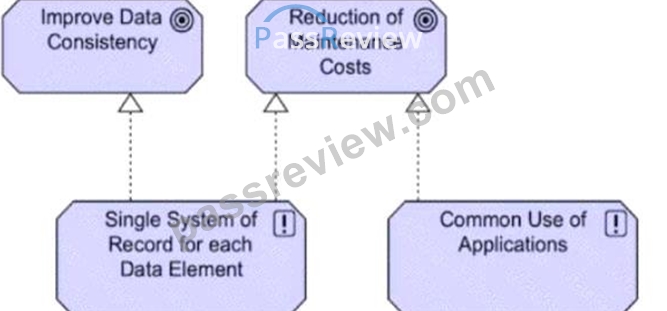
(A diagram showingImprove Data ConsistencyandReduction of Maintenance Costsat the top, connected to Single System of Record for each Data ElementandCommon Use of Applications.) Which of the following best describes this diagram?
- A. Principles and the goals they realize.
- B. Goals and the assigned values.
- C. Requirements and the meanings assigned.
- D. Drivers and the associated outcomes.
Answer: A
Explanation:
Comprehensive and Detailed In-Depth Explanation:
The diagram presentsPrinciples and Goals, which are core elements inArchiMate's Motivation Layer. In ArchiMate 3.2, principles represent fundamentalguidelines or constraints that influence architecture, whilegoals represent intended outcomesof an enterprise transformation.
Understanding the Diagram:
* Improve Data ConsistencyandReduction of Maintenance Costsaregoals-they describedesirable future statesof the enterprise.
* Single System of Record for each Data ElementandCommon Use of Applicationsareprinciples- theyguide decision-making and architecture choicesto help achieve the goals.
* Therelationships between these elements indicate that the principles contribute to realizing the goals.
Analysis of Answer Choices:
#A. Principles and the goals they realize.##Correct Answer
* Principlesdefine fundamental rules that guide decision-making (e.g.,Single System of Record for each Data Element).
* Goalsrepresent desired business outcomes (e.g.,Improve Data Consistency).
* ArchiMate 3.2 Specification, Section 6.2.2, defines how principles guide enterprise architecture to realize goals.
#B. Requirements and the meanings assigned.##Incorrect
* Requirements describe what needs to be implemented, whereasthis diagram represents high-level principles and goals, not specific implementation needs.
* ArchiMate 3.2 Specification, Section 6.2.3, differentiatesrequirements from principles and goals.
#C. Goals and the assigned values.##Incorrect
* While the diagram includesgoals, thelower elements are not values but principlesthat help achieve the goals.
* Values in ArchiMate typically represent high-level business benefits rather than architectural guidelines.
#D. Drivers and the associated outcomes.##Incorrect
* Drivers represent external forces or motivations(e.g., market trends, customer demands).
* This diagramdoes not include external drivers; it focuses on principles guiding internal changes.
#A. Principles and the goals they realize.
References:
* ArchiMate 3.2 Specification: Sections 6.2.2 (Principles) and 6.2.1 (Goals).
* Archi User Guide: Understanding the relationship between principles and goals in enterprise architecture.
NEW QUESTION # 56
Consider the following entities:
* A business partner
* A software application for software sales
* Server hardware used to host business applications
What ArchiMate aspect describes these entities?
- A. Business structure
- B. Active structure
- C. Behavior
- D. Passive structure
Answer: B
Explanation:
Comprehensive and Detailed in Depth Explanation:In ArchiMate, theActive Structureaspect represents elements thatperform behaviorandact upon other elements.
* ABusiness Partneris anactive entitythat interacts with a business.
* ASoftware Applicationis anApplication Component, which belongs to theActive Structureaspect.
* Server Hardwareis part of theTechnology Layerbut still falls under theActive Structurecategory.
Since all three elements representactive entities performing tasks, they fall underActive Structureas per the ArchiMate 3.2 Specification.
References:
* Archi User Guide
* ArchiMate 3.2 Specification
NEW QUESTION # 57
Consider the diagram:
(A diagram showingChief Marketing Officerconnected toMarket Share.)
What element represents theChief Marketing Officer?
- A. Business Actor
- B. Role
- C. Stakeholder
- D. Actor
Answer: C
Explanation:
Comprehensive and Detailed In-Depth Explanation:
TheChief Marketing Officer (CMO)in this diagram is depicted as astakeholder, as it representsan individual or a group with concerns about market share.
InArchiMate 3.2, astakeholderis an entity thathas an interest in the outcomes of enterprise architecture, business processes, or strategic goals. TheMarket Shareconcept represents abusiness driver or key metric
, which directly aligns withstakeholder concernsin an organization.
Analysis of Answer Choices:
#A. Business Actor##Incorrect.
* ABusiness Actorrepresents anorganizational entity that performs behavior(e.g., a company, department, or system).
* TheCMO is an individual with a concern (Market Share), not a system or department performing business processes.
* ArchiMate 3.2 Specification, Section 6.2.1, states that aBusiness Actor is an operational entity rather than a strategic role or stakeholder.
#B. Role##Incorrect.
* ARolerepresents aresponsibility or job function assigned to actors, but thediagram does not depict responsibilities or assigned functions.
* Arole is usually linked to a business actor, while theCMO in this context is linked to a business concern (Market Share).
* ArchiMate 3.2 Specification, Section 6.3.1, states thatroles are used to define responsibilities, whereas stakeholders are used to define concerns.
#C. Stakeholder##Correct Answer
* TheCMO represents a strategic position with concerns about business performance, making it a Stakeholderin ArchiMate.
* ArchiMate 3.2 Specification, Section 6.2.1, definesStakeholder as an entity concerned with outcomes and business goals, exactly fitting the context of this diagram.
#D. Actor##Incorrect.
* AnActorin ArchiMate is used to defineentities performing business behaviors(such as a department or a system).
* TheCMO is not performing an explicit business function but rather has concerns about market performance.
#C. Stakeholder
References:
* ArchiMate 3.2 Specification: Sections 6.2.1 (Stakeholder), 6.3.1 (Role), and 6.2.1 (Business Actor).
* Archi User Guide: Defining stakeholders and their concerns in Enterprise Architecture.
NEW QUESTION # 58
Consider the following diagram: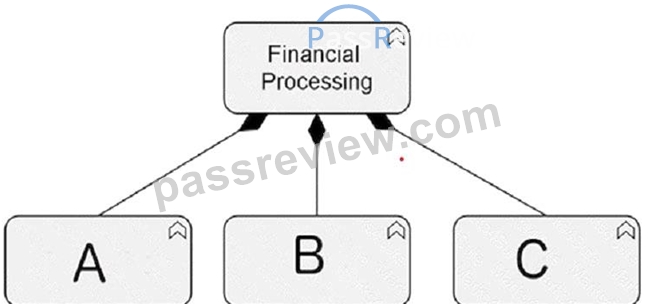
Which of the following is the correct description of the diagram?
- A. The financial processing function aggregates the three sub-functions Al B, and C.
- B. The financial processing function is assigned the three sub-functions A, B, and C.
- C. The financial processing function is composed of three sub-functions A, B, and C.
- D. The financial processing function is influenced by the three sub-functions A, B, and C_
Answer: C
Explanation:
Based on the ArchiMate 3 documents or objectives, the diagram uses a composition relationship to indicate that the financial processing function consists of three sub-functions A, B, and C. A composition relationship is a type of structural relationship that represents a whole-part hierarchy between elements. The notation for a composition relationship is a solid line with a filled diamond at the end that points to the whole element.
References: ArchiMate 3.2 Specification, Chapter 4 Generic Metamodel, Section 4.1 Behavior and Structure Elements, Subsection 4.1.2 Structural Relationships 1.
NEW QUESTION # 59
Which of the following answers best interprets the diagram?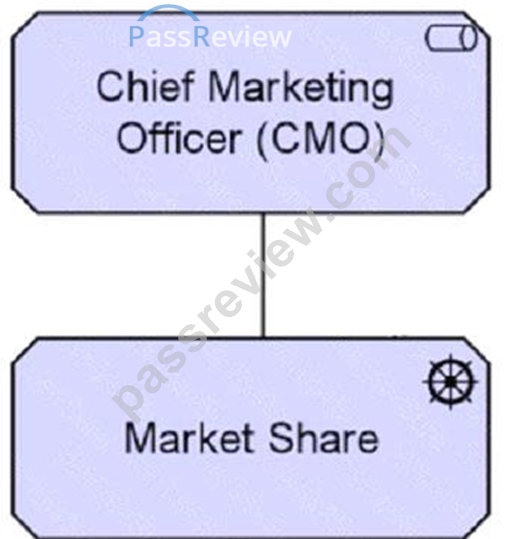
- A. The CMO has a goal related to Market Share
- B. The CMO is concerned with the driver Market Share.
- C. The CMO is motivated by the driver Market Share.
- D. The CMO has a requirement to increase Market Share.
Answer: C
Explanation:
According to the ArchiMate 3.2 Specification1, a driver represents an external or internal condition that motivates an organization to define its goals and implement the changes necessary to achieve them. Drivers that are associated with a stakeholder are often called "concerns" of that stakeholder. A stakeholder represents the role of an individual, team, or organization (or classes thereof) that represents their interests in the outcome of the architecture. A motivation element is an element that represents the reasons for designing and implementing an architecture, such as stakeholders, drivers, goals, principles, requirements, or value. A motivation element is denoted by a hexagonal shape.
The diagram below shows a motivation element (driver) named Market Share that influences a stakeholder named CMO. The influence relationship is denoted by a dashed line with an open arrowhead.
The influence relationship means that the driver affects the stakeholder's interests or concerns. Therefore, the best interpretation of the diagram is that the CMO is motivated by the driver Market Share.
NEW QUESTION # 60
Complete the sentence. The passive counterpart of the application component in the application layer is called a(n)_____________
- A. Meaning
- B. Application event
- C. Data object
- D. Product
Answer: C
Explanation:
According to the application layer metamodel, the passive counterpart of the application component is the data object, which represents data structured for automated processing. A data object can be accessed or manipulated by an application component or an application function.
References: ArchiMate 3.2 Specification, Chapter 8: Application Layer1; Application Layer in ArchiMate Part 1 - Metamodel2.
NEW QUESTION # 61
Consider the following symbol, which represents information about a transformation project at ArchiSurance involving systems and business processes: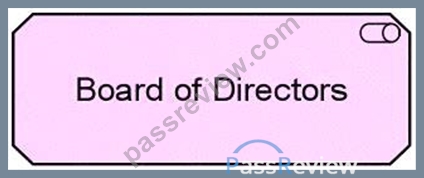
Which of the following statements correctly expresses the meaning of the symbol?
- A. The Board of Directors has concerns about the project
- B. The transformed systems will store information of interest to the Board of Directors
- C. The Board of Directors has a business role in the project
- D. The Board of Directors will use the transformed systems
Answer: A
NEW QUESTION # 62 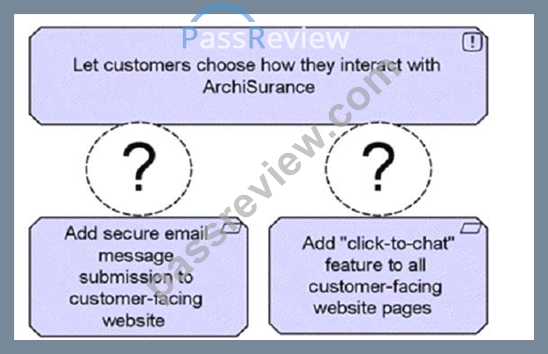
Which of the following is the correct relationship between the bottom elements and the top element?
- A. Aggregation
- B. Access
- C. Specialization
- D. Realization
Answer: A
Explanation:
Based on the ArchiMate 3 documents or objectives, an aggregation relationship indicates that an element groups a number of other concepts. The aggregation relationship has been inspired by the aggregation relationship in UML class diagrams. Unlike composition, aggregation does not imply an existence dependency between the aggregating and aggregated concepts. The notation for an aggregation relationship is a solid line with an empty diamond at the end that points to the whole element. The diagram uses an aggregation relationship from the bottom elements to the top element to indicate that the top element groups the bottom elements.
References: ArchiMate 3.2 Specification, Chapter 5 Relationships, Section 5.1 Structural Relationships 1; Structural Relationship: Part 3 - ArchiMate Resources for FREE 2.
NEW QUESTION # 63
Consider the following symbol, which represents information about a transformation project at ArchiSurance involving systems and business processes:
Which of the following statements correctly expresses the meaning of the symbol?
- A. The Board of Directors has concerns about the project
- B. The transformed systems will store information of interest to the Board of Directors
- C. The Board of Directors has a business role in the project
- D. The Board of Directors will use the transformed systems
Answer: A
NEW QUESTION # 64
Consider the diagram showing astandard server configurationatArchiSurance: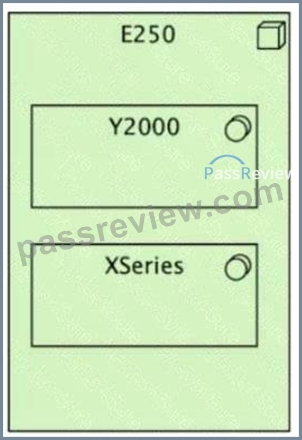
(A diagram depictingE250 as a node, containingY2000 and XSeriesas internal components.) Which of the following correctly describes the diagram?
- A. TheE250 node is running internally-developed Y2000 software for enterprise risk analysis and is fitted with an XSeries custom disk array.
- B. TheE250 is an assembly of Y2000 processing units and XSeries high-speed memory.
- C. TheE250 node is running Y2000 middleware and the XSeries operating system.
- D. TheE250 device is fitted with the Y2000 software application and the XSeries communication middleware.
Answer: C
Explanation:
Comprehensive and Detailed In-Depth Explanation:
ThisArchiMate Technology Layer diagramrepresents aserver configuration, where:
* E250is modeled as aTechnology Node(a physical or virtual server).
* Y2000 and XSeriesare contained withinE250, indicating that they aresoftware components running on this node.
* Therelationship suggests that Y2000 is middleware and XSeries is an operating system.
InArchiMate 3.2, aTechnology Noderepresents acomputing platform that hosts software elements like applications, middleware, and operating systems.
Analysis of Answer Choices:
#A. The E250 is an assembly of Y2000 processing units and XSeries high-speed memory.##Incorrect
* E250 is a Technology Node (server), not just hardware components.
* Y2000 and XSeries are software components, not processing units or memory modules.
#B. The E250 node is running internally-developed Y2000 software for enterprise risk analysis and is fitted with an XSeries custom disk array.##Incorrect
* There is no indication that XSeries is a disk array; rather, it appears to be software.
* The diagram shows Y2000 and XSeries as software components inside E250, not as hardware attachments.
#C. The E250 device is fitted with the Y2000 software application and the XSeries communication middleware.##Incorrect
* Middleware typically supports application integration, while operating systems manage hardware resources.
* The diagram suggests that XSeries functions as an OS, not middleware.
#D. The E250 node is running Y2000 middleware and the XSeries operating system.##Correct Answer
* This matches typical server configurations where a middleware application runs on top of an operating system.
* Y2000 (middleware) handles enterprise risk analysis functions, while XSeries (operating system) manages the E250 server.
* ArchiMate 3.2 Specification, Section 6.6.5, defines Middleware as software that facilitates integration between applications and the underlying OS.
#D. The E250 node is running Y2000 middleware and the XSeries operating system.
References:
* ArchiMate 3.2 Specification: Sections 6.6.1 (Technology Nodes), 6.6.5 (Middleware), and 6.6.6 (Operating Systems).
* Archi User Guide: Modeling technology infrastructure and server configurations.
NEW QUESTION # 65
Consider the diagram: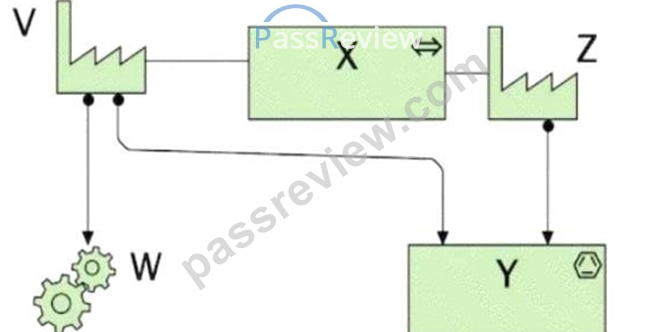
(A diagram showingV, W, X, and Ywhere:
* Vhas a factory-like symbol.
* Whas a gear-like symbol.
* Xis connected toY, which has a transportation-related symbol.)
What are elementsV, W, and X?
- A. V = Production process, W = Finished Material, X = Transport network
- B. V = Factory, W = Raw material, X = Transportation
- C. V = Facility, W = Equipment, X = Distribution network
- D. V = Equipment, W = Facility, X = Distribution channel
Answer: B
Explanation:
Comprehensive and Detailed In-Depth Explanation:
ThisArchiMate Physical Layer diagramrepresentslogistics and supply chain operations. The elements in the diagram align withphysical infrastructure conceptsused inArchiMate 3.2.
Understanding the Diagram Elements:
* V (Factory symbol)# Represents aFactory or Production Facility, where goods are manufactured.
* W (Gear symbol)# RepresentsRaw Material or Equipmentthat isused in production.
* X (Network or Transportation symbol)# RepresentsTransportation or a Distribution networkfor moving goods.
* Y (End-point receiving goods)# Represents alogistics center, warehouse, or transportation endpoint
.
This matchesoption D, where:
* V = Factory# The starting point of manufacturing.
* W = Raw material# Essential input for production.
* X = Transportation# Moving products to distribution centers.
Analysis of Answer Choices:
#A. V = Production process, W = Finished Material, X = Transport network##Incorrect
* V is not a process; it is aphysical location (Factory).
* W represents raw material, not finished material.
* X represents transportation, but V is wrongly classified as a process.
#B. V = Equipment, W = Facility, X = Distribution channel##Incorrect
* V represents a Facility (Factory), not just Equipment.
* W represents raw material, not a Facility.
* X is more of a transportation network rather than a distribution channel.
#C. V = Facility, W = Equipment, X = Distribution network##Incorrect
* W represents raw material, not just Equipment.
* X represents Transportation, not strictly a distribution network.
#D. V = Factory, W = Raw material, X = Transportation##Correct Answer
* This is the best match with the diagram's physical elements.
* V (Factory) is the production source.
* W (Raw material) is used in production.
* X (Transportation) is the means of moving goods.
* ArchiMate 3.2 Specification, Section 7.7, definesFacilities, Materials, and Transportation as part of the Physical Layer modeling concepts.
#D. V = Factory, W = Raw material, X = Transportation.
References:
* ArchiMate 3.2 Specification: Sections 7.7 (Facilities & Physical Elements), 7.8 (Material Flow), and 7.9 (Distribution & Logistics).
* Archi User Guide: Modeling physical infrastructure in enterprise architecture.
NEW QUESTION # 66
Complete following sentence: In the generic metamodel the main types of elements can be divided into
- A. resources and events
- B. structure and behavior
- C. grouping and location
- D. process and function
Answer: B
Explanation:
Based on the ArchiMate 3 documents or objectives, the generic metamodel defines two main types of elements: structure and behavior. Structure elements represent the structural concepts that model the static construction or composition of concepts of the same or different types. Behavior elements represent units of activity performed by one or more active structure elements.
References: ArchiMate 3.2 Specification, Chapter 4 Generic Metamodel, Section 4.1 Behavior and Structure Elements 1; ArchiMate 3.0.1 Specification - The Open Group 2.
NEW QUESTION # 67
Consider the following diagram: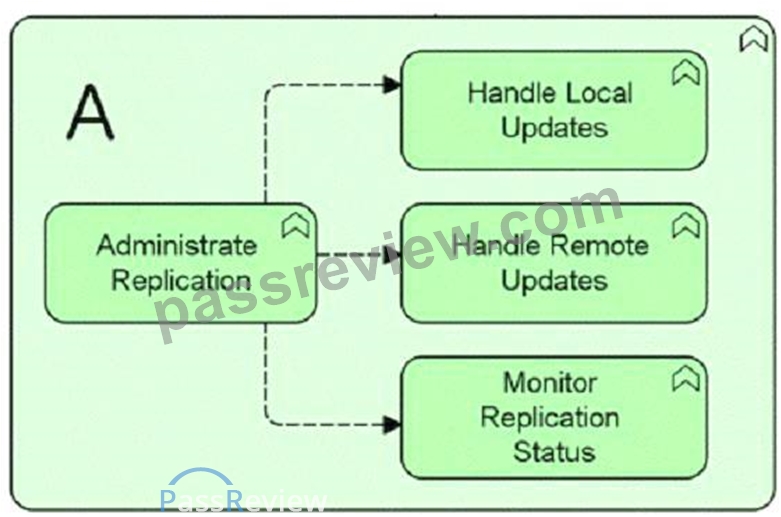
What correctly describes this diagram?
- A. Technology function A is composed of four technology functions. Information flows from Administrate Replication to the other functions.
- B. Technology function A is composed of four technology processes. The technology process Administrate Replication reads information from the three other processes.
- C. Technology process A aggregates four technology services. The Administrate Replication service is broken down into three other services.
- D. Four technology functions realize technology function A The first function Administrate Replication triggers the other three functions in parallel
Answer: A
Explanation:
Based on the ArchiMate 3 documents or objectives, a technology function represents a collection of technology behavior that can be performed by a node. The diagram uses a composition relationship to indicate that technology function A consists of four other technology functions. The notation for a composition relationship is a solid line with a filled diamond at the end that points to the whole element. The diagram also uses an information flow relationship to indicate that information is exchanged from Administrate Replication to the other functions. The notation for an information flow relationship is a dashed line with an open arrowhead at the end that points to the direction of the flow.
References: ArchiMate 3.2 Specification, Chapter 4 Generic Metamodel, Section 4.1 Behavior and Structure Elements, Subsection 4.1.2 Structural Relationships 1; ArchiMate 3.2 Specification, Chapter 11 Technology Layer, Section 11.2 BehaviorElements 1; ArchiMate 3.2 Specification, Chapter 5 Relationships, Section 5.5 Other Relationships 1; ArchiMate Patterns - Technology Layer - General Geekery
2.
NEW QUESTION # 68
Which answer correctly describes the four elements (A, B, C, and D) shown in this diagram?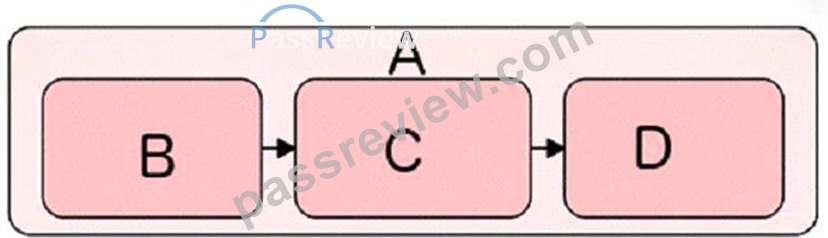
- A. Project components
- B. A plateau and deliverables
- C. Work packages
- D. Business processes
Answer: C
Explanation:
The diagram shows a work package, which is a grouping of behavior and/or structure elements that can be assigned to one or more performers. A work package can be used to model a project or a program, and it can contain deliverables, which are outcomes of the work package. The four elements (A, B, C, and D) are all deliverables that are part of the work package.
References: ArchiMate 3.2 Specification, Chapter 10: Motivation Elements, Section 10.4 Work Package1; Chapter 11: Strategy Elements, Section 11.5 Deliverable2.
NEW QUESTION # 69
Which of the following is the correct relationship between the bottom elements and the top element?
- A. Aggregation
- B. Access
- C. Specialization
- D. Realization
Answer: A
Explanation:
Based on the ArchiMate 3 documents or objectives, an aggregation relationship indicates that an element groups a number of other concepts. The aggregation relationship has been inspired by the aggregation relationship in UML class diagrams. Unlike composition, aggregation does not imply an existence dependency between the aggregating and aggregated concepts. The notation for an aggregation relationship is a solid line with an empty diamond at the end that points to the whole element. The diagram uses an aggregation relationship from the bottom elements to the top element to indicate that the top element groups the bottom elements.
NEW QUESTION # 70
Complete the sentence. According to the top-level hierarchical structure of the ArchiMate Language, a model is considered to be __.
- A. A collection of concepts
- B. A set of elements
- C. An assembly of views
- D. An arrangement of relationships
Answer: A
Explanation:
Comprehensive and Detailed in Depth Explanation:AnArchiMate modelconsists ofa structured collection of conceptsthat represent enterprise architecture. These concepts includeactive structure, behavior, and passive structure elements, along with their relationships.
Amodel is not just a set of elements or relationships, but rather aconceptual frameworkthatrepresents an enterprise architecture holistically.
TheArchiMate 3.2 Specificationstates that anArchiMate model is a collection of interrelated concepts that define and describe enterprise architectures.
References:
* Archi User Guide
* ArchiMate 3.2 Specification
NEW QUESTION # 71
In the Application Layer metamodel, what is the relationship type from an application service to a data object?
- A. Aggregation
- B. Composition
- C. Realization
- D. Access
Answer: D
NEW QUESTION # 72
Which of the following answers best interprets the diagram?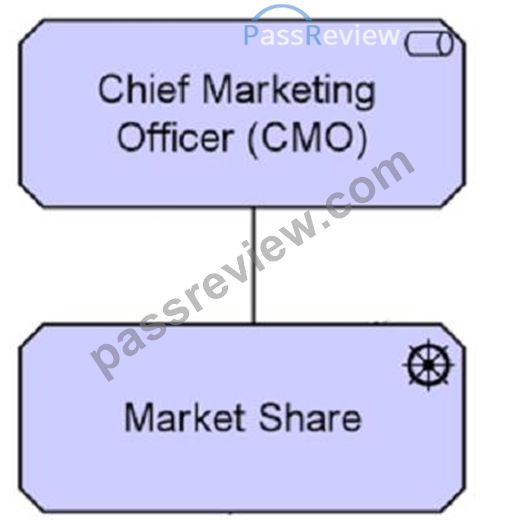
- A. The CMO has a goal related to Market Share
- B. The CMO is concerned with the driver Market Share.
- C. The CMO is motivated by the driver Market Share.
- D. The CMO has a requirement to increase Market Share.
Answer: C
Explanation:
According to the ArchiMate 3.2 Specification1, a driver represents an external or internal condition that motivates an organization to define its goals and implement the changes necessary to achieve them. Drivers that are associated with a stakeholder are often called "concerns" of that stakeholder. A stakeholder represents the role of an individual, team, or organization (or classes thereof) that represents their interests in the outcome of the architecture. A motivation element is an element that represents the reasons for designing and implementing an architecture, such as stakeholders, drivers, goals, principles, requirements, or value. A motivation element is denoted by a hexagonal shape.
The diagram below shows a motivation element (driver) named Market Share that influences a stakeholder named CMO. The influence relationship is denoted by a dashed line with an open arrowhead.
The influence relationship means that the driver affects the stakeholder's interests or concerns. Therefore, the best interpretation of the diagram is that the CMO is motivated by the driver Market Share.
NEW QUESTION # 73
......
Use Real The Open Group Achieve the OGA-031 Dumps - 100% Exam Passing Guarantee: https://getfreedumps.passreview.com/OGA-031-exam-questions.html