

Network Appliance NS0-185 Real Exam Questions Guaranteed Updated Dump from PassReview
Verified Pass NS0-185 Exam in First Attempt Guaranteed
NEW QUESTION # 32
A customer has a six-node cluster running NFS and FCP. The customer wants to add nodes to the cluster.
How many nodes would be added in this scenario?
- A. 0
- B. 1
- C. 2
- D. 3
Answer: A
Explanation:
Explanation (250-350 words):
ONTAP clusters support amaximum of 24 nodesper cluster. In this scenario, the cluster already hassix nodes running mixed NAS (NFS) and SAN (FCP) workloads. When expanding an ONTAP cluster, NetApp best practices and installation rules strongly recommend adding nodesin HA pairsto maintain balanced high availability, performance symmetry, and consistent failover behavior.
Because nodes must be added in pairs, the cluster can scale from six nodes to eight, ten, twelve, and so on, up to the 24-node limit. However, the question is asking how many nodeswould be added, not the maximum supported. The standard NetApp expansion model for a six-node cluster is to addanother three HA pairs, which equalssix additional nodes, bringing the cluster to twelve nodes.
Adding only two or four nodes would result in uneven scaling and is not the standard recommended growth pattern for clusters of this size. Adding eighteen nodes would exceed practical expansion planning for a six- node system and approach the cluster maximum without justification.
Therefore, the correct answer is6.
NEW QUESTION # 33
After the Installation of a new NetApp FAS system, you use theNetAppDocs tool for site design documentation.
In this scenario, in which three document formats would you create an inventory report? (Choose three.)
- A. .docx
- B. .ps
- C. .html
- D. .xlsx
- E. .pdf
Answer: A,D,E
Explanation:
The NetAppDocs tool is a PowerShell module that contains a set of functions to automate the creation of NetApp site design documentation. NetAppDocs can generate Excel, Word and PDF document types. The data contained in the output documents can be sanitized for use in sites where the data may be sensitive. NetAppDocs can also generate a 'Differences Report' for change management purposes.
NEW QUESTION # 34
Which command would be used to measure the throughput and latency of traffic between nodes?
- A. statistics node show
- B. network test-path
- C. qos statistics workload performance show
- D. cluster ping-cluster
Answer: D
Explanation:
The cluster ping-cluster command is specifically designed to testinter-node cluster network connectivity, includinglatency, packet loss, and throughputbetween cluster nodes. This command generates synthetic traffic over the cluster interconnect and measures performance characteristics that directly affect cluster health and stability.
The command is commonly used duringpost-installation validation, cluster expansion, and troubleshooting scenarios involving cluster network performance. It provides insight into whether the cluster interconnect is operating within expected parameters.
Other commands listed do not provide this functionality. QoS workload statistics focus on application-level performance, network test-path validates reachability for LIF failover paths, and statistics node show reports internal node counters rather than inter-node network performance.
Therefore, the correct answer isB.
NEW QUESTION # 35
Your customer wants to know more about the network configuration within the cluster. In this scenario, which statement is correct about a LIF?
- A. A LIF is a port that provides physical connections.
- B. A LIF is an IP address or a WWPN that is associated with a port.
- C. A LIF is created within a broadcast domain and contains a pool of IP address.
- D. A LIF separates network domains to access cluster data.
Answer: B
Explanation:
https://library.netapp.com/ecmdocs/ECMP1141204/html/GUID-039A758B-E5A3-4085-B808-
8573E5572B64.html
A LIF (logical interface) is an IP address with associated characteristics.
NEW QUESTION # 36
You are preparing to install a new 2-node AFF A250 system at a customer site with an existing cluster that uses NetApp CN1610 cluster interconnect switches.
In this scenario, what are two valid actions for this installation? (Choose two.)
- A. Create a new 2-node switched cluster that uses the CN1610 cluster switches.
- B. Migrate the existing cluster to new switches and add the new nodes.
- C. Create a new 2-node switchless cluster.
- D. Add the new nodes to the existing cluster and switches.
Answer: A,C
Explanation:
AFF A250 systems are not supported on CN1610 cluster switches. Therefore, they cannot be added to an existing cluster that uses those switches. Valid options are to either create a new switched cluster using the CN1610 switches (if supported for that configuration) or deploy the AFF A250 as a switchless 2-node cluster.
NEW QUESTION # 37
Which license is required to enable storage failover?
- A. CFO
- B. LC
- C. no license is required
- D. SFO
Answer: C
Explanation:
Storage failover is acore ONTAP featureand does not require a separate license. As long as the hardware supports HA and the system is properly cabled and configured, storage failover is available by default.
Therefore,no license is required.
NEW QUESTION # 38
A customer wants to protect data using point-in-time copies. Which two ONTAP features provide snapshot-based data protection and quick recovery options?
- A. VLAN tagging
- B. LIF failover
- C. SnapRestore
- D. Snapshot copies
Answer: C,D
Explanation:
Snapshot copies capture point-in-time data states, and SnapRestore enables rapid recovery.
VLAN tagging and LIF failover are networking features unrelated to data protection.
NEW QUESTION # 39
You are preparing for the installation of a new ONTAP 9.8 cluster and need to get the preinstallation information from the customer.
In this scenario, which NetApp tool would you use to create a configuration spreadsheet template for the deployment?
- A. Active IQ Config Advisor
- B. Active IQ Unified Manager
- C. ConfigBuilder
- D. Interoperability Matrix Tool
Answer: C
Explanation:
https://configbuilder.netapp.com/Index.aspx
NEW QUESTION # 40
What should you do to change the data protocol of a LIF?
- A. Shut down the assigned port.
- B. Put the LIF in another broadcast domain.
- C. Delete and re-recreate the LIF.
- D. Add the new data protocol to the LIF.
Answer: C
Explanation:
You cannot modify the data protocols used by an FC LIF. However, you can modify the services assigned to a service policy or change the service policy assigned to an IP LIF.
To modify the data protocols used by a FC LIF, you must delete and re-create the LIF. To make service policy changes to an IP LIF, there is a brief outage while the updates occur.
NEW QUESTION # 41
A customer wants to separate management traffic from data traffic to improve security and performance. Which two configuration steps should be implemented in ONTAP networking to achieve proper traffic isolation?
- A. Configure SnapMirror replication
- B. Create separate broadcast domains
- C. Use distinct VLANs
- D. Enable deduplication
Answer: B,C
Explanation:
Broadcast domains and VLANs allow logical and physical segmentation of network traffic, improving performance and security. Deduplication and SnapMirror are storage optimization and replication features that do not affect network traffic separation.
NEW QUESTION # 42
You are preparing for an installation of a new 4-node cluster that uses Cisco Nexus 3232C switches. Which two files should be downloaded and from where? (Choose two.)
- A. RCF, from the Cisco Support site
- B. current validated NX-OS, from the NetApp Support Site
- C. current validated NX-OS, from the Cisco Support site
- D. RCF, from the NetApp Support Site
Answer: C,D
Explanation:
https://docs.netapp.com/us-en/ontap-systems-switches/switch-cisco-3232c/setup-switch.html
NEW QUESTION # 43
A storage administrator needs to monitor cluster health and performance. Which two ONTAP tools or features provide insights into system status and help identify potential issues?
- A. ONTAP CLI system health commands
- B. LUN mapping
- C. Active IQ Unified Manager
- D. CIFS shares
Answer: A,C
Explanation:
Active IQ Unified Manager and CLI health commands provide monitoring and diagnostics. CIFS shares and LUN mapping relate to data access, not system monitoring.
NEW QUESTION # 44
During installation, you must configure networking for internal cluster communication. Which two components are required to ensure proper communication between nodes and maintain cluster health in an ONTAP environment?
- A. Cluster LIFs
- B. CIFS shares
- C. Cluster interconnect switches
- D. Data LIFs
Answer: A,C
Explanation:
Cluster LIFs handle node-to-node communication, while interconnect switches provide physical connectivity. Data LIFs serve client access, and CIFS shares operate at the application level, making them irrelevant for internal cluster communication.
NEW QUESTION # 45
During installation, you need to configure time synchronization across all nodes. Which two configurations ensure consistent time settings and prevent authentication or logging issues?
- A. Set correct time zone
- B. Configure NTP servers
- C. Configure SnapMirror relationships
- D. Create aggregates
Answer: A,B
Explanation:
NTP ensures accurate time synchronization, while correct time zone settings maintain consistency across logs and services. Aggregates and SnapMirror do not affect system time configuration.
NEW QUESTION # 46
You are configuring networking for a new AFF A800 cluster that runs ONTAP 9.8 software. You notice that newly created interface groups and VLAN interfaces are placed into broadcast domains by the system. In this scenario, what provides this function?
- A. interface auto revert
- B. IPspaces
- C. Interface failover groups
- D. automatic port placement
Answer: D
Explanation:
https://docs.netapp.com/us-en/ontap/networking/configure_vlans_over_physical_ports.html
NEW QUESTION # 47
You installed a new 4-node AFF A400 ONTAP 9.8 cluster. The AFF A400 controller data ports were automatically discovered byautomatic port placement.
In this scenario, which two ONTAP network settings were automatically configured? (Choose two.)
- A. broadcast domains
- B. IPspaces
- C. subnets
- D. routes
Answer: A,C
Explanation:
Within the ONTAP SAN implementation and configuration domain,automatic port placementis a key installation feature designed to simplify initial network setup during cluster deployment. In ONTAP 9.8, when controller data ports are discovered, ONTAP automatically analyzes physical port connectivity, speed, and role, and assigns those ports to appropriatebroadcast domainsandsubnets.
Broadcast domains define Layer 2 boundaries and group ports that share the same network reachability.
During installation, ONTAP automatically creates and assigns broadcast domains based on detected network topology and intended port usage. This behavior is explicitly described in NetApp installation objectives as part of reducing manual network configuration during initial setup.
Subnets are also automatically created and associated when automatic port placement is enabled. ONTAP uses subnets to manage pools of IP addresses for data LIF creation. By automatically configuring subnets, ONTAP enables rapid deployment of NAS and SAN data LIFs without requiring administrators to manually define IP address ranges during installation.
By contrast,routesare not automatically configured by automatic port placement. Routes must be explicitly defined by the administrator to control Layer 3 traffic flow between networks. Similarly,IPspacesare logical network containers that must be deliberately designed and created based on multi-tenancy or isolation requirements. IPspaces are never automatically created by ONTAP during installation because they have architectural implications that require administrator intent.
Therefore, the two ONTAP network settings that are automatically configured by automatic port placement are broadcast domainsandsubnets, makingC and Dthe correct answers.
NEW QUESTION # 48
You have set up a new 2-node switchless cluster and want to verify that the failover is configured correctly.
In this scenario, which two commands accomplish this task? (Choose two.)
- A. cluster ha show
- B. storage failover show-takeover
- C. storage failover show
- D. cluster ring show
Answer: A,C
Explanation:
To verify failover in a two-node ONTAP configuration, you must confirm both cluster-level HA state (for two-node clusters) and storage failover state (takeover/giveback readiness) for the HA pair.
The commandcluster ha showis used to verify the cluster HA status, which is especially relevant in two-node clusters where cluster HA can affect whether services remain available when one node is halted/rebooted.
ONTAP documentation notes behaviors specific to two-node clusters and cluster HA, including the importance of proper HA configuration to avoid both nodes stopping data service under certain halt/reboot conditions.
The commandstorage failover showis the primary command to verify HA pair readiness, showing takeover
/giveback capability, partner connectivity, and status indicators needed to confirm that storage failover is configured correctly.
Option C (cluster ring show) is a cluster database/ring status diagnostic command; while it can be useful in troubleshooting quorum or RDB-related issues, it is not the standard command pair for verifying HA failover configuration correctness after installation. Option D (storage failover show-takeover) is not the common baseline verification command cited for confirming general failover configuration; it is more takeover-output oriented rather than providing the full readiness overview that storage failover show provides.
Therefore, the two commands that accomplish correct failover verification in this scenario areA. cluster ha showandB. storage failover show.
NEW QUESTION # 49
Exhibit.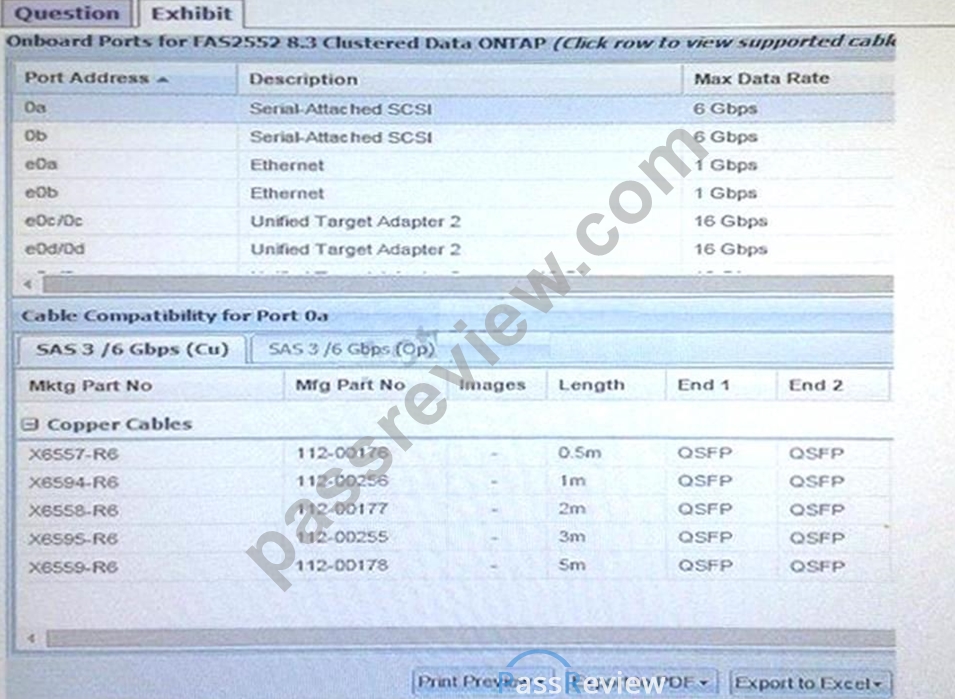
You are installing a FAS2254 and a DS2246 disk shelf at a customer's site. The controller and disk shelf must be racked in separate rows in the data center due to available space.
The customer wants you to use two of the 20-meter copper SAS cables to make connections. Referring to the exhibit, which statement is correct?
- A. The controller and disk shelf must be closer together if copper cables are to be used.
- B. You will need to contact sales to obtain the 20 meter copper cables.
- C. You will need to contact sales to obtain an Ethernet adapter.
- D. You will need to contact sales to obtain a wireless adapter.
Answer: A
Explanation:
This question tests installation cabling constraints and supported cabling media for SAS connectivity. The key issue is distance: the customer wants to use20-meter copper SAS cablesbetween a controller and a shelf that are installed in separate rows.
NetApp hardware cabling guidance indicates that when long distance SAS connectivity is required, the supported approach is to useSAS optical cabling(for applicable platforms and shelf/IOM combinations). The ONTAP hardware systems documentation describes "mini-SAS HD SAS optical cable rules," noting that optical AOC SAS cables are available in lengths up to50 metersfor controller-to-stack and shelf-to-shelf connections in supported configurations. This highlights a critical installation principle: long SAS runs are addressed withoptical, not copper.
The documentation also establishes that SAS cabling within a stack must be consistent (all copper or all optical) and that mixed approaches have specific constraints. While the excerpt emphasizes optical rules (because optical is the mechanism for long distance), it implicitly reinforces that copper has practical distance limitations and is not the long-distance solution.
Therefore, if the customer insists on copper SAS, the correct guidance is thatthe controller and disk shelf must be closer togetherto remain within supported copper SAS distance limits and to ensure signal integrity and supported operation. Option B is incorrect because simply "obtaining" 20-meter copper SAS cables does not make the configuration supported. Option D is incorrect because Ethernet adapters do not replace SAS for shelf connectivity. Option A is nonsensical in this context because SAS shelf connectivity cannot be replaced by a "wireless adapter" as a supported installation practice.
Thus, the correct answer isC: if copper cables are to be used, the devices must be closer together; otherwise the supported solution is to use a supported SAS optical approach.
NEW QUESTION # 50
You are expanding an existing 4-node ONTAP 9.8 cluster with a FAS8300 HA pair by adding a new FAS500f HA pair. Before the expansion, you are asked to save the configuration of the cluster to a backup file.
In this scenario, which two ONTAP configuration backup methods are available? (Choose two.)
- A. cluster
- B. node
- C. switch
- D. storage VM
Answer: A,B
Explanation:
Before you expand a cluster, you should use advanced privilege to create a backup file to save the cluster configuration information and optionally save the node configurations.
https://docs.netapp.com/us-en/ontap-sm-
classic/expansion/task_backing_up_cluster_configuration.html
NEW QUESTION # 51
You have completed a base installation and system registration of an AFF A250 system, but you notice that you have one failed drive. Neither un-failing nor reseating the drive repaired it.
In this scenario, which two actions should you take? (Choose two.)
- A. Ask the customer to open a technical case with NetApp Support.
- B. Power off the system until the drive has been replaced.
- C. Ask the customer for a drive with the same capacity and replace it.
- D. Run Active IQ Config Advisor to collect all the logs on the system.
Answer: A,D
NEW QUESTION # 52
You were asked to install a FAS9000 with two quad-port SAS PCI cards installed in slot 9 and slot 1.
In this scenario, which ports are used for the second stack?
- A. 9a/1d
- B. 9b/1b
- C. 9a/1a
- D. 9c/1a
Answer: D
Explanation:
NetApp SAS cabling rules define port sequencing. The second stack uses9c and 1a, makingBcorrect.
NEW QUESTION # 53
Click the Exhibit button. You want to add an AFF A400 system to an existing 4-node cluster.
Referring to the exhibit, which number points to the ports that are used to cable the new nodes to the cluster interconnect switches.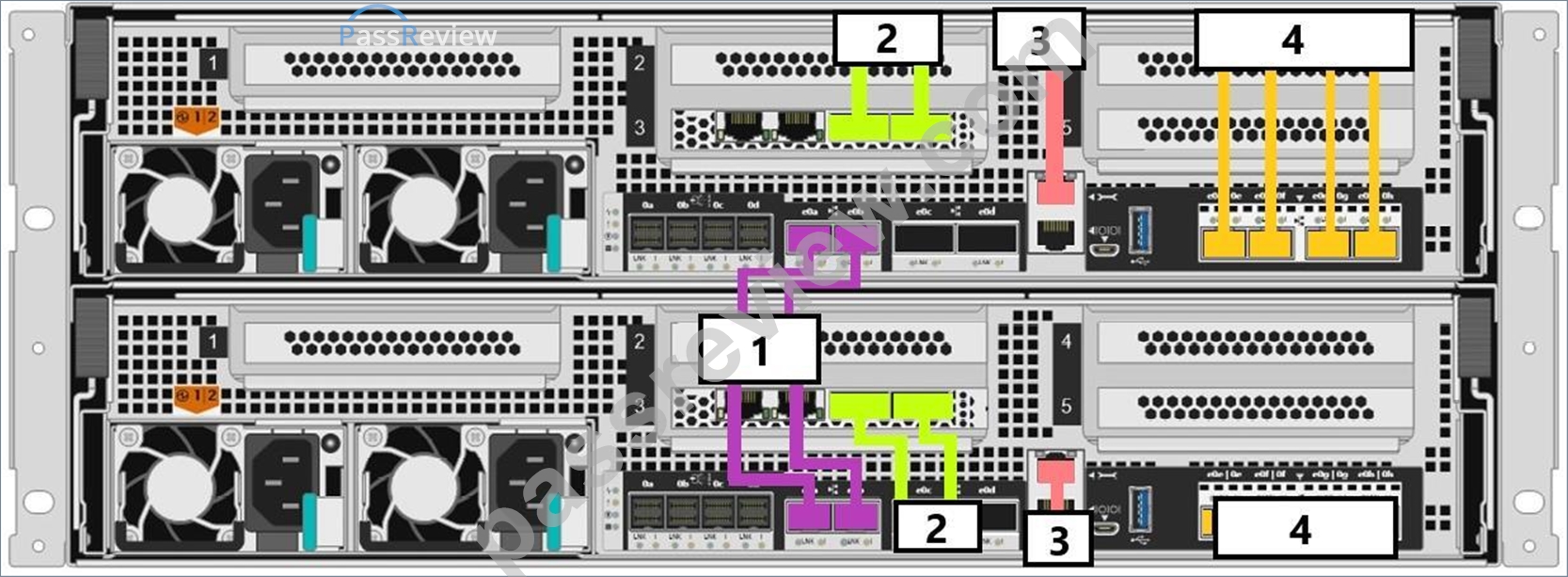
- A. 0
- B. 1
- C. 2
- D. 3
Answer: A
Explanation:
Port e3a and e3b are used for interconnect switches.
https://docs.netapp.com/us-en/ontap-systems/a400/install-detailed-guide.html#option-2-cable-a- switched-cluster
NEW QUESTION # 54
You have completed a NetApp ONTAP installation and the customer asks you how they can open a Pl case with NetApp Support. In this scenario, what should you tell the customer?
- A. Contact support through the NetApp Digital Advisor.
- B. Contact NetApp Support online at mysupport.netapp.com.
- C. Use the telephone to call NetApp Support.
- D. Request a call back using the autosupport trigger command.
Answer: B
Explanation:
https://kb.netapp.com/Support/General_Support/How_to_open_a_technical_case
NEW QUESTION # 55
To ensure that your customer's cluster is robust and operational, you need to be familiar with configuration best practices.
Which three practice rules should you always follow? (Choose three.)
- A. All power supply units should be plugged into the same power grid.
- B. Do not use the root aggregate for storing data.
- C. Keep all nodes in the cluster on the same version of ONTAP.
- D. Remove failed disk drives once a year to maintain minimum interruption in controller stability.
- E. Use LIFs with defined failover policies.
Answer: B,C,E
Explanation:
ONTAP SAN solution assessment requires adherence to proven configuration best practices to ensure availability, resiliency, and supportability.
First,all nodes must run the same ONTAP version. Mixed-version clusters are only permitted temporarily during upgrades. Running different versions long-term can cause compatibility issues and is not supported as a steady-state configuration.
Second,LIFs must have defined failover policies. Proper LIF failover ensures that network access is maintained during port, node, or network failures. This is a foundational availability principle in ONTAP networking design.
Third,the root aggregate must never be used for data storage. The root aggregate is reserved exclusively for system metadata and cluster operations. Storing user data on the root aggregate can compromise system stability and is explicitly prohibited in NetApp best practices.
Removing failed disks annually is incorrect; failed disks must be replaced immediately. Plugging all power supplies into the same power grid eliminates redundancy and violates high-availability design principles.
Therefore, the correct answers areA, B, and E.
NEW QUESTION # 56
You want to enable secure communication with the SP or BMC through CA-signed certificates.
Which two certificate types must be installed in this scenario? (Choose two.)
- A. root CA certificate
- B. ONTAP certificate
- C. server certificate
- D. cluster certificate
Answer: A,C
Explanation:
https://docs.netapp.com/us-en/ontap/authentication/install-ca-signed-server-digital-certificate- task.html
https://kb.netapp.com/Advice_and_Troubleshooting/Data_Storage_Software/ONTAP_OS/How_to
_configure_communication_between_ONTAP_and_Service_Processor_(SP)_or_BMC_with_Cert ificate_Authority_(CA)_signed_certificates
NEW QUESTION # 57
......
Download Real Network Appliance NS0-185 Exam Dumps Test Engine Exam Questions: https://getfreedumps.passreview.com/NS0-185-exam-questions.html