

JN0-336 Dumps - Grab Out For [NEW-2025] Juniper Exam
JN0-336 Exam Dumps PDF Guaranteed Success with Accurate & Updated Questions
NEW QUESTION # 21
What are two benefits of using a vSRX in a software-defined network? (Choose two.)
- A. scalability
- B. granular security
- C. no required software license
- D. infinite number of interfaces
Answer: A,B
Explanation:
- Scalability: vSRX instances can be easily added or removed as the needs of the network change, making it a flexible option for scaling in a software-defined network.
- Granular Security: vSRX allows for granular security policies to be enforced at the virtual interface level, making it an effective solution for securing traffic in a software-defined network.
The two benefits of using a vSRX in a software-defined network are scalability and granular security.
Scalability allows you to increase the number of resources available to meet the demands of network traffic, while granular security provides a level of control and flexibility to your network security that is not possible with a traditional firewall. With a vSRX, you can create multiple levels of security policies, rules, and access control lists to ensure that only authorized traffic can enter and exit your network.
Additionally, you would not require a software license to use the vSRX, making it an economical solution for those looking for increased security and flexibility.
NEW QUESTION # 22
When a security policy is deleted, which statement is correct about the default behavior of active sessions allowed by that policy?
- A. The active sessions allowed by the policy will continue
- B. The active sessions allowed by the policy will be marked as a legacy flow and will continue to be forwarded.
- C. The active sessions allowed by the policy will be dropped.
- D. The active sessions allowed by the policy will be reevaluated by the cached
Answer: B
Explanation:
When a security policy is deleted, the existing sessions that were previously allowed by that policy are not immediately dropped; instead, they are typically treated as legacy flows. This means they are allowed to continue until they naturally end or until the session timeout is reached. This behavior ensures that deleting a policy does not abruptly disrupt ongoing traffic flows that were previously authorized by that policy. This approach helps in avoiding unintended service disruptions, especially in production environments where active connections may be critical to operations.
NEW QUESTION # 23
Which two statements about SRX Series device chassis clusters are true? (Choose two.)
- A. Chassis cluster member devices must be the same model.
- B. Each chassis cluster member requires a unique cluster ID value.
- C. Redundancy group 0 is only active on the cluster backup node.
- D. Each chassis cluster member device can host active redundancy groups
Answer: A,D
Explanation:
In a chassis cluster, both nodes can host active redundancy groups. The active redundancy groups can be distributed between the two nodes, depending on the configuration and failover status, allowing each node to handle traffic for different sets of services or interfaces.
For the chassis clustering to function correctly, both nodes in the cluster must be of the same model.
This requirement ensures that the hardware capabilities, such as processing power and interface compatibility, are identical, which is crucial for maintaining consistent performance and behavior between cluster nodes.
NEW QUESTION # 24
Exhibit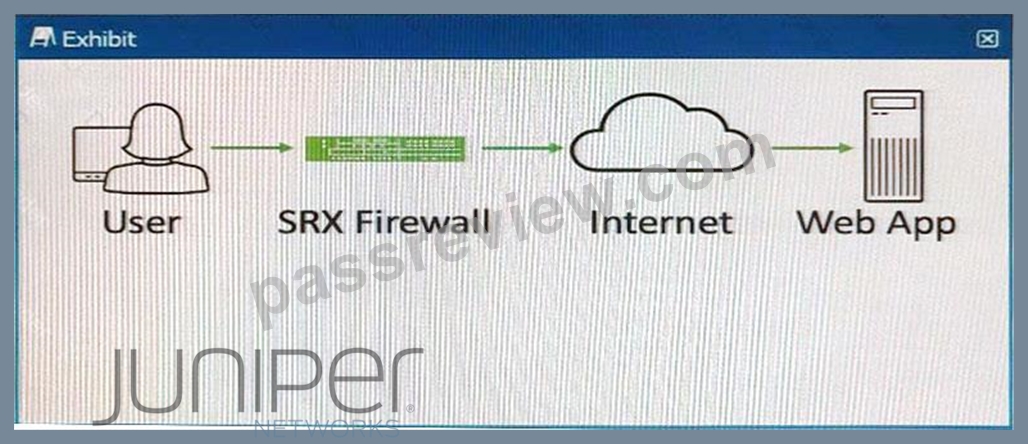
Referring to the exhibit, which two statements describe the type of proxy used? (Choose two.)
- A. forward proxy
- B. client protection proxy
- C. reverse proxy
- D. server protection proxy
Answer: A,C
Explanation:
In the exhibit, the SRX Firewall could be acting as a forward proxy, managing outbound internet requests from internal users or clients within a private network to the internet. Forward proxies are commonly used to control and monitor outbound traffic, provide content caching to improve load times, and enforce company policies.
The scenario can also imply a reverse proxy setup where the SRX Firewall might be configured to direct incoming requests from the internet to the web application. Reverse proxies are used to balance load, enhance security, manage SSL encryption, and provide additional caching functionalities for inbound traffic to servers.
NEW QUESTION # 25
Your network uses a single JSA host and you want to implement a cluster.
In this scenario, which two statements are correct? (Choose two.)
- A. The primary and secondary hosts must be configured with the same storage devices.
- B. The secondary host can backup multiple JSA primary hosts.
- C. The cluster virtual IP will need an unused IP address assigned.
- D. The software versions on both primary and secondary hosts
Answer: C,D
Explanation:
According to the Juniper Networks JNCIP-SEC Study Guide, when setting up a cluster with a single JSA host, both the primary and secondary hosts must have the same software version installed. Additionally, an unused IP address must be assigned to the cluster virtual IP. The primary and secondary hosts do not need to be configured with the same storage devices, and the secondary host cannot be used to backup multiple JSA primary hosts.
NEW QUESTION # 26
You set up the Juniper ATP Appliance solution on your network and notice that the macOS files are not being analyzed......... malware.
In this scenario, what must you do?
- A. Create a macOS virtual machine on the JATP Appliance and install the secondary core software.
- B. Under Config > System Profiles≥Secondary Cores workspace, enable macOs Detection.
- C. Under Config -> System Profiles→≥Secondary Cores workspace, create a macOS profile
- D. You must obtain a Apple Mac Mini device and install the secondary core software.
Answer: C
NEW QUESTION # 27
Exhibit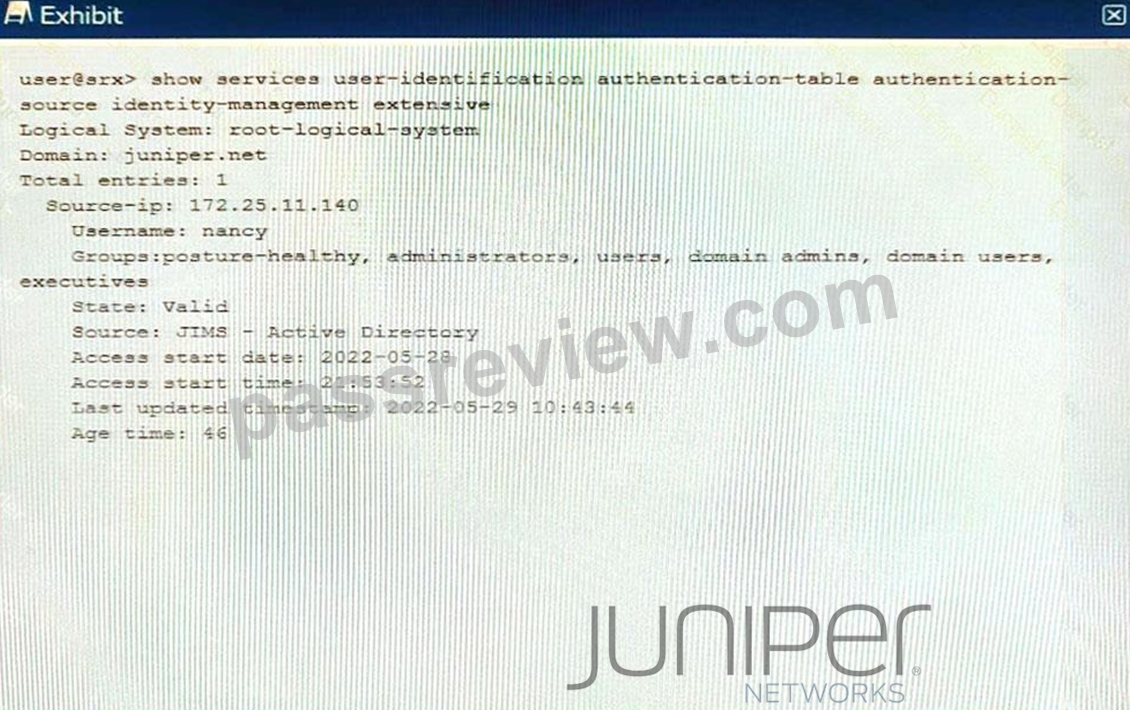
Referring to the exhibit, which two statements are true? (Choose two.)
- A. The IP address of the authenticating domain controller is 172.25.11.140.
- B. Nancy is a member of the Active Directory sales group.
- C. Nancy logged in to the juniper.net Active Directory domain.
- D. The IP address of Nancy's client PC is 172.25.11.
Answer: A,C
NEW QUESTION # 28
Which two statements are correct about security policy changes when using the policy rematch feature? (Choose two.)
- A. When a policy change includes changing the policy's source or destination address match condition, all existing sessions are reevaluated.
- B. When a policy change includes changing the policy's action from permit to deny, all existing sessions are maintained
- C. When a policy change includes changing the policy's source or destination address match condition, all existing sessions are dropped.
- D. When a policy change includes changing the policy's action from permit to deny, all existing sessions are dropped.
Answer: A,D
Explanation:
policy rematch is a feature that enables the device to reevaluate an active session when its associated security policy is modified. The session remains open if it still matches the policy that allowed the session initially. The session is closed if its associated policy is renamed, deactivated, or deleted1.
NEW QUESTION # 29
Click the Exhibit button.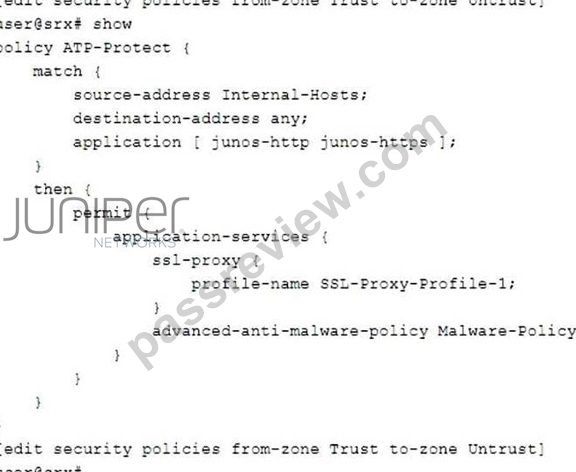
You are asked to create a security policy that will automatically add infected hosts to the infected hosts feed and block further communication through the SRX Series device.
What needs to be added to this configuration to complete this task?
- A. Add logging to the permit portion of the security policy.
- B. Add a match rule to the security policy with an appropriate threat level.
- C. Add an action to the permit portion of the security policy.
- D. Add a security intelligence policy to the permit portion of the security policy.
Answer: D
Explanation:
To create a security policy that will automatically add infected hosts to the infected hosts feed and block further communication through the SRX Series device, you need to add a security intelligence policy to the permit portion of the security policy. A security intelligence policy is a policy that allows you to block or monitor traffic from malicious sources based on threat intelligence feeds from Juniper ATP Cloud or other providers. One of the feeds that you can use is the Infected-Hosts feed, which contains IP addresses of hosts that are infected with malware and communicate with command-and-control servers.
You can create a profile and a rule for the Infected-Hosts feed and specify the threat level and the action to take for the infected hosts. Then, you can link the security intelligence policy with the firewall policy and apply it to the traffic that you want to protect. Reference: = Security Intelligence Overview, Configuring Security Intelligence Policy, Configure the Security Intelligence Policy on the SRX Series Device
NEW QUESTION # 30
Exhibit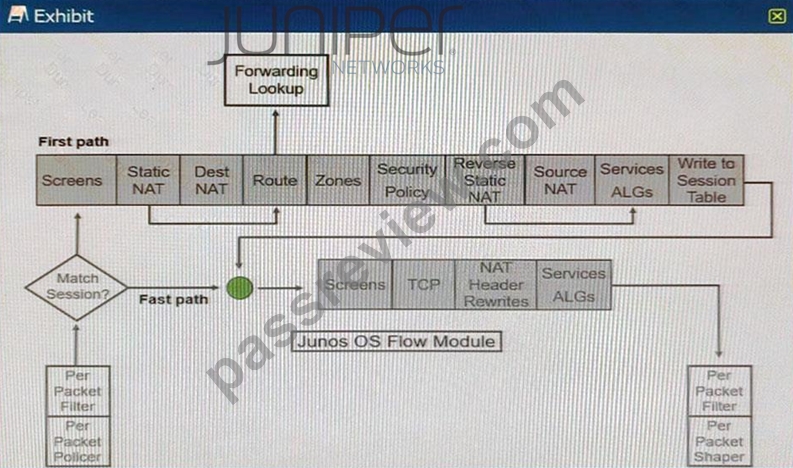
Referring to the SRX Series flow module diagram shown in the exhibit, where is application security processed?
- A. Security Policy
- B. Services ALGs
- C. Screens
- D. Forwarding Lookup
Answer: B
NEW QUESTION # 31
What information does encrypted traffic insights (ETI) use to notify SRX Series devices about known malware sites?
- A. domain names
- B. dynamic address groups
- C. MAC addresses
- D. certificates
Answer: A
Explanation:
Encrypted traffic insights (ETI) uses domain names to notify SRX Series devices about known malware sites. ETI is a feature of the SRX Series firewall that can detect and block malware that is hidden in encrypted traffic. It works by analyzing the domain names of the websites that the encrypted traffic is attempting to access. If the domain name matches a known malware site, ETIwill send an alert to the SRX Series device, which can then take appropriate action to block the traffic. ETI is a useful tool for protecting against threats that attempt to evade detection by hiding in encrypted traffic.
NEW QUESTION # 32
You want to permit access to an application but block application sub.
Which two security policy features provide this capability? (Choose two.)
- A. micro application detection
- B. APPID
- C. URL filtering
- D. content filtering
Answer: A,B
Explanation:
Micro application detection is a feature that enables more granular control over applications by identifying and taking action on sub-features or specific behaviors within an application. For example, allowing access to Facebook while blocking Facebook Chat.
Application Identification (APPID) is a feature that identifies and controls applications based on their traffic patterns and characteristics. APPID can be configured to recognize not only the main application but also its various subcomponents, allowing for precise control over what is allowed or blocked.
NEW QUESTION # 33
You are troubleshooting unexpected issues on your JIMS server due to out of order event log timestamps.
Which action should you take to solve this issue?
- A. Enable time synchronization on the JIMS server.
- B. Enable time synchronization on the domain controllers.
- C. Enable time synchronization on the SRX Series devices.
- D. Enable time synchronization on the client devices.
Answer: B
Explanation:
To solve the issue of out of order event log timestamps on your JIMS server, you should enable time synchronization on the domain controllers. JIMS (Juniper Identity Management Service) is a Windows service that collects user, device, and group information from Active Directory domains or syslog sources and provides it to SRX Series devices and CSO for identity-based security policies. JIMS relies on the timestamps of the event logs generated by the domain controllers to track user logins, logouts, and IP address changes. If the domain controllers have different or inaccurate clocks, the event logs may have out of order or incorrect timestamps, which can cause JIMS to miss or misinterpret some events and affect its accuracy and performance. Therefore, you should ensure that all the domain controllers in your network are synchronized with a reliable time source, such as an NTP server or a Windows Time service. Reference: = Juniper Identity Management Service User Guide, Juniper Identity Management Service Feature Guide, Configure JIMS Collector to Get Microsoft Event Logs, Considerations for timestamps in centralized logging platforms
NEW QUESTION # 34
Which two statements are true about the vSRX? (Choose two.)
- A. UNIX is the base OS.
- B. Linux is the base OS.
- C. It does not have VMXNET3 vNIC support.
- D. It has VMXNET3 vNIC support.
Answer: B,D
NEW QUESTION # 35
Exhibit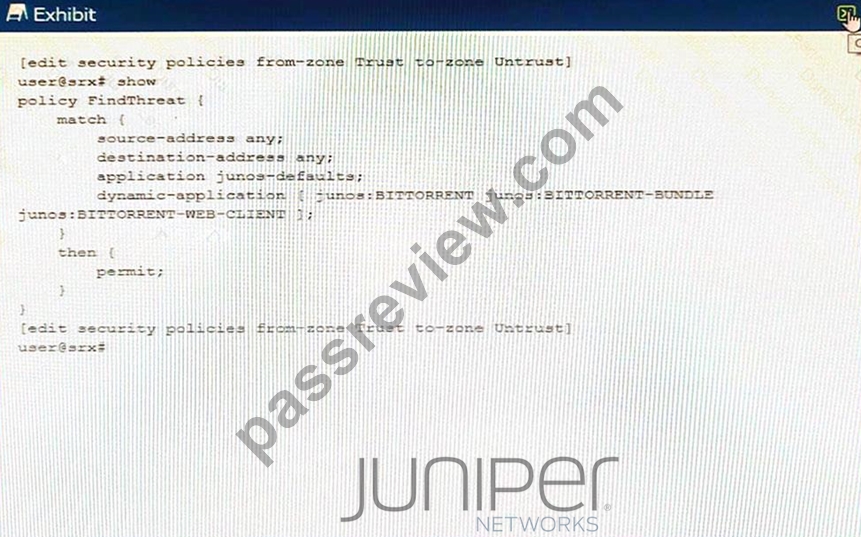
You are asked to track BitTorrent traffic on your network. You need to automatically add the workstations to the High_Risk_Workstations feed and the servers to the BitTorrent_Servers feed automatically to help mitigate future threats.
Which two commands would add this functionality to the FindThreat policy? (Choose two.)
- A.

- B.

- C.

- D.

Answer: C,D
NEW QUESTION # 36
How does the SSL proxy detect if encryption is being used?
- A. It queries the client device.
- B. It uses application identity services.
- C. It looks at the destination port number.
- D. It verifies the length of the packet
Answer: C
Explanation:
The SSL proxy can detect if encryption is being used by looking at the destination port number of the packet. If the port number is 443, then the proxy can assume that the packet is being sent over an encrypted connection. If the port number is different, then the proxy can assume that the packet is not encrypted. For more information, please refer to the Juniper Networks JNCIS-SEC Study Guide.
NEW QUESTION # 37
Which solution enables you to create security policies that include user and group information?
- A. ATP Appliance
- B. NETCONF
- C. Network Director
- D. JIMS
Answer: D
Explanation:
The solution that enables you to create security policies that include user and group information is JIMS (Juniper Identity Management Service). JIMS collects and maintains a large database of user, device, and group information from Active Directory domains or syslog sources, and enables SRX Series devices to rapidly identify thousands of users in a large, distributed enterprise. With JIMS, you can create security policies that include user and group information, and enforce user-based access control policies to protect network resources.
NEW QUESTION # 38
You are preparing a proposal for a new customer who has submitted the following requirements for a vSRX deployment:
-- globally distributed,
-- rapid provisioning,
-- scale based on demand,
-- and low CapEx.
Which solution satisfies these requirements?
- A. VMWare ESXi
- B. Network Director
- C. Juniper ATP Cloud
- D. AWS
Answer: D
Explanation:
The solution that satisfies the requirements for a vSRX deployment is AWS. AWS (Amazon Web Services) is a cloud computing platform that provides on-demand services such as infrastructure, platform, software, and database as a service. AWS is globally distributed, meaning that it has data centers in multiple regions around the world. AWS also allows rapid provisioning, meaning that you can launch vSRX instances in minutes using preconfigured Amazon Machine Images (AMIs) or custom templates. AWS also enables scaling based on demand, meaning that you can adjust the number and size of vSRX instances according to your network traffic and performance needs. AWS also has low CapEx (capital expenditure), meaning that you only pay for what you use and do not need to invest in hardware or maintenance costs.
Reference: = vSRX Deployment Guide for AWS, Understand vSRX Virtual Firewall with AWS, What Is Amazon Web Services?
NEW QUESTION # 39
Which two statements are true about the vSRX? (Choose two.)
- A. UNIX is the base OS.
- B. Linux is the base OS.
- C. It does not have VMXNET3 vNIC support.
- D. It has VMXNET3 vNIC support.
Answer: B,D
Explanation:
Reference: Juniper Networks Security, Specialist (JNCIS-SEC) Study Guide, Chapter 1: Introduction to Junos Security, page 1-8.
The vSRX is a virtual security appliance that runs on a virtual machine. It provides firewall, VPN, and other security services in a virtualized environment.
The vSRX is based on a version of Junos OS that is optimized for virtualization. It runs on a Linux kernel and uses a KVM hypervisor. It supports VMware ESXi and KVM hypervisors.
The vSRX has support for VMXNET3 vNICs, which are high-performance virtual network interfaces provided by VMware. These interfaces can provide higher throughput and lower CPU utilization than other virtual NIC types.
NEW QUESTION # 40
Exhibit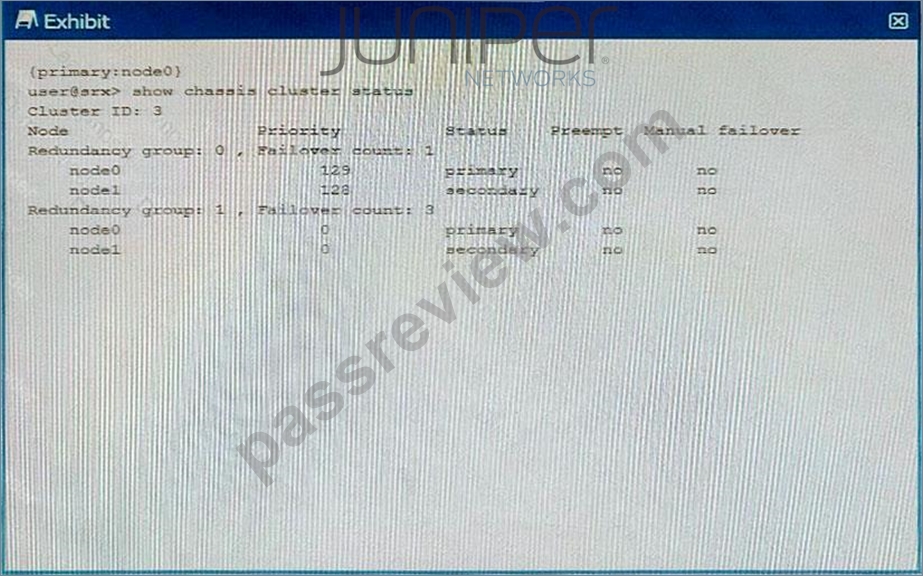
Using the information from the exhibit, which statement is correct?
- A. Redundancy group 0 is in an ineligible state.
- B. Node1 is the active node for the control plane
- C. There are no issues with the cluster.
- D. Redundancy group 1 is in an ineligible state.
Answer: C
NEW QUESTION # 41
Which two statements are true about Juniper ATP Cloud? (Choose two.)
- A. Juniper ATP Cloud uses multiple antivirus software packages to analyze files.
- B. Juniper ATP Cloud only uses one antivirus software package to analyze files.
- C. Juniper ATP Cloud uses antivirus software packages to protect against zero-day threats.
- D. Juniper ATP Cloud does not use antivirus software packages to protect against zero-day threats.
Answer: A,D
Explanation:
Two statements that are true about Juniper ATP Cloud are:
Juniper ATP Cloud uses multiple antivirus software packages to analyze files: Juniper ATP Cloud is a cloud-based service that provides advanced threat prevention and detection for your network. It integrates with SRX Series firewalls and MX Series routers to analyze files and network traffic for signs of malicious activity. Juniper ATP Cloud uses multiple antivirus software packages from different vendors to scan files for known malware signatures and provide a comprehensive verdict based on their results.
Juniper ATP Cloud does not use antivirus software packages to protect against zero-day threats: Juniper ATP Cloud protects against zero-day threats by using dynamic analysis, not antivirus software packages.
Dynamic analysis is a method of executing files in a sandbox environment and observing their behavior and network interactions. Dynamic analysis can uncover unknown malware that may evade static analysis or signature-based detection methods.
Reference: = Juniper Advanced Threat Prevention Cloud (ATP Cloud), Juniper Advanced Threat Prevention Cloud | ATP Cloud | Juniper Networks, Breaking Down Security Complexity with Juniper Networks' ATP Cloud
NEW QUESTION # 42
......
Get New JN0-336 Certification Practice Test Questions Exam Dumps: https://getfreedumps.passreview.com/JN0-336-exam-questions.html