

Jan-2026 FREE Snowflake COF-C02 PRACTICE QUESTIONS AND ANSWERS UPDATES
DEMO FREE BEFORE YOU BUY COF-C02 DUMPS
The first part of the exam covers topics such as Snowflake architecture, database objects, security, and performance tuning. The second part of the exam covers topics such as data loading, data unloading, and data transformation. The hands-on exercises in the second part of the exam require candidates to demonstrate their skills in using Snowflake to load, transform, and unload data.
NEW QUESTION # 457
How are serverless features billed?
- A. Serverless features are not billed, unless the total cost for the month exceeds 10% of the warehouse credits, on the account
- B. Per minute multiplied by an automatic sizing for the job, with a minimum of one minute
- C. Per second multiplied by the size, as determined by the SERVERLESS_FEATURES_SIZE account parameter
- D. Per second multiplied by an automatic sizing for the job
Answer: B
Explanation:
Serverless features in Snowflake are billed based on the time they are used, measured in minutes. The cost is calculated by multiplying the duration of the job by an automatic sizing determined by Snowflake, with a minimum billing increment of one minute. This means that even if a serverless feature is used for less than a minute, it will still be billed for the full minute.
NEW QUESTION # 458
A user wants to upload a file to an internal Snowflake stage using a put command.
Which tools and or connectors could be used to execute this command? (Select TWO).
- A. SnowSQL
- B. Python connector
- C. SQL API
- D. Snowsight worksheets
- E. SnowCD
Answer: A,D
Explanation:
To upload a file to an internal Snowflake stage using a PUT command, you can use:
* B. SnowSQL: SnowSQL, the command-line client for Snowflake, supports the PUT command, allowing users to upload files directly to Snowflake stages from their local file systems.
* E. Snowsight worksheets: Snowsight, the web interface for Snowflake, provides a user-friendly environment for executing SQL commands, including the PUT command, through its interactive worksheets.
References:
* Snowflake Documentation: Loading Data into Snowflake using SnowSQL
* Snowflake Documentation: Using Snowsight
NEW QUESTION # 459
What value provides information about disk usage for operations where intermediate results do not fit in memory in a Query Profile?
- A. Pruning
- B. IO
- C. Network
- D. Spilling
Answer: D
Explanation:
In Snowflake, when a query execution requires more memory than what is available, Snowflake handles these situations by spilling the intermediate results to disk. This process is known as "spilling." The Query Profile in Snowflake includes a metric that helps users identify when and how much data spilling occurs during the execution of a query. This information is crucial for optimizing queries as excessive spilling can significantly slow down query performance. The value that provides this information about disk usage due to intermediate results not fitting in memory is appropriately labeled as "Spilling" in the Query Profile.
References:
* Snowflake Documentation on Query Profile and Performance: This section explains the various components of the query profile, including the spilling metric, which indicates disk usage for operations where intermediate results exceed available memory.
NEW QUESTION # 460
What are the main differences between the account usage views and the information schema views? (Select TWO).
- A. Account issue views contain dropped objects but information schema views do not.
- B. No active warehouse to needed to query account usage views but one is needed to query information schema views.
- C. Information schema views are read-only but account usage views are not.
- D. Data retention for account usage views is 1 year but is 7 days to 6 months for information schema views, depending on the view.
- E. Account usage views do not contain data about tables but information schema views do.
Answer: A,D
Explanation:
The account usage views in Snowflake provide historical usage data about the Snowflake account, and they retain this data for a period of up to 1 year. These views include information about dropped objects, enabling audit and tracking activities. On the other hand, information schema views provide metadata about database objects currently in use, such as tables and views, but do not include dropped objects. The retention of data in information schema views varies, but it is generally shorter than the retention for account usage views, ranging from 7 days to a maximum of 6 months, depending on the specific view.
Reference: Snowflake Documentation on Account Usage and Information Schema
NEW QUESTION # 461
Which categories are included in the execution time summary in a Query Profile? (Select TWO).
- A. Local Disk I/O
- B. Percentage of data read from cache
- C. Initialization
- D. Pruning
- E. Spilling
Answer: C,D
Explanation:
In the execution time summary of a Query Profile in Snowflake, the categories included provide insights into various aspects of query execution. "Pruning" refers to the process by which Snowflake reduces the amount of data scanned by eliminating partitions of data that are not relevant to the query, thus improving performance.
"Initialization" represents the time taken for query planning and setup before actual execution begins. These metrics are crucial for understanding and optimizing query performance.
Reference: Snowflake Documentation on the Query Profile, which outlines the different metrics and categories included in the execution summary:
https://docs.snowflake.com/en/user-guide/ui-query-profile.html#execution-summary
NEW QUESTION # 462
What is the default file size when unloading data from Snowflake using the COPY command?
- A. 8 GB
- B. 16 MB
- C. 5 MB
- D. 32 MB
Answer: B
NEW QUESTION # 463
A user is loading JSON documents composed of a huge array containing multiple records into Snowflake. The user enables the strip__outer_array file format option
What does the STRIP_OUTER_ARRAY file format do?
- A. It removes the outer array structure and loads the records into separate table rows,
- B. It removes the NULL elements from the JSON object eliminating invalid data and enables the ability to load the records
- C. It removes the trailing spaces in the last element of the outer array and loads the records into separate table columns
- D. It removes the last element of the outer array.
Answer: A
NEW QUESTION # 464
What does Snowflake recommend a user do if they need to connect to Snowflake with a tool or technology mat is not listed in Snowflake partner ecosystem?
- A. Use a custom-built connector.
- B. Use Snowflake's native API.
- C. Connect through Snowflake's JDBC or ODBC drivers
- D. Contact Snowflake Support for a new driver.
Answer: C
Explanation:
If a user needs to connect to Snowflake with a tool or technology that is not listed in Snowflake's partner ecosystem, Snowflake recommends using its JDBC or ODBC drivers. These drivers provide a standard method of connecting from various tools and programming languages to Snowflake, offering wide compatibility and flexibility. By using these drivers, users can establish connections to Snowflake from their applications, ensuring they can leverage the capabilities of Snowflake regardless of the specific tools or technologies they are using.References: Snowflake Documentation on Client Drivers
NEW QUESTION # 465
What privilege should a user be granted to change permissions for new objects in a managed access schema?
- A. Grant the OWNERSHIP privilege on the schema.
- B. Grant the MANAGE GRANTS global privilege.
- C. Grant ALL privileges on the schema.
- D. Grant the OWNERSHIP privilege on the database.
Answer: B
Explanation:
To change permissions for new objects in a managed access schema, a user should be granted the MANAGE GRANTS global privilege. This privilege allows the user to manage access control through grants on all securable objects within Snowflake2. References: [COF-C02] SnowPro Core Certification Exam Study Guide
NEW QUESTION # 466
Which of the following items does the Cloud services Layer manage? Choose 4 answers
- A. Query compilation and optimization
- B. Metadata
- C. Data security
- D. user authentication
- E. external blob storage
Answer: A,B,C,D
NEW QUESTION # 467
Which Snowflake partner specializes in data catalog solutions?
- A. Alation
- B. DataRobot
- C. dbt
- D. Tableau
Answer: A
Explanation:
Alation is known for specializing in data catalog solutions and is a partner of Snowflake. Data catalog solutions are essential for organizations to effectively manage their metadata and make it easily accessible and understandable for users, which aligns with the capabilities provided by Alation.
Reference:
[COF-C02] SnowPro Core Certification Exam Study Guide
Snowflake's official documentation and partner listings
NEW QUESTION # 468
Which MINIMUM set of privileges is required to temporarily bypass an active network policy by configuring the user object property MINS_TO_BYPASS_NETWORK_POLICY?
- A. Only Snowflake Support can set the value for this object property
- B. Only while in the securityadmin role
- C. Only while in the ACCOUNTADMIH role
- D. Only the role with the ownership privilege on the network policy
Answer: C
Explanation:
To temporarily bypass an active network policy by configuring the user object propertyMINS_TO_BYPASS_NETWORK_POLICY, the minimum set of privileges required is having the ACCOUNTADMIN role. This role has the necessary privileges to make such changes, including modifying user properties that affect network policies.
References:
* Snowflake Documentation: Network Policy Management
NEW QUESTION # 469
Which Snowflake table is an implicit object layered on a stage, where the stage can be either internal or external?
- A. Transient table
- B. Directory table
- C. Temporary table
- D. A table with a materialized view
Answer: B
Explanation:
A directory table in Snowflake is an implicit object layered on a stage, whether internal or external. It allows users to query the contents of a stage as if it were a table, providing metadata about the files stored in the stage, such as filenames, file sizes, and last modified timestamps.
Snowflake Documentation: Directory Tables
NEW QUESTION # 470
Use of what parameter will allow files to be loaded even if the file metadata has expired?
- A. LOAD_UNCERTAIN_FILES = TRUE
- B. MATCH_BY_COLUMN_NAME = CASE_INSENSITIVE
- C. PURGE = TRUE
- D. ENFORCE_LENGTH = TRUE
Answer: C
NEW QUESTION # 471
Which command can be used to load data into an internal stage?
- A. copy
- B. GET
- C. PUT
- D. LOAD
Answer: C
Explanation:
The PUT command is used to load data into an internal stage in Snowflake. This command uploads data files from a local file system to a named internal stage, making the data available for subsequent loading into a Snowflake table using the COPY INTO command.
Reference:
[COF-C02] SnowPro Core Certification Exam Study Guide
Snowflake Documentation on Data Loading
NEW QUESTION # 472
Which of the following Snowflake objects can be shared using a secure share? (Select TWO).
- A. Materialized views
- B. Sequences
- C. Secure User Defined Functions (UDFs)
- D. Tables
- E. Procedures
Answer: C,D
Explanation:
Secure sharing in Snowflake allows users to share specific objects with other Snowflake accounts without physically copying the data, thus not consuming additional storage. Tables and Secure User Defined Functions (UDFs) are among the objects that can be shared using this feature. Materialized views, sequences, and procedures are not shareable objects in Snowflake.
Reference:
[COF-C02] SnowPro Core Certification Exam Study Guide
Snowflake Documentation on Secure Data Sharing1
NEW QUESTION # 473
Which Snowflake mechanism is used to limit the number of micro-partitions scanned by a query?
- A. Retrieval optimization
- B. Query pruning
- C. Cluster depth
- D. Caching
Answer: B
Explanation:
Query pruning in Snowflake is the mechanism used to limit the number of micro-partitions scanned by a query. By analyzing the filters and conditions applied in a query, Snowflake can skip over micro-partitions that do not contain relevant data, thereby reducing the amount of data processed and improving query performance. This technique is particularly effective for large datasets and is a key component of Snowflake's performance optimization features.
Reference:
Snowflake Documentation: Query Performance Optimization
NEW QUESTION # 474
Who can activate and enforce a network policy for all users in a Snowflake account? (Select TWO)
- A. A role that has been granted the ATTACH POLICY privilege
- B. A role that has the NETWORK_POLlCY account parameter set
- C. A role that has the CWKERSHIE of the network policy
- D. A user with a SECURITYADMIN or higher role
- E. A user with an USERADMIN or higher role
Answer: C,D
NEW QUESTION # 475
How can a Snowflake user access a JSON object, given the following table? (Select TWO).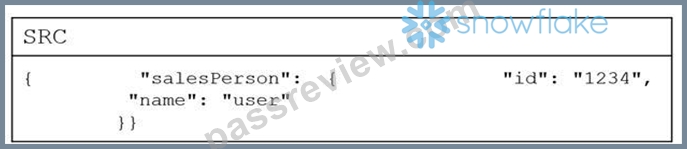
- A. src:salesperson.name
- B. SRC:salesperson.name
- C. src:sa1esPerson. name
- D. SRC:salesperson.Name
- E. src:salesperson.Name
Answer: A,E
Explanation:
To access a JSON object in Snowflake, dot notation is used where the path to the object is specified after the column name containing the JSON data. Both lowercase and uppercase can be used for attribute names, so both "name" and "Name" are valid. References: [COF-C02] SnowPro Core Certification Exam Study Guide
NEW QUESTION # 476
......
Latest Snowflake COF-C02 Dumps with Test Engine and PDF: https://getfreedumps.passreview.com/COF-C02-exam-questions.html