

ISO-45001-Lead-Auditor Practice Test Questions Answers Updated 104 Questions
ISO-45001-Lead-Auditor dumps & ISO 45001 Sure Practice with 104 Questions
NEW QUESTION # 56
Which two of the following phrases would apply to "plan" in relation to the Plan-Do-Check-Act cycle for a business process?
- A. Providing infrastructure
- B. Setting objectives
- C. Retaining documentation
- D. Training staff
- E. Calibrating instruments
- F. Organising changes
Answer: B,F
NEW QUESTION # 57
You are an audit team leader conducting an ISO 45001 surveillance audit of a nautical college that provides course for those working in the maritime sector. The College Principle Is absent, and you are interviewing the Deputy (DP) DP: 1 apologise for the absence of the College Principle. He has called in sick today and we are really short of staff.
You: 1 see, it really should not affect the OHSMS so the audit can progress as normal.
DP: The College principle set up the system. I am afraidi am not as familiar with it as he is.
You: OK, let's start with the OH and S policy. What are the main issues for the OHSMS here?
DP: Give me a minute. I need look at the OH and S Policy on the noticeboard in his office.
As the audit progresses, It is clear that the Deputy College Principle has a very low knowledge of the OHSMS. He continually has to search the answers to your questions or asks staff members about their processes.
Choose one of the following options that best describes the basis for the nonconformity.
- A. The Deputy College Principal is not competent to manage the CM ISMS.
- B. As a member of the management team, the Deputy College Principal Is not aware of the OHSMS policy.
- C. OHSS improvement is riot possible due to the lack of awareness of the OHSMS.
- D. The OH and S Polity only exists -:s -i document in the Collegeprinciple office.
Answer: B
Explanation:
Comprehensive Detailed Explanation along with All ISO 45001 Audit Reference Clause 5.1 of ISO 45001:2018 requires top management to demonstrate leadership and commitment to the OH&S management system. This includes awareness of the OH&S policy and its objectives.
Analysis of Options:
A . As a member of the management team, the Deputy College Principal is not aware of the OHSMS policy:
Correct. A lack of awareness of the policy reflects poor leadership commitment, which violates Clause 5.1.
B . OH&S improvement is not possible due to the lack of awareness of the OHSMS:
Incorrect. While improvement may be hindered, this is not the main issue in this scenario.
C . The Deputy College Principal is not competent to manage the OHSMS:
Incorrect. The Deputy's competence to manage the OHSMS is not in question; the issue is their lack of awareness of key elements.
D . The OH&S policy only exists as a document in the College Principal's office:
Incorrect. The policy may be accessible but not effectively communicated or understood by management.
ISO Reference:
Clause 5.1: Leadership and commitment.
Clause 5.2: OH&S policy.
NEW QUESTION # 58
You are in the closing meeting of a second-party audit to ISO 45001. Which three of the following topics are most likely to come for discussion?
- A. nature of the trading relationship that currently exists between the auditee ' s and auditor ' s organisations.
- B. The extent of the auditee ' s documented information system.
- C. The extent to which the auditee Is conforming to the requirements set out in ISO 45001.
- D. The names and email address of a attendees at the closing meeting. The question of who should chair the closing meeting.
- E. The extent to which the auditee is conforming to the OH and S requirements contained in supply contracts with the auditing organisation.
- F. Whether the work instructions for a specify auditee OH and S process are focused on efficiency.
- G. Whether the audit has correctly performed in current contracts with other customers.
Answer: A,C,E
Explanation:
The closing meeting of a second-party audit focuses on the findings, conformance to agreed requirements, and areas for improvement. ISO 19011:2018 provides guidance on closing meetings, stating that the results of the audit, including conformity with criteria, must be reviewed and agreed upon.
Analysis of Options:
* A. The names and email addresses of attendees at the closing meeting: Irrelevant. Attendance details are not part of the audit discussion.
* B. The extent of the auditee's documented information system: While relevant during the audit, it is not typically a focus in the closing meeting.
* C. The extent to which the auditee is conforming to OH and S requirements in supply contracts:
Correct. Second-party audits often assess compliance with contractual requirements.
* D. The extent to which the auditee conforms to ISO 45001 requirements: Correct. The core purpose of the audit is to evaluate conformity to ISO 45001.
* E. The nature of the trading relationship between the organizations: Correct. The trading relationship often shapes the scope and context of second-party audits.
* F. Whether the audit has correctly performed in current contracts with other customers:
Irrelevant. The focus is on the specific audit, not contracts with other customers.
* G. Whether the work instructions for a specific OH and S process are focused on efficiency:
Irrelevant. Efficiency is not the primary focus of an OH and S audit.
ISO References:
* ISO 19011:2018, Clause 6.6.1: Conducting the closing meeting.
* ISO 45001:2018, Clause 9.2: Internal audit requirements.
NEW QUESTION # 59
You are auditing a site of Good Food Shack, a restaurant chain. In the kitchen area, you notice a half-filled open drum sitting in a pool of liquid, which is dribbling across a work are a. You ask the head Chef what is in the drum and are told it is waste the frying process. When you ask why it is kept there, You are told that it is not normally kept there, but it not a problem and says that he will arrange it to be moved to a storeroom and will give the floor a good clean.
Look around the kitchen, you observe knives and cleavers lying around on worktops, staff wearing no protective gloves and a large pot of boiling water with nobody near it. There is no evidence of any fire extinguishers of fine blankets within sight.
You decide to raise a nonconformance. Select one of the options that best describes the finding against clause 8.1.2 of ISO 45001.
- A. Training of the kitchen staff was not effective enough to prevent poor safety awareness in the kitchen area.
- B. Staff are at risk of serious injury while working in the kitchen.
- C. Measures to prevent slippage in the kitchen from waste cooking oil were not taken.
- D. Failure to reduce risks associated with working in the kitchen.
Answer: D
Explanation:
Comprehensive Detailed Explanation along with All ISO 45001 Audit Reference Clause 8.1.2 of ISO 45001 pertains to Eliminating Hazards and Reducing OH&S Risks. Organizations must implement appropriate controls to manage workplace hazards effectively.
Issue Identified:
The kitchen environment at the audited site presents multiple hazards, including:
Oil spillage creating a slip hazard.
Open drums of waste material posing a chemical or hygiene hazard.
Unsecured knives and cleavers increasing the risk of cuts.
Boiling water left unattended, posing a risk of burns.
Lack of visible fire extinguishers or fire blankets, increasing fire risk.
Analysis of Options:
A . Failure to reduce risks associated with working in the kitchen.
This option accurately captures the broader failure to implement effective measures to eliminate or reduce hazards across multiple areas in the kitchen.
B . Measures to prevent slippage in the kitchen from waste cooking oil were not taken.
This is specific to one hazard (oil spillage) and does not address other significant risks observed, such as fire safety or sharp tools.
C . Staff are at risk of serious injury while working in the kitchen.
While true, this is more of a general observation and does not address the root cause of the hazards or the failure of controls.
D . Training of the kitchen staff was not effective enough to prevent poor safety awareness in the kitchen area.
Although training deficiencies may contribute to the issue, this option does not reflect the overarching systemic failure to manage hazards effectively.
Best Description of the Nonconformance:
Failure to reduce risks associated with working in the kitchen (Option A) is the most comprehensive finding, reflecting the organization's lack of adequate controls to mitigate hazards.
ISO Reference:
Clause 8.1.2: Organizations must establish controls to eliminate or minimize OH&S risks systematically.
Clause 7.2: Ensuring competency through training is important but must be coupled with hazard control measures.
NEW QUESTION # 60
Whistlekleen is a national dry cleaning and laundry organization with 50 shops. You are conducting an OHSMS surveillance audit of the head office and are sampling health and safety performance monitoring.
You find that 80 per cent of incident originate from five shops in the same region. Most of these relate to staff and customer feeling unwell due to breathing in the pungent atmosphere. Some required to be hospitalized.
The OHS Manager tells you that these are the oldest shops in the organization. The cleaning equipment emits Volatile Organic Compounds (VOCs) and needs replacing but the organisation cannot afford it at the moment.
- A. Give an explanation to the Agency of what went wrong.
- B. Offer to compensate employees and customers for possible health implications.
- C. Select the three best options for how this should be handled by the organisation through its OHSMS.
- D. Apologise to the Agency and advise that corrective action will be taken within 15 days.
- E. Defend the court case and await the legal outcome.
- F. Conduct an internal enquiry to establish who is to blame.
- G. Monitor VOC emissions to ensure compliance with safe limits.
- H. Investigate changing the cleaning process to use chemicals with safe VOC content.
- I. Advise that the faulty equipment will be replaced within the next two years.
- J. On raising the matter with senior management, you are told that there are plans to replace the equipment in these shops over the next five years.
- K. When reviewing the nonformity report files, you find the organization is facing a legal dispute with the Health and Safety Agency over multiple breaches of OHAandS legislation.
Answer: E,F,K
NEW QUESTION # 61
What type of audit is conducted by an organisation to determine the degree of conformity of its OH and S management system against the requirements of ISO 45001:2018?
- A. Surveillance audit
- B. Third-party audit
- C. Supplier audit
- D. First-party audit
Answer: D
NEW QUESTION # 62
You identify that the OSHMS manager conducts a safety inspection of the building each day before the museum opens to the public. You review your latest report and note that there seems to be some confusion between what constitutes a hazard and what constitutes a risk.
Which three of the following observations has the OHSMS manager correctly rated?
- A. The fire extinguishers in the Natural World area have not been serviced in the last five years [Risk)
- B. The carpet on the main staircase is peeling off (Risk)
- C. The head of the dinosaur suspended over the main hall has become detached from the rest of the skeleton (Risk)
- D. Conference room emergency sign directs people to an exit that is no longer available for use (Hazard)
- E. The emergency light In the gift shop did not work when checked (Risk)
- F. The non-slip mats have been removed from the restaurant (Risk)
- G. There Is a high possibility of unfit food being sold due to the failure of the oven temperature indicator In the visitors ' restaurant (Hazard)
- H. There is a water leak next to the electric heater in the admissions area (Danger)
Answer: A,B,E
Explanation:
* Hazard: A potential source of harm or adverse health effects.
* Risk: The likelihood of harm occurring as a result of the hazard.
* Danger: An immediate threat that requires urgent action.
Analysis of Options:
* A. Conference room emergency sign directs people to an exit that is no longer available for use (Hazard): Correctly identified as a hazard since it poses a potential risk during emergencies.
* B. The carpet on the main staircase is peeling off (Risk): This is a hazard, not a risk, as it represents a source of potential harm.
* C. The emergency light in the gift shop did not work when checked (Risk): This is a hazard because it is a condition that could lead to a risk during emergencies.
* D. The fire extinguishers in the Natural World area have not been serviced in the last five years (Risk): Correctly identified as a risk because the likelihood of fire-related harm increases without proper servicing.
* E. The head of the dinosaur suspended over the main hall has become detached from the rest of the skeleton (Risk): This is a hazard, not a risk, as it represents a potential source of harm.
* F. The non-slip mats have been removed from the restaurant (Risk): This is a hazard, not a risk.
* G. There is a high possibility of unfit food being sold due to the failure of the oven temperature indicator in the visitors ' restaurant (Hazard): This is a risk because it specifies the likelihood of harm occurring (selling unfit food).
* H. There is a water leak next to the electric heater in the admissions area (Danger): Correctly identified as a danger because it represents an immediate and critical threat.
ISO References:
* Clause 6.1.2: Hazard identification and assessment of risks and opportunities.
NEW QUESTION # 63
Select three options that would provide evidence of conformance with clause 9.1.1 of ISO 45001.
- A. Periodic analysis of the results of improvement actions.
- B. An increase in the visitors using the website.
- C. An OH and S objective to reduce the number of reported incidents.
- D. A procedure on how to determine trends when analysing OHS data.
- E. Competency of centre staff.
- F. Reports showing that elevators have passed the annual inspection.
- G. Signage that alerts visitors to hazards in the centre.
- H. Reports of accidents to staff members.
Answer: A,D,H
NEW QUESTION # 64
You have been assigned by the audit team leader to evaluate the process of complying with application legislation.
Which three of the following statements about the evaluation of compliance are true?
- A. The organisation is required to evaluate its compliance status with OH&S legal and other requirements
- B. If the organisation is falling to address a legal requirement relating to another discipline e.g. Environmental management, this cannot be raised In the audit.
- C. The organisation is required to establish a process for evaluating compliance
- D. A management review is required in all instances where one or more legal requirements are not being met.
- E. The organisation cannot outsource its process for evaluating compliance.
- F. The organization must evaluate its compliance status at least once a year
- G. Every member of an audit team must have a detailed understanding of the legal requirements for the sector and type of organisation they are auditing.
- H. 'Other requirements' include requirements that the organisation has chosen to comply with.
Answer: A,C,H
Explanation:
Comprehensive Detailed Explanation along with All ISO 45001 Audit Reference Clause 9.1.2 of ISO 45001:2018 outlines the need for organizations to evaluate compliance with applicable legal and other requirements as part of their OH&S management system.
Analysis of Options:
A :The organization must evaluate its compliance status at least once a year:
The standard does not prescribe a specific frequency but states that evaluations must be conducted at planned intervals.
B :'Other requirements' include requirements that the organization has chosen to comply with:
Correct. Other requirements may include voluntary standards, industry codes, or contractual obligations.
C :A management review is required in all instances where one or more legal requirements are not being met:
This is not true. Management reviews address compliance but are not mandated for every noncompliance.
D :Every member of an audit team must have a detailed understanding of the legal requirements for the sector and type of organization they are auditing:
Not true. Auditors must have general competency but can rely on subject-matter experts for legal specifics.
E :If the organization is failing to address a legal requirement relating to another discipline (e.g., Environmental management), this cannot be raised in the audit:
Not true. If the legal noncompliance impacts OH&S, it can be raised.
F :The organization cannot outsource its process for evaluating compliance:
The organization can outsource evaluation but retains accountability.
G:The organization is required to establish a process for evaluating compliance:
Correct. Clause 9.1.2 requires a process for compliance evaluation.
H :The organization is required to evaluate its compliance status with OH&S legal and other requirements:
Correct. Clause 9.1.2 explicitly states this requirement.
ISO Reference:
Clause 9.1.2: Evaluation of compliance.
Clause 7.5: Documented information requirements
NEW QUESTION # 65
ISO 45001 requires the organisation to maintain and retain documented OH&SMS information.
Check each statement and determine which two are true:
- A. The terms "maintain" and "retain" can be used interchangeably."
- B. Documented information to be retained includes material safety data sheets.
- C. A documented plan for achieving occupational health and safety objectives should be maintained.
- D. Industry-specific standards provided by the client should be maintained.
- E. The results of emergency drills should be kept.
- F. The occupational health and safety policy is an example of a document to be kept.
Answer: C,F
NEW QUESTION # 66
Aitchandness inc, manufactures safety footwear and other items of personal protective equipment (PPE). The organisation applied for ISO 45001 certification, and after the initial certificate audit, the certificate body decided that the audit team leader should carry out a follow-up audit to determine whether the non- conformities could be closed out.
A major non-conformity was raised at Stage 2 because of inadequate storage and handling of chemical used in the production process. Minor non-conformities related to retaining documentation, staff safety training and inadequate testing of emergency procedures.
Select four of the actions which the auditor could take at the follow-up audit to determine the effectiveness of corrective action for the non-conformities.
- A. Interview staff to see whether they have received training in the revised emergency response procedures.
- B. Check whether documented procedures for the revised processes have been signed off by the OH and S Manager.
- C. Check that the safety data sheets associated with the chemical being used where checked for completeness.
- D. Interview the OH and S Manager to determine whether additional health and safety objectives have been established.
- E. Inspect the relevant areas to check whether chemical were being stored and handled in a safe manner.
- F. Ask whether the organization's internal audit schedule was revised to included more audit associated with the storage and handling of chemicals.
- G. Determine whether an updated risk assessment has been carried out on the revised chemical storage and handling processes.
- H. Ask to review the latest emergency response drill report to check whether the revised emergency response process is fit for purpose
Answer: B,E,G,H
Explanation:
Follow-up audits verify that corrective actions have been implemented effectively and address the root cause of the nonconformities.
Analysis of Options:
* A. Review the latest emergency response drill report: Correct. This verifies whether emergency response processes are functional and effective.
* B. Check if the internal audit schedule was revised: Incorrect. While beneficial, this is not directly related to closing out the nonconformity.
* C. Check safety data sheets for completeness: Incorrect. While this ensures compliance, it is not directly related to verifying corrective actions.
* D. Check if revised procedures were signed off: Correct. This confirms that changes were properly documented and approved.
* E. Determine whether an updated risk assessment was carried out: Correct. Risk assessments confirm the effectiveness of new controls.
* F. Inspect areas for safe chemical storage and handling: Correct. Direct observation ensures that corrective actions are implemented effectively.
* G. Interview staff on revised emergency procedures: Incorrect. While important, this does not directly address the effectiveness of corrective actions for chemical storage.
* H. Interview the OH and S Manager about additional objectives: Incorrect. This is unrelated to the specific nonconformities raised.
ISO References:
* Clause 10.2.2: Verification of corrective actions.
* Clause 8.1.2: Hazard identification and controls.
NEW QUESTION # 67
Which one of the following options identifies the information that the audit team leader should communicate to the auditee before the closing meeting?
- A. The outcome of the audit, including the conclusion.
- B. Audit findings that pose a significant health and safety risk.
- C. Performance of individual workers when responding to health and safety-related questions.
- D. Diverging opinions within the audit team.
Answer: B
Explanation:
The correct answer is A. Audit findings that pose a significant health and safety risk.
In management system auditing practice, the audit team leader is expected to maintain communication with the auditee during the audit, especially when serious issues are identified. Where audit evidence indicates a significant risk , this should be communicated without waiting for the closing meeting , so the organization can take prompt action if needed. ISO guidance on conducting audits emphasizes communication during the audit and presentation of findings and conclusions at the closing meeting, while serious risks are handled immediately rather than being delayed. ( ISO ) Why the other options are not correct:
* B. The outcome of the audit, including the conclusion is normally communicated at the closing meeting , not before it. ( Advisera )
* C. Diverging opinions within the audit team are internal audit team matters. Only unresolved issues relevant to audit results may be raised appropriately, but internal team differences are not the key information to communicate beforehand.
* D. Performance of individual workers when responding to health and safety-related questions is not the purpose of audit reporting. A management system audit evaluates the system and its implementation, not individual worker appraisal.
Therefore, the information that should be communicated to the auditee before the closing meeting is:
A). Audit findings that pose a significant health and safety risk.
NEW QUESTION # 68
Showitoff is an organization specialization in the design and production of wall decorating materials for the domestic market.
During an ISO 45001 certification audit of the site, the auditor comes across an open, walled area just outside the maintenance department. It contains various scraps of wood and metal as well as serveral rusty components. Several heavy concrete beams are learning against a thin brick wall in which cracks are available. When asked about it, the OHS Manager states that he presumes that the materials come from maintenance work, so it is the Maintenance Manager's responsibility.
The auditor interview the Maintenance Manager in his department. He asks about the area outside and is told that it contains some excess material that the Manager likes to keep in case they come in handy at some stage.
The auditor points out that the wall appears to be unstable and could collapse at any moment. The Maintenance Manager is not aware of such a situation.
The auditor decides to review the process for evaluation of compliance with health and safety regulations in more depth.
Select six option that provide a meaningful audit trail for this process.
- A. What input does the Maintenance Manager have in the determination of legal compliance?
- B. How arc OH&S objectives verified?
- C. How ore updates to OH&S regulations monitored?
- D. What are the qualifications of the OHS Manager and Maintenance Managers?
- E. How is the cost of safety Improvements calculated?
- F. What hazards have been identified as being associated with regulations?
- G. What is the cost of repairing the wall?
- H. What knowledge does the OHS Manager have in relevant safety leaislation?
- I. How are OHSMS records of compliance evaluations controlled and managed?
- J. How arc maintenance start made aware of regulatory requirements?
Answer: A,C,F,H,I,J
Explanation:
Comprehensive Detailed Explanation along with All ISO 45001 Audit References An audit trail for evaluating compliance with regulations should focus on the identification, communication, and monitoring of legal and other requirements. Clause 9.1.2 of ISO 45001:2018 requires organizations to evaluate compliance with applicable OH&S legal and other requirements.
Analysis of Options:
* A. What is the cost of repairing the wall?Irrelevant to compliance evaluation, as cost considerations are not part of legal compliance.
* B. What hazards have been identified as being associated with regulations?Correct. Identifying hazards is a critical step in understanding compliance obligations (Clause 6.1.2).
* C. How are maintenance staff made aware of regulatory requirements?Correct. Communication and training are vital for compliance (Clause 7.3).
* D. How are OH&S objectives verified?Not directly relevant to compliance evaluations, as objectives pertain to performance improvement.
* E. How are OHSMS records of compliance evaluations controlled and managed?Correct. Proper documentation and record-keeping are essential for demonstrating compliance (Clause 7.5).
* F. How are updates to OH&S regulations monitored?Correct. Monitoring regulatory changes is critical for maintaining compliance (Clause 6.1.3).
* G. How is the cost of safety improvements calculated?Irrelevant to compliance, as cost analysis is not required by ISO 45001.
* H. What are the qualifications of the OHS Manager and Maintenance Manager?While competence is important, this does not directly relate to compliance evaluations.
* I. What input does the Maintenance Manager have in the determination of legal compliance?
Correct. Understanding the roles and responsibilities of key personnel ensures effective compliance (Clause 5.3).
* J. What knowledge does the OHS Manager have in relevant safety legislation?Correct. Awareness of applicable legislation is critical for effective compliance evaluation (Clause 7.2).
ISO References:
* Clause 9.1.2: Evaluation of compliance.
* Clause 6.1.2: Hazard identification and risk assessment.
* Clause 7.5: Documented information.
NEW QUESTION # 69
What is the definition of the term ' audit ' as per clause 3.32 of ISO 45001:2018?
- A. A legal requirement to comply with health and safety standards
- B. A document that outlines safety procedures and guidelines
- C. An evaluation of the effectiveness of health and safety measures
- D. A systematic process to assess the risks in a workplace
Answer: C
Explanation:
According to Clause 3.32 of ISO 45001:2018 , an audit is defined as a systematic, independent, and documented process for obtaining objective evidence and evaluating it to determine the extent to which audit criteria are fulfilled.
This involves assessing the effectiveness of health and safety measures implemented in the organization ' s OH and S management system.
Analysis of Options:
* A. A systematic process to assess the risks in a workplace: Incorrect. While audits may include risk assessments, the purpose is broader and involves evaluating the entire OH and S management system.
* B. An evaluation of the effectiveness of health and safety measures: Correct. This aligns with the definition of an audit as per ISO 45001:2018.
* C. A legal requirement to comply with health and safety standards: Incorrect. An audit is not necessarily a legal requirement but a process to assess conformity.
* D. A document that outlines safety procedures and guidelines: Incorrect. An audit is a process, not a document.
ISO Reference:
* Clause 3.32: Audit definition.
NEW QUESTION # 70
Like many other quality management systems, ISO 45001 uses what is known as a ' PDCA ' circle. What do those initials stand for?
- A. Prepare, Deliver, Control, Assess
- B. Plan, Deliver, Control, Achieve
- C. Plan, Do, Check, Ask
- D. Plan, Do, Check, Act
Answer: D
Explanation:
The PDCA (Plan-Do-Check-Act) model is a continuous improvement framework used in ISO 45001 and other management systems.
* Plan: Establish objectives and processes to deliver results in line with the OH and S policy.
* Do: Implement the processes.
* Check: Monitor and measure processes against the policy, objectives, and requirements.
* Act: Take actions to continually improve the system ' s performance.
Analysis of Options:
* A. Plan, Do, Check, Act: Correct. This is the standard PDCA cycle.
* B. Plan, Do, Check, Ask: Incorrect. " Ask " is not part of the cycle.
* C. Plan, Deliver, Control, Achieve: Incorrect. This is not the PDCA cycle.
* D. Prepare, Deliver, Control, Assess: Incorrect. This deviates from the PDCA framework.
ISO Reference:
* Clause 0.3: PDCA model.
NEW QUESTION # 71
Showitoff is an organisation spcialising in the design and production of wall decorating material for the domestic market. During an ISO 45001 certification audit of the site, the auditor comes across an open, walled area just outside the maintenance department. It contains various scraps of wood and metal as well as several rusty components. Several heavy concrete beams are learning against a thin brick wall in which cracks are visible. When asked about it, the OHS Manager states that he presume that the material come from maintenance work, so it is the Maintenance Manager's responsibility.
The auditor interviews the Maintenance Manager in his department. He asks about the area outside and is told that it contains some excess materials that the Manager likes to keep in case they come in handy at some stage. The auditor points out that the wall appears to be unstable collapse at any moment. The Maintenance Manager is not aware of such a situation.
Which three statement represent good audit practice?
- A. The auditor should advice the organisation to get rid of the walled area.
- B. The audit should refer the organization to the health and safety authorities.
- C. The audit should ask the Maintenance Manager to conduct a safety survey.
- D. The auditor should consider surveying more areas of the site for other potentially unsafe situations.
- E. The audit should demand that the Maintenance Manager deals with the wall.
- F. The audit should raise a nonconformity against ISO 45001.
- G. The auditor should check whether the organization has identified the safety hazards associated with the walled area.
- H. The audit should check the lines of communication between the OHS Manager and maintenance Manager.
Answer: D,G,H
Explanation:
Clause 6.1.2 of ISO 45001:2018 emphasizes the identification of hazards and assessment of risks, and Clause
5.4 highlights the importance of consultation and communication among roles. The auditor ' s role includes verifying conformity to these clauses through evidence gathering and observation.
Analysis of Options:
* A. The auditor should advise the organization to get rid of the walled area. This is outside the scope of an auditor's role, which is to observe and report findings, not to dictate specific actions.
* B. The auditor should ask the Maintenance Manager to conduct a safety survey. While safety surveys are useful, asking the Maintenance Manager to conduct one is not the auditor's responsibility.
* C. The auditor should check the lines of communication between the OHS Manager and Maintenance Manager. This aligns with ISO 45001:2018, Clause 5.4, as communication gaps may have contributed to the situation.
* D. The auditor should check whether the organization has identified the safety hazards associated with the walled area. Clause 6.1.2 requires hazard identification. The auditor must determine whether this has been done.
* E. The auditor should consider surveying more areas of the site for other potentially unsafe situations. Broadening the audit scope to identify additional risks is a good practice in line with Clause
9.2.2.
* F. The auditor should demand that the Maintenance Manager deals with the wall. Demanding action is not within the auditor's authority. The auditor should raise findings instead.
* G. The auditor should raise a nonconformity against ISO 45001. While this may be appropriate depending on evidence, raising a nonconformity is not a replacement for good audit practices.
* H. The auditor should refer the organization to health and safety authorities. This step is extreme and should only occur if there is an imminent danger and no action is being taken.
ISO References:
* Clause 6.1.2: Hazard identification and risk assessment.
* Clause 5.4: Worker consultation and participation.
* Clause 9.2.2: Internal audit program and execution.
NEW QUESTION # 72
What does ISO 45001 say are the hazards that have to be considered when planning a health and safety management system? Select the ONE best answer.
- A. Work hazards and environmental factors such as bad weather
- B. Work activities where there is the possibility of danger
- C. Work activities, workplace design, and human factors such as hours of work and bullying and harassment
- D. Hot-work, working at height, enclosed space entry, and work on electrical equipment
Answer: C
Explanation:
ISO 45001:2018 requires a holistic approach to occupational health and safety. This means considering all aspects that could impact worker well-being, not just obvious physical hazards. The correct answer encompasses work activities (the tasks themselves), workplace design (the physical environment), and human factors (psychological and social aspects like working hours and harassment). It ' s the most comprehensive and aligned with the standard ' s philosophy ISO 45001:2018, Clause 6.1.2, outlines requirements for hazard identification . Hazards to consider include work activities, workplace design, human factors, and social factors that may impact OH and S. These go beyond traditional physical risks and include psychosocial and organizational hazards.
Analysis of Options:
* A. Work activities, workplace design, and human factors such as hours of work and bullying and harassment: Correct. This comprehensively addresses hazard categories outlined in ISO 45001, Clause
6.1.2.
* B. Work activities where there is the possibility of danger: Too general. ISO 45001 includes broader categories of hazards, including those related to organizational and social factors.
* C. Hot-work, working at height, enclosed space entry, and work on electrical equipment: Too narrow. These are specific hazards but do not encompass the full range outlined in ISO 45001.
* D. Work hazards and environmental factors such as bad weather: Incomplete. While environmental factors are relevant, ISO 45001 also includes workplace design, human factors, and psychosocial hazards.
ISO References:
* Clause 6.1.2.1: Hazard identification.
* Annex A.6.1.2: Examples of hazard categories, including workplace design and human factors.
NEW QUESTION # 73
Wash-it-up is an organization that provides window cleaning services for the industrial sector. It has been certified t ISO 45001 for some time and has appointed a new OHS Manager. The audit plan during a surveillance audit includes the improvement actions and the auditor asks to see the most recent management review meeting minutes.
surveillance audit includes the Improvement actions and the auditor asks to see the most recent management review meeting minutes.
Which six of the statements would represent output audit evidence for the management review?
- A. Decagons related to continual improvement opportunities
- B. Report showing the trend of an increase In safety incidents
- C. Improvements In the OHSMS
- D. Worker feedback of positive and negative comments
- E. Plan to priorities health and safety issues as a business strategy
- F. Opportunities to integrate the OHS management system with other business processes
- G. Minutes of previous management reviews
- H. Allocation of a bigger budget for the OHS department
- I. Updates to the risk register
- J. Procurement of new safety harnesses for workers
Answer: A,C,E,F,H,I
Explanation:
Comprehensive Detailed Explanation along with All ISO 45001 Audit References Clause 9.3 of ISO 45001:2018 outlines the requirements for management reviews. These reviews must evaluate the performance of the OHSMS and identify opportunities for improvement. Outputs of management reviews typically include decisions and actions that align with strategic and operational priorities.
Analysis of Options:
* A. Decisions related to continual improvement opportunities:This is a valid output, as continual improvement is a key objective of management reviews under Clause 10.3.
* B. Allocation of a bigger budget for the OHS department:Resource allocation is a common output of management reviews to address identified needs.
* C. Improvements in the OHSMS:Improvements reflect the organization's commitment to enhancing safety performance.
* D. Minutes of previous management reviews:While minutes provide context, they are not an output of the current management review.
* E. Opportunities to integrate the OHS management system with other business processes:
Integration opportunities are valid outputs, as they enhance the system's effectiveness.
* F. Plan to prioritize health and safety issues as a business strategy:Strategic alignment of health and safety with business objectives is an expected output.
* G. Procurement of new safety harnesses for workers:This is an operational action, not a direct output of the management review process.
* H. Report showing the trend of an increase in safety incidents:This is an input to the management review, not an output.
* I. Updates to the risk register:Risk register updates reflect changes in identified hazards and risks, making this a valid output.
* J. Worker feedback of positive and negative comments:Worker feedback is an input to the management review, not an output.
ISO References:
* Clause 9.3: Management review inputs and outputs.
* Clause 10.3: Continual improvement actions.
NEW QUESTION # 74
What type of audit is conducted by an organisation to determine the degree of conformity of its OH&S management system against the requirements of ISO 45001:2018?
- A. Surveillance audit
- B. Third-party audit
- C. Supplier audit
- D. First-party audit
Answer: D
NEW QUESTION # 75
For the purpose of operating an ISO 45001-based Occupational Health and Safety Management System, which two of the following are relevant requirements of a relevant interested party?
- A. Competitors requiring information on the organisation ' s work environment.
- B. Subcontractor producing products and services that minimise the risk of harm.
- C. Investors requiring maximum growth in return for their capital.
- D. Shareholders requiring guaranteed dividend payments.
- E. Workers requiring a safe environment in which to work.
- F. Top management requiring an annual bonus.
Answer: B,E
Explanation:
ISO 45001 Clause 4.2 requires the organization to determine the relevant interested parties , their relevant needs and expectations (requirements) , and which of those become legal or other requirements for the OH and S management system. Workers are explicitly central to ISO 45001, and the standard is aimed at providing safe and healthy workplaces and preventing work-related injury and ill health. Therefore, A.
Workers requiring a safe environment in which to work is clearly a relevant requirement of a relevant interested party.
ISO 45001 Annex A.4.2 lists suppliers, contractors and subcontractors among examples of interested parties. Since externally provided products and services can affect OH and S performance, a requirement linked to minimizing the risk of harm in those products and services is relevant to the OH and S management system. That is why B. Subcontractor producing products and services that minimise the risk of harm is also relevant. It aligns with the standard's treatment of contractors/subcontractors as interested parties and with operational control over externally provided products and services that can affect OH and S.
Why the others are not correct:
* C. Competitors requiring information on the organisation ' s work environment is not a relevant OH and S requirement.
* D. Top management requiring an annual bonus is a financial/personal issue, not an OH and S interested-party requirement.
* E. Investors requiring maximum growth in return for their capital is a business expectation, but not a relevant OH and S requirement in this context.
* F. Shareholders requiring guaranteed dividend payments is also financial and not relevant to the OH and S management system, even though shareholders may be interested parties in a broader business sense. ISO 45001 requires only the needs and expectations that are relevant to the OH and SMS to be determined.
NEW QUESTION # 76
The following options are key actions involved in a first-party audit.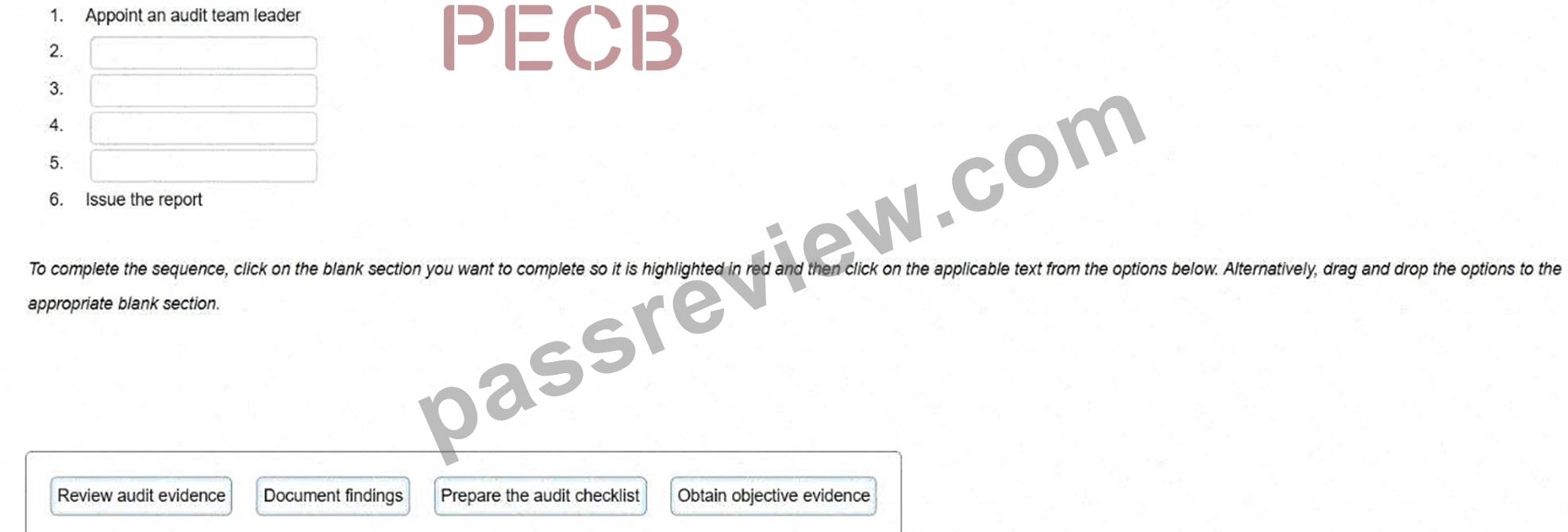
Put them in order to show the sequence in which the actions should take place.
Answer:
Explanation: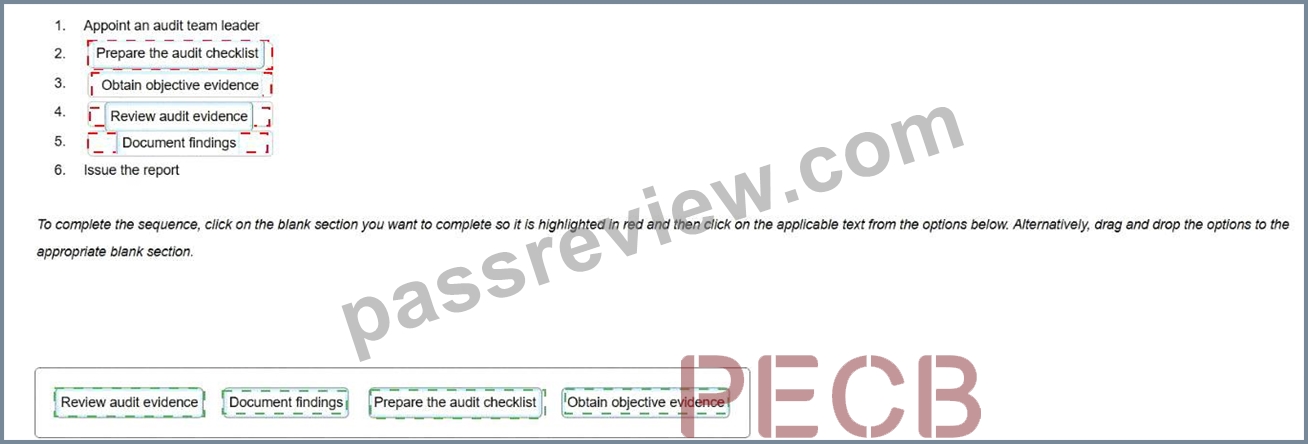
Explanation:
2. Prepare the audit checklist, 3. Obtain objective evidence, 4. Review audit evidence, 5. Document findings For a first-party audit, the sequence follows the normal audit flow described in ISO auditing guidance: first the audit is initiated and leadership is assigned, then audit activities are prepared, then evidence is collected during the audit, then that evidence is evaluated, then findings are recorded, and finally the audit report is issued. ISO 19011 describes the audit flow as initiating the audit, preparing audit activities, conducting audit activities, and preparing and distributing the audit report. ( ISO ) That is why, after 1. Appoint an audit team leader , the next correct step is 2. Prepare the audit checklist .
The checklist is part of preparing for the audit and helps the auditor plan questions, clauses, process interactions, and sampling points before going on to collect evidence. ( WEDEAQ | Official VDA QMC Partner ) After preparation, the auditor moves to 3. Obtain objective evidence . Audit evidence is gathered through interviews, observation, and review of documented information during the audit. This is a core activity of conducting the audit. ( DNV ) Once evidence is collected, the auditor must 4. Review audit evidence . ISO audit practice requires the evidence to be evaluated against the audit criteria to determine whether conformity or nonconformity exists.
Evidence is not simply collected and reported immediately; it is first reviewed and assessed. ( PRETESH BISWAS ) After reviewing the evidence, the auditor can 5. Document findings . Findings are the result of evaluating the evidence against criteria, so they logically come after evidence review. Recorded findings can include conformity, nonconformity, and opportunities for improvement, depending on the audit plan and method. ( PRETESH BISWAS ) The final step is 6. Issue the report , because the report is prepared only after the audit evidence has been reviewed and the findings have been determined and documented. ( ISO ) So, the correct full order is:
1. Appoint an audit team leader
2. Prepare the audit checklist
3. Obtain objective evidence
4. Review audit evidence
5. Document findings
6. Issue the report
NEW QUESTION # 77
An audit team leader arrives at a fabrication organisation that manufactures stairways to ..certification audit. At a meeting with the OHSMS Manager the audit finds that the responsibility for worker consultation and participation lies with the managerial team. Select from the options four actions by the managerial team that encourage worker consultation and participation.
- A. Appointing worker's representatives
- B. Giving ownership of health and safety matters
- C. Conducting toolbox talks on health and safety
- D. threatening reprisals to whistleblowers
- E. Ignoring worker's suggestions
- F. Implementing a payment scheme to reward worker's OHS performance
- G. Promoting collaborating workers to higher positions
- H. Implementing methods tor engaging workers
Answer: A,B,C,H
Explanation:
Comprehensive Detailed Explanation along with All ISO 45001 Audit Reference Clause 5.4 of ISO 45001:2018 emphasizes the importance of worker consultation and participation in the OHS management system. It requires organizations to establish processes that ensure workers are actively involved in decision-making and implementation of OHS practices.
Analysis of Options:
A . Promoting collaborating workers to higher positions:
While promotions may boost morale, they do not directly contribute to worker consultation and participation in the OHSMS.
B . Appointing worker representatives:
This action fosters direct communication and representation of workers' interests in health and safety matters.
C . Conducting toolbox talks on health and safety:
Toolbox talks are an effective way to engage workers in discussing and addressing health and safety issues.
D . Giving ownership of health and safety matters:
Involving workers in decision-making and giving them responsibility for specific health and safety tasks encourages participation.
E . Ignoring workers' suggestions:
This undermines consultation and is contrary to ISO 45001 principles.
F . Implementing a payment scheme to reward workers' OHS performance:
While incentives can motivate safe behavior, they are not a consultation or participation mechanism as required by Clause 5.4.
G . Implementing methods for engaging workers:
This aligns directly with Clause 5.4, as effective engagement methods (e.g., surveys, focus groups) enhance participation.
H . Threatening reprisals to whistleblowers:
This violates ISO 45001 principles and discourages worker participation.
ISO Reference:
Clause 5.4: Worker consultation and participation.
Clause 5.1: Leadership's responsibility to foster participation.
NEW QUESTION # 78
What is the definition of the term 'audit' as per clause 3.32 of ISO 45001:2018?
- A. A legal requirement to comply with health and safety standards
- B. A document that outlines safety procedures and guidelines
- C. An evaluation of the effectiveness of health and safety measures
- D. A systematic process to assess the risks in a workplace
Answer: C
Explanation:
According to Clause 3.32 of ISO 45001:2018, an audit is defined as a systematic, independent, and documented process for obtaining objective evidence and evaluating it to determine the extent to which audit criteria are fulfilled.
This involves assessing the effectiveness of health and safety measures implemented in the organization's OH&S management system.
Analysis of Options:
* A. A systematic process to assess the risks in a workplace:Incorrect. While audits may include risk assessments, the purpose is broader and involves evaluating the entire OH&S management system.
* B. An evaluation of the effectiveness of health and safety measures:Correct. This aligns with the definition of an audit as per ISO 45001:2018.
* C. A legal requirement to comply with health and safety standards:Incorrect. An audit is not necessarily a legal requirement but a process to assess conformity.
* D. A document that outlines safety procedures and guidelines:Incorrect. An audit is a process, not a document.
ISO Reference:
* Clause 3.32: Audit definition.
NEW QUESTION # 79
An internal auditor of a manufacturer of plastic packaging products for the food industry raised a nonconformity against section 10.2 of ISO 45001 in Report IA202. The nonconformity (NC3) stated: "The level of reported health and safety incidents has increased by 9.7% over the last 12 months. This included an increase in reported accidents." A third-party auditor reviewing the internal audit process came across the nonconformity and found that there was no evidence of having been reported to relevant staff. Select three of the following nonconformities that the auditor could raise to ISO 45001.
- A. 8.1.1 - Operations were not properly controlled to avoid health and safety incidents.
- B. 9.2.2.e - Management failed to take any action to deal with the audit nonconformity.
- C. 10.2.b - The root cause of the increase in reported health and safety accidents was not investigated.
- D. 9.2.2.d - Staff were not made aware that health and safety incidents were increasing.
- E. 9.2.2 - Report IA202 contained a poorly worded nonconformity (NC3).
- F. 7.4.3 - The results of the internal audit IA202 were not communicated to interested parties.
Answer: B,C,F
Explanation:
Clause 10.2 requires organizations to investigate nonconformities, determine their causes, and take corrective actions to prevent recurrence. Clause 9.2.2 specifies the requirements for managing internal audit processes, while Clause 7.4.3 emphasizes the need to communicate relevant information effectively.
Analysis of Options:
* A. 9.2.2.e - Management failed to take any action to deal with the audit nonconformity:Correct.
Management must ensure that internal audit findings are addressed promptly. The lack of action violates Clause 9.2.2.e.
* B. 9.2.2.d - Staff were not made aware that health and safety incidents were increasing:Incorrect.
This clause pertains to the planning and conduct of audits, not the communication of findings.
* C. 8.1.1 - Operations were not properly controlled to avoid health and safety incidents:Incorrect.
While increased incidents may suggest operational issues, this option does not directly relate to the internal audit findings.
* D. 9.2.2 - Report IA202 contained a poorly worded nonconformity (NC3):Incorrect. The clarity of the nonconformity wording is not directly relevant to Clause 9.2.2.
* E. 10.2.b - The root cause of the increase in reported health and safety accidents was not investigated:Correct. Failure to investigate root causes violates Clause 10.2.b.
* F. 7.4.3 - The results of the internal audit IA202 were not communicated to interested parties:
Correct. Effective communication of audit results is required under Clause 7.4.3.
ISO References:
* Clause 9.2.2: Internal audit process requirements.
* Clause 10.2: Nonconformity and corrective action.
* Clause 7.4.3: Communication requirements.
NEW QUESTION # 80
In the ISO 45001 health and safety management system, what is 'documented information'? Select the ONE best answer.
- A. Any paperwork generated when the system is in operation
- B. The master copies of the documents used to operate the system, held in any format
- C. Any information about the system, or generated by it, held in any format
- D. Paperwork such as Permits to work and risk assessments
Answer: C
Explanation:
ISO 45001 defines "documented information" as information required to be controlled and maintained by an organization. This can include policies, procedures, records, or other relevant data in any format (Clause 3.19). It encompasses all information used to establish, operate, and demonstrate the effectiveness of the OH&S management system.
Analysis of Options:
A . Any paperwork generated when the system is in operation:
Incorrect. This is too narrow and excludes digital or other formats.
B . Any information about the system, or generated by it, held in any format:
Correct. This aligns with the ISO 45001 definition in Clause 3.19.
C . Paperwork such as Permits to Work and risk assessments:
Incorrect. These are examples of documented information but do not encompass the full scope of the term.
D . The master copies of the documents used to operate the system, held in any format:
Incorrect. This definition is limited to master copies, while documented information includes records as well.
ISO Reference:
Clause 3.19: Definition of documented information.
Clause 7.5: Control of documented information.
NEW QUESTION # 81
......
New ISO-45001-Lead-Auditor Exam Questions| Real ISO-45001-Lead-Auditor Dumps: https://getfreedumps.passreview.com/ISO-45001-Lead-Auditor-exam-questions.html