

Authentic Best resources for JN0-363 Test Engine Practice Exam
[2025] JN0-363 PDF Questions - Perfect Prospect To Go With PassReview Practice Exam
The JN0-363 exam covers a wide range of topics related to service provider routing and switching, including the architecture, implementation, and operation of Junos software. Candidates will be tested on their ability to configure, monitor, troubleshoot, and maintain various Junos devices, as well as their knowledge of routing protocols such as OSPF and BGP. JN0-363 exam also covers topics related to MPLS, Layer 2 and Layer 3 VPNs, and multicast routing.
NEW QUESTION # 23
Exhibit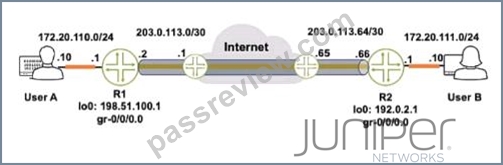
Referring to the exhibit, how do you verify the status of the tunnel from R1?
- A. Issue the ping 172.20.iii.io source 203.0.113.2 command.
- B. Issue the ping 172.20. Ill. 10 command.
- C. Issue the ping 172.20.111.10 source 172.20.110.1 command.
- D. Issue the ping 172.20.111.10 source 198.51.100.1 command.
Answer: A
NEW QUESTION # 24
You are asked to create connections between routing instances on the same Junos device and route between the connected Instances. What are two ways to accomplish this task? (Choose two.)
- A. Use loopback interfaces.
- B. Use logical tunnel interfaces.
- C. Use physical interfaces.
- D. Use an IRB interface.
Answer: A,B
Explanation:
To create connections between routing instances on the same Junos device and route between them, you can use logical tunnel interfaces, which are virtual interfaces that can be used to route traffic between instances without the need for physical connectivity. Additionally, loopback interfaces, which represent the device itself, can be used to route traffic between routing instances as they are always up and can be reached within the device.
Reference:
Juniper Networks Technical Documentation on Routing Instances
Juniper Networks Technical Documentation on Logical Tunnel Interfaces
NEW QUESTION # 25
Click the Exhibit button.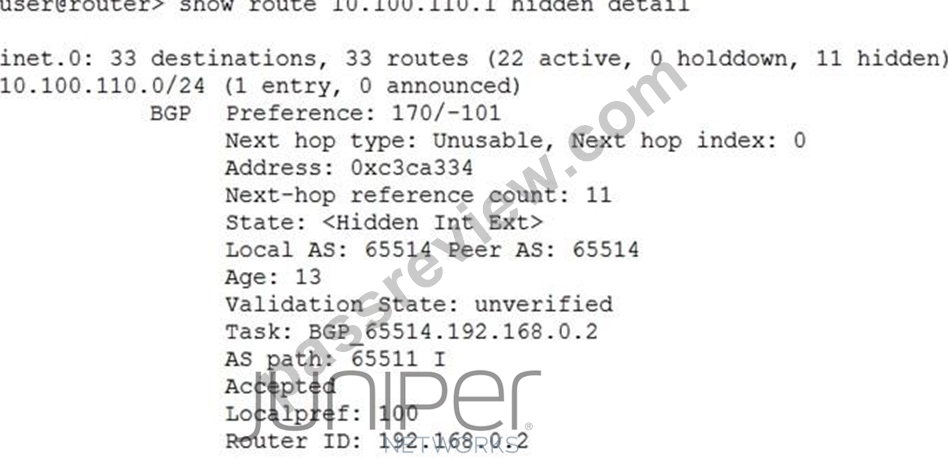
Referring to the exhibit, why is the route hidden?
- A. The route has yet to be verified
- B. The protocol next hop is not reachable
- C. The wrong BGP address family is enabled for the BGP session
- D. The MPLS LSP to the 192.168.0.2 peer is down
Answer: B
NEW QUESTION # 26
Exhibit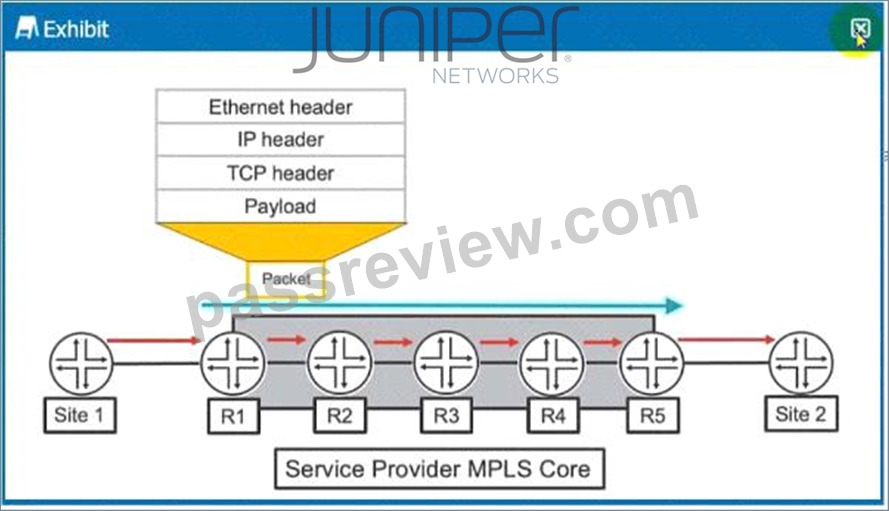
Which two statements ate correct about the actions taken as the packet traverses the service provider MPLS network from Site 1 to Site 2 as shown in the exhibit? (Choose two.)
- A. R1 will perform a lookup using the mpls.0 table.
- B. R2 will perform a lookup using the inet.3 table.
- C. R2 will perform a lookup using the mpls.0 table.
- D. R1 will perform a lookup using the lnet.3 table.
Answer: A,C
Explanation:
In MPLS (Multiprotocol Label Switching) networks, routers use label switching to forward packets. The first router at the edge of the MPLS network (R1) will perform a lookup in the mpls.0 table to determine the label to attach to the packet as it enters the MPLS network. This label informs the next routers in the MPLS network (like R2) on how to forward the packet. Internal MPLS routers, like R2, also perform lookups in their mpls.0 table to determine how to switch the packet toward its destination (label swapping). The inet.3 table is used for resolving next-hop information for labeled routes, but it's the mpls.0 table that is used for label switching decisions.
References:
Juniper Networks documentation on MPLS: MPLS Applications User Guide for Routing Devices
NEW QUESTION # 27
Which statement is correct about IS-IS?
- A. IS-IS is a path vector routing protocol.
- B. IS-IS is a classful routing protocol.
- C. IS-IS is a distance vector routing protocol.
- D. IS-IS is a link-state routing protocol.
Answer: D
Explanation:
IS-IS is a link-state routing protocol that uses a Shortest Path First (SPF) algorithm to create a topology map of the network. It floods link-state advertisements (LSAs) to all nodes within the network area to ensure each node has a consistent view of the network topology.
Reference:
Juniper Networks Technical Documentation on IS-IS
Understanding IS-IS - Juniper Networks
NEW QUESTION # 28
Which two statements are correct when using LDP? (Choose two.)
- A. The lnet.3 table will contain only the paths explicitly defined.
- B. LDP label-switched paths are created by configuring LDP on at least one physical router interface.
- C. LDP label-switched paths are created by configuring LDP on the loopbacK Interface.
- D. The inet.3 table will contain a full mesh of label-switched paths to other LDP-enabled routers.
Answer: B,D
NEW QUESTION # 29
Exhibit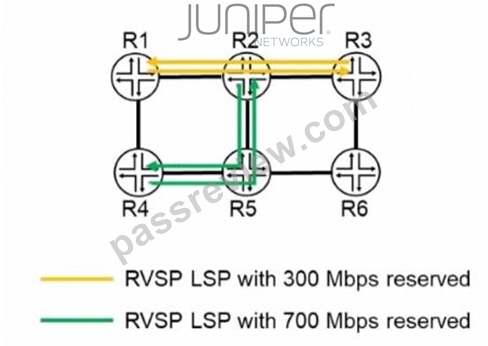
The exhibit shows a topology with 1 Gbps interfaces between routers, and four RSVP LSPs operating with the respective bandwidth reservations.
Which path will be selected for a new LSP from R4 to R6 with a bandwidth reservation of 400 Mbps?
- A. R4 -> R1 -> R2 -> R3 -> R6
- B. R4 -> R5 -> R2 -> R3 -> R6
- C. R4 -> R1 -> R2 -> R5 -> R6
- D. R4 -> R5 -> R6
Answer: C
NEW QUESTION # 30
Exhibit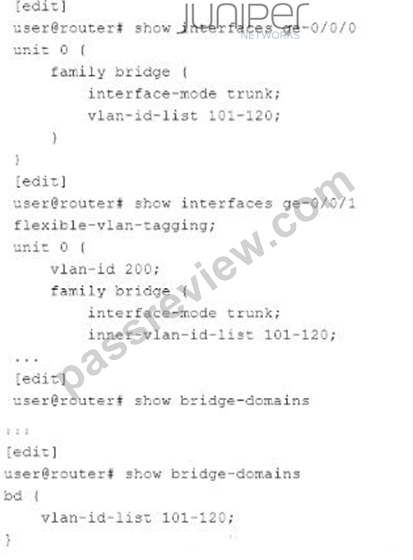
Referring to the exhibit, which two statements are correct? (Choose two.)
- A. Traffic ingressing ge-0/0/0 that is tagged with VLAN 101 will egress ge-0/0/1 unchanged.
- B. Traffic ingressing ge-0/0/0 that is tagged will VLAN 100 will be dropped.
- C. Traffic ingressing ge0/0/0 that Is tagged with VLAN 200 will egress ge-0/0/1 with an outer VLAN tag of 200.
- D. Traffic ingressing ge-0/0/0 that is tagged with VLAN 101 will egress ge-0/0M with an outer VLAN tag of 200.
Answer: A,B
NEW QUESTION # 31
Exhibit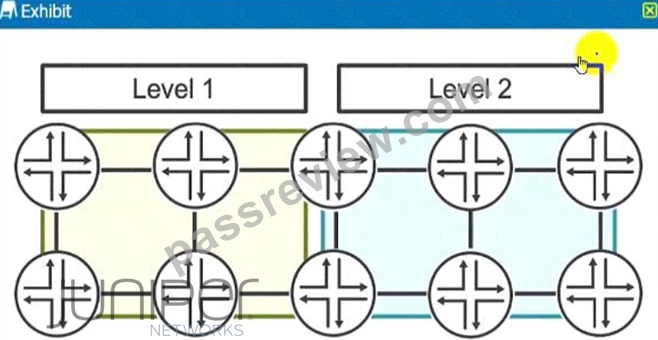
Referring to the exhibit, which two statements are correct? (Choose two.)
- A. Prefixes in Level 2 will be not redistributed to Level 1.
- B. Prefixes in Level 2 will be redistributed to Level 1.
- C. Prefixes in Level 1 will not be redistributed to Level 2.
- D. Prefixes in Level 1 will be redistributed to Level 2.
Answer: B,D
Explanation:
In IS-IS, Level 1 routes are usually contained within the same area and Level 2 routes are used to interconnect different areas. By default, routes from Level 1 are redistributed into Level 2, and vice versa, to ensure reachability between areas.
References
Juniper Networks Technical Documentation on IS-IS
By default, IS-IS protocol leaks routing information from a Level 1 area to a Level 2 area. However, to leak routing information from a Level 2 area to a Level 1 area, an export policy must be explicitly configured.
NEW QUESTION # 32
Exhibit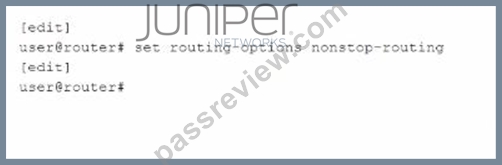
Referring to the exhibit, which two additional steps should you lake to fully configure NSR? (Choose two.)
- A. You must configure graceful restart.
- B. You should configure the max period for NSR precision timers.
- C. You should configure commit synchronization.
- D. You must configure GRES.
Answer: C,D
Explanation:
https://www.juniper.net/documentation/us/en/software/junos/high-availability/topics/task/nsr-configuring.html Nonstop routing (NSR) requires both Graceful Routing Engine Switchover (GRES) and commit synchronization to be configured to maintain routing protocol and forwarding state during a Routing Engine switchover. NSR allows the secondary Routing Engine to take over the control plane without the protocols needing to restart, and GRES ensures that the forwarding plane continues operating with the current forwarding table. Commit synchronization ensures that configuration changes are synchronized between the primary and backup Routing Engines.
Reference:
Juniper Networks documentation on High Availability: Configuring Nonstop Active Routing
NEW QUESTION # 33
Click the Exhibit button.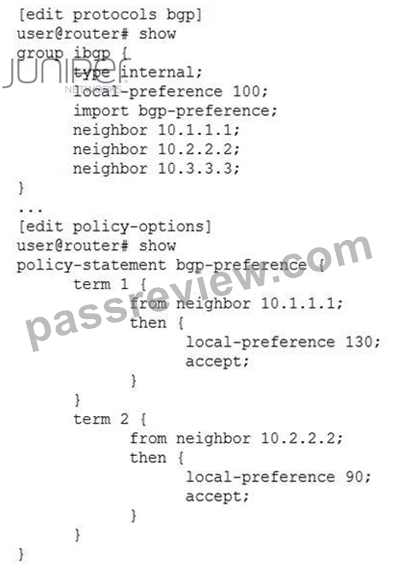
Referring to the exhibit, which statement is correct?
- A. Routes from 10.1.1.1 are less preferred than the default local preference
- B. Routes from 10.1.1.1 are less preferred than routes from 10.2.2.2
- C. Routes from 10.2.2.2 are less preferred than routes from 10.1.1.1
- D. Routes from 10.3.3.3 are less preferred than the default local preference
Answer: C
NEW QUESTION # 34
Which two statements ate correct about the BGP next-hop attribute value? (Choose two.)
- A. By default, the next-hop value is not changed across EBGP links.
- B. By default, the next-hop value is not changed across IBGP links.
- C. By default, the next-hop value is changed across IBGP links.
- D. By default, the next-hop value is changed across EBGP links.
Answer: B,D
Explanation:
By default, the router that originally sourced the route into BGP places its peer address into the attribute field. The next-hop value is then typically changed when the route is transmitted across external gGP (EBGP) links. Internal BGP (IBGP) peers do not alter the next-hop value between themselves.
B: By default, the next-hop value is changed when a route is passed from an EBGP peer to another EBGP peer.
C: By default, the next-hop value is retained when a route is advertised across IBGP links.
Reference::
BGP Next Hop Attribute, Juniper TechLibrary
Understanding BGP Next-Hop Selection, Juniper TechLibrary
NEW QUESTION # 35
You want to make use of the nonstop active routing (NSR) feature.
Which complementary feature must also be enabled?
- A. graceful restart
- B. Virtual Router Redundancy Protocol
- C. graceful Routing Engine switchover
- D. IP anycast
Answer: C
Explanation:
https://www.juniper.net/documentation/en_US/junos/topics/concept/nsr-overview.html
NEW QUESTION # 36
You want to share routes between two routing instances that you have configured?
What are two ways to accomplish this task? (Choose two.)
- A. Use a RIB group.
- B. Configure an instance import policy
- C. Create a forwarding instance.
- D. Use a non-forwarding instance.
Answer: A,B
Explanation:
static route with a next-hop of next-table pointing to the appropriate routing table which contains more accurate information rib-groups to mirror routing information from one route-table to another. However, in many cases, in order to make this work, interface-routes also need to be mirrored. RIB Group policy can be used to constrain the routing information instance-import and instance-export statements configured within the individual routing-instances to leak routes from one table to another. Again, policy can be used here to constrain the routing information. This method is more straightforward than the rib-group method A final approach is to use physical interfaces or logical-tunnels to stitch routing-instances and use a routing protocol or static routes across this connection between the two routing-instances.
To share routes between two routing instances on a Junos device, you can configure an instance import policy in one or both instances to import routes from the other instance. Alternatively, a RIB (Routing Information Base) group can be used to share routes between instances.
Reference::
Routing Instances Overview, Juniper Networks Documentation
RIB Groups Configuration Guide, Juniper Networks Documentation
NEW QUESTION # 37
Click the Exhibit.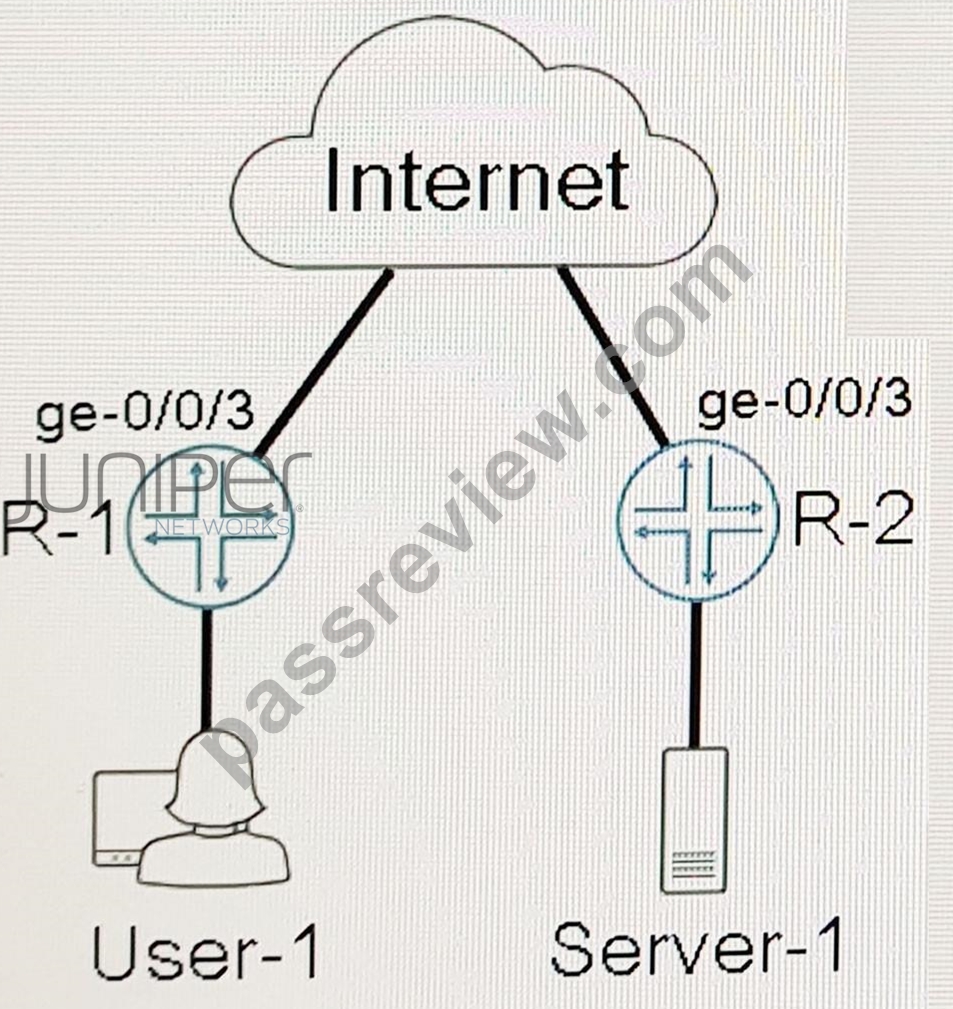
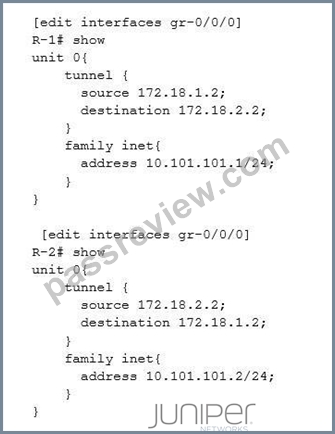
Referring to the exhibit, the GRE tunnel between R-1 and R2 allows connectivity between User-1 and Server-1. User-1 can communicate with Server-1 with packets that are up to 1448 bytes in size.
However, if the packet size is larger than 1448, User-1 cannot communicate with Server-1.
In this scenario, how do you solve the communication problem?
- A. Apply the allow-fragmentation statement to the GRE tunnel configuration.
- B. Apply the path-mtu-discovery statement to the GRE tunnel configuration.
- C. Change the physical MTU on the ge-0/0/3 interfaces on R-1 and R-2 to 1448 bytes.
- D. Change the physical MTU on the gr-0/0/0 interfaces on R-1 and R-2 to 1448 bytes.
Answer: A
NEW QUESTION # 38
Exhibit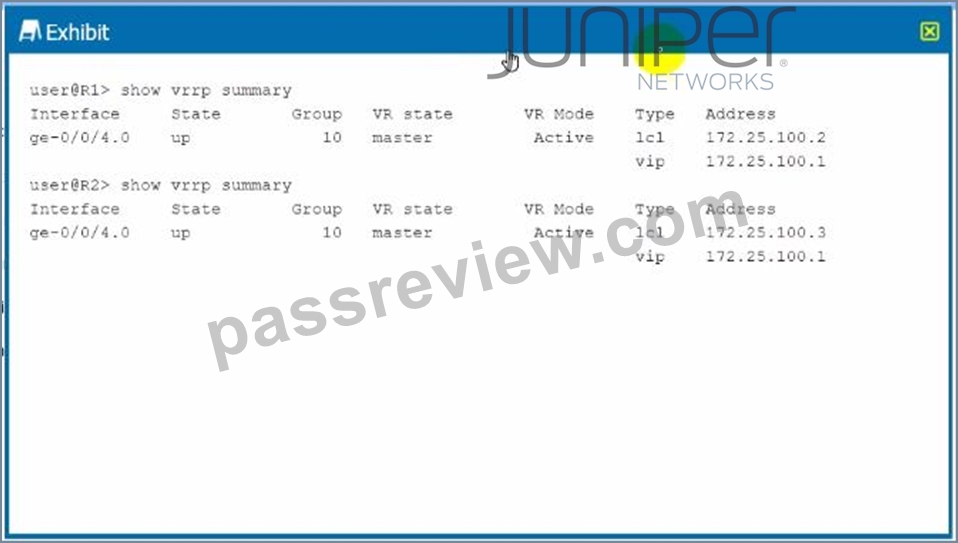
Referring to the exhibit, which statement is true about VRRP?
- A. The routers should use different virtual IP addresses for VRRP to function correctly.
- B. VRRP Is functioning normally in active/active mode.
- C. Both routers are in the same state because they have the same VRRP priority.
- D. VRRP communication between the two devices is not functioning correctly.
Answer: B
Explanation:
The exhibit shows the show vrrp summary output from two routers, with both routers listing the state of their VRRP group as master. VRRP allows for multiple routers to share a virtual IP address and a virtual MAC address, but usually, only one router is the master at any given time while others are in backup state. However, in some configurations, VRRP can operate in an active/active mode where multiple routers handle traffic simultaneously for load sharing. Since both routers show the state as master and there is no evidence of misconfiguration in the virtual IP addresses or priority, it indicates that VRRP is likely functioning in an active/active setup.
Reference:
Juniper documentation on VRRP: Junos OS VRRP Overview
NEW QUESTION # 39
......
The JN0-363 exam covers a wide range of topics, including network architecture, routing protocols, MPLS, BGP, OSPF, and VPN technologies. Candidates are expected to have a strong foundation in these areas and be able to apply their knowledge to real-world scenarios. JN0-363 exam is designed to test the candidate's ability to deploy, configure, and troubleshoot Juniper Networks routers and switches in a service provider environment.
Best updated resource for JN0-363 Online Practice Exam: https://getfreedumps.passreview.com/JN0-363-exam-questions.html