

New 2026 CIPT exam questions Welcome to download the newest PassReview CIPT PDF dumps (258 Q&As)
P.S. Free 2026 Information Privacy Technologist CIPT dumps are available on Google Drive shared by PassReview
NEW QUESTION # 104
Which of the following are the mandatory pieces of information to be included in the documentation of records of processing activities for an organization that processes personal data on behalf of another organization?
- A. Descriptions of the processing activities and relevant data subjects.
- B. Time limits for erasure of different categories of data.
- C. Contact details of the processor and Data Protection Offer (DPO).
- D. Copies of the consent forms from each data subject.
Answer: C
Explanation:
Copies of the consent forms from each data subject (A): This is not a mandatory piece of information for the documentation of processing activities. Reference: GDPR Article 30.
Time limits for erasure of different categories of data (B): This is mandatory as per GDPR requirements to ensure that data is not kept longer than necessary. Reference: GDPR Article 30.
Contact details of the processor and Data Protection Officer (DPO) (C): The GDPR mandates that the records of processing activities must include the contact details of the processor and the DPO. Reference:
GDPR Article 30(2)(a).
Descriptions of the processing activities and relevant data subjects (D): This is mandatory to provide a clear understanding of what data is being processed and for whom. Reference: GDPR Article 30(1)(b).
NEW QUESTION # 105
SCENARIO
Please use the following to answer the next question:
Chuck, a compliance auditor for a consulting firm focusing on healthcare clients, was required to travel to the client's office to perform an onsite review of the client's operations. He rented a car from Finley Motors upon arrival at the airport as so he could commute to and from the client's office. The car rental agreement was electronically signed by Chuck and included his name, address, driver's license, make/model of the car, billing rate, and additional details describing the rental transaction. On the second night, Chuck was caught by a red light camera not stopping at an intersection on his way to dinner. Chuck returned the car back to the car rental agency at the end week without mentioning the infraction and Finley Motors emailed a copy of the final receipt to the address on file.
Local law enforcement later reviewed the red light camera footage. As Finley Motors is the registered owner of the car, a notice was sent to them indicating the infraction and fine incurred. This notice included the license plate number, occurrence date and time, a photograph of the driver, and a web portal link to a video clip of the violation for further review. Finley Motors, however, was not responsible for the violation as they were not driving the car at the time and transferred the incident to AMP Payment Resources for further review. AMP Payment Resources identified Chuck as the driver based on the rental agreement he signed when picking up the car and then contacted Chuck directly through a written letter regarding the infraction to collect the fine.
After reviewing the incident through the AMP Payment Resources' web portal, Chuck paid the fine using his personal credit card. Two weeks later, Finley Motors sent Chuck an email promotion offering 10% off a future rental.
How can Finley Motors reduce the risk associated with transferring Chuck's personal information to AMP Payment Resources?
- A. By requesting AMP Payment Resources delete unnecessary datasets and only utilize what is necessary to process the violation notice.
- B. By providing only the minimum necessary data to process the violation notice and masking all other information prior to transfer.
- C. By transferring all information to separate datafiles and requiring AMP Payment Resources to combine the datasets during processing of the violation notice.
- D. By obfuscating the minimum necessary data to process the violation notice and require AMP Payment Resources to secure store the personal information.
Answer: B
Explanation:
To reduce the risk associated with transferring Chuck's personal information to AMP Payment Resources, Finley Motors could take several steps. One such step would be option A: By providing only the minimum necessary data to process the violation notice and masking all other information prior to transfer. By providing only the minimum necessary data to process the violation notice and masking all other information prior to transfer, Finley Motors can help reduce the risk associated with transferring Chuck's personal information. This can help ensure that only necessary data is shared and that any unnecessary or sensitive data is protected.
NEW QUESTION # 106
SCENARIO - Please use the following to answer the next question:
Carol was a US-based glassmaker who sold her work at art festivals. She kept things simple by only accepting cash and personal checks.
As business grew, Carol couldn't keep up with demand, and traveling to festivals became burdensome. Carol opened a small boutique and hired Sam to run it while she worked in the studio. Sam was a natural salesperson, and business doubled. Carol told Sam, :'l don't know what you are doing, but keep doing it; But months later, the gift shop was in chaos. Carol realized that Sam needed help so she hired Jane, who had business expertise and could handle the back-office tasks. Sam would continue to focus on sales. Carol gave Jane a few weeks to get acquainted with the artisan craft business, and then scheduled a meeting for the three of them to discuss Jane s first impressions.
At the meeting, Carol could not wait to hear Jane s thoughts, but she was unprepared for what Jane had to say.
"Carol. I know that he doesn't realize it, but some of Sam s efforts to increase sales have put you in a vulnerable position. You are not protecting customers personal information like you should." Sam said, :'l am protecting our information. I keep it in the safe with our bank deposit. It's only a list of customers names, addresses and phone numbers that I get from their checks before I deposit them. I contact them when you finish a piece that I think they would like. That's the only information I have! The only other thing I do is post photos and information about your work on the photo sharing site that I use with family and friends. I provide my email address and people send me their information if they want to see more of your work. Posting online really helps sales, Carol. In fact, the only complaint I hear is about having to come into the shop to make a purchase." Carol replied, "Jane, that doesn't sound so bad. Could you just fix things and help us to post even more online?"
''I can," said Jane. "But it's not quite that simple. I need to set up a new program to make sure that we follow the best practices in data management. And I am concerned for our customers. They should be able to manage how we use their personal information. We also should develop a social media strategy" Sam and Jane worked hard during the following year. One of the decisions they made was to contract with an outside vendor to manage online sales. At the end of the year Carol shared some exciting news. ''Sam and Jane, you have done such a great job that one of the biggest names in the glass business wants to buy us out!
And Jane, they want to talk to you about merging all of our customer and vendor information with theirs beforehand " What type of principles would be the best guide for Jane s ideas regarding a new data management program?
- A. Vendor management principles.
- B. Collection limitation principles.
- C. Fair Information Practice Principles.
- D. Incident preparedness principles.
Answer: B
NEW QUESTION # 107
A key principle of an effective privacy policy is that it should be?
- A. Written in enough detail to cover the majority of likely scenarios.
- B. Made general enough to maximize flexibility in its application.
- C. Designed primarily by the organization s lawyers.
- D. Presented with external parties as the intended audience.
Answer: C
NEW QUESTION # 108
SCENARIO
Tom looked forward to starting his new position with a U.S -based automobile leasing company (New Company), now operating in 32 states. New Company was recently formed through the merger of two prominent players, one from the eastern region (East Company) and one from the western region (West Company). Tom, a Certified Information Privacy Technologist (CIPT), is New Company's first Information Privacy and Security Officer. He met today with Dick from East Company, and Harry, from West Company.
Dick and Harry are veteran senior information privacy and security professionals at their respective companies, and continue to lead the east and west divisions of New Company. The purpose of the meeting was to conduct a SWOT (strengths/weaknesses/opportunities/threats) analysis for New Company. Their SWOT analysis conclusions are summarized below.
Dick was enthusiastic about an opportunity for the New Company to reduce costs and increase computing power and flexibility through cloud services. East Company had been contemplating moving to the cloud, but West Company already had a vendor that was providing it with software-as-a-service (SaaS). Dick was looking forward to extending this service to the eastern region. Harry noted that this was a threat as well, because West Company had to rely on the third party to protect its data.
Tom mentioned that neither of the legacy companies had sufficient data storage space to meet the projected growth of New Company, which he saw as a weakness. Tom stated that one of the team's first projects would be to construct a consolidated New Company data warehouse. Tom would personally lead this project and would be held accountable if information was modified during transmission to or during storage in the new data warehouse.
Tom, Dick and Harry agreed that employee network access could be considered both a strength and a weakness. East Company and West Company had strong performance records in this regard; both had robust network access controls that were working as designed. However, during a projected year-long transition period, New Company employees would need to be able to connect to a New Company network while retaining access to the East Company and West Company networks.
When employees are working remotely, they usually connect to a Wi-Fi network. What should Harry advise for maintaining company security in this situation?
- A. Employing Wired Equivalent Privacy (WEP) encryption.
- B. Retaining the password assigned by the network.
- C. Hiding wireless service set identifiers (SSID).
- D. Using tokens sent through HTTP sites to verify user identity.
Answer: C
NEW QUESTION # 109
What risk is mitigated when routing video traffic through a company's application servers, rather than sending the video traffic directly from one user to another?
- A. The user is protected against phishing attacks.
- B. The user's identity is protected from the other user.
- C. The user is assured that stronger authentication methods have been used.
- D. The user's approximate physical location is hidden from the other user.
Answer: D
Explanation:
* Option A: Phishing attacks are typically related to email or messaging security rather than direct video traffic.
* Option B: While identity protection can be a factor, routing through company servers primarily obfuscates the user's IP address and other metadata, which reveals physical location rather than identity specifics.
* Option C: Routing video traffic through a company's servers hides the users' IP addresses from each other, which prevents them from determining each other's physical location.
* Option D: Stronger authentication methods are related to access control but not necessarily to the routing of video traffic.
:
IAPP CIPT Study Guide
Network security principles related to traffic routing
NEW QUESTION # 110
SCENARIO
Clean-Q is a company that offers house-hold and office cleaning services. The company receives requests from consumers via their website and telephone, to book cleaning services. Based on the type and size of service, Clean-Q then contracts individuals that are registered on its resource database - currently managed in-house by Clean-Q IT Support. Because of Clean-Q's business model, resources are contracted as needed instead of permanently employed.
The table below indicates some of the personal information Clean-Q requires as part of its business operations: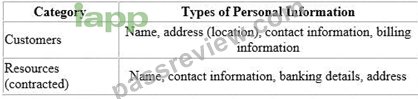
Clean-Q has an internal employee base of about 30 people. A recent privacy compliance exercise has been conducted to align employee data management and human resource functions with applicable data protection regulation. Therefore, the Clean-Q permanent employee base is not included as part of this scenario.
With an increase in construction work and housing developments, Clean-Q has had an influx of requests for cleaning services. The demand has overwhelmed Clean-Q's traditional supply and demand system that has caused some overlapping bookings.
Ina business strategy session held by senior management recently, Clear-Q invited vendors to present potential solutions to their current operational issues. These vendors included Application developers and Cloud-Q's solution providers, presenting their proposed solutions and platforms.
The Managing Director opted to initiate the process to integrate Clean-Q's operations with a cloud solution (LeadOps) that will provide the following solution one single online platform: A web interface that Clean-Q accesses for the purposes of resource and customer management. This would entail uploading resource and customer information.
* A customer facing web interface that enables customers to register, manage and submit cleaning service requests online.
* A resource facing web interface that enables resources to apply and manage their assigned jobs.
* An online payment facility for customers to pay for services.
If Clean-Q were to utilize LeadOps' services, what is a contract clause that may be included in the agreement entered into with LeadOps?
- A. A provision that allows Clean-Q to conduct audits of LeadOps' information processing and information security environment, at LeadOps' cost and at any time that Clean-Q requires.
- B. A provision that requires LeadOps to notify Clean-Q of any suspected breaches of information that involves customer or resource information managed on behalf of Clean-Q.
- C. A provision prescribing technical and organizational controls that LeadOps must implement.
- D. A provision that holds LeadOps liable for a data breach involving Clean-Q's information.
Answer: B
Explanation:
When engaging with a cloud service provider like LeadOps, it's critical to include specific clauses in the contract to ensure the protection and management of personal information. Here's why a notification clause is essential:
* Data Breach Notification: A provision requiring LeadOps to notify Clean-Q of any suspected breaches ensures that Clean-Q can take immediate action to mitigate any potential damage, inform affected individuals, and comply with regulatory obligations.
* Regulatory Compliance: Many data protection regulations, such as GDPR and CCPA, mandate timely notification of data breaches to both the regulatory authorities and the affected individuals. Including this clause ensures compliance with such laws.
* Risk Management: Prompt notification allows Clean-Q to manage and address any risks associated with the breach, including public relations issues and potential legal liabilities.
* Transparency and Accountability: This clause promotes transparency and accountability, ensuring that LeadOps maintains a high standard of data security and is responsible for informing Clean-Q about any security incidents.
NEW QUESTION # 111
How should the sharing of information within an organization be documented?
- A. With a binding contract.
- B. With a disclosure statement.
- C. With a data flow diagram.
- D. With a memorandum of agreement.
Answer: C
Explanation:
The sharing of information within an organization should be documented with a data flow diagram. A data flow diagram (DFD) visually represents the flow of data within a system, showing how data is processed and transferred between different parts of the organization. It helps to identify where data is stored, how it moves through various processes, and where it might be shared internally. This method provides a clear and comprehensive overview of data interactions, facilitating better understanding and management of data sharing practices.
Reference:
IAPP CIPT Study Guide: Data Flow Diagrams (DFD) as a tool for mapping data flows within an organization.
GDPR, Article 30: Records of processing activities, which often use data flow diagrams for documentation.
NEW QUESTION # 112
SCENARIO - Please use the following to answer the next question:
Clean-Q is a company that offers house-hold and office cleaning services. The company receives requests from consumers via their website and telephor, to book cleaning services. Based on the type and size of service, Clean-Q then contracts individuals that are registered on its resource database - currently managed in-house by Clean-Q IT Support. Because of Clean-Q:s business.
model, resources are contracted as needed instead of permanently employed.
The table below indicates some of the personal information Clean-Q requires as part of its business operations: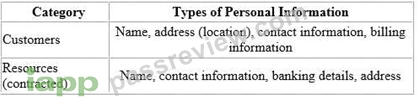
Clean-Q has an internal employee base of about 30 people. A recent privacy compliance exercise has been conducted to align employee data management and human resource functions with applicable data protection regulation.
Therefore, the Clean-Q permanent employee base is not included as part of this scenario.
With an increase in construction work and housing developments, Clean-Q has had an influx of requests for cleaning services. The demand has overwhelmed Clean-Q:s traditional supply and demand system that has caused some overlapping bookings.
In a business statrategy session held by senior management recently, Clearning invited vendors to present potential solutions to their current operational issues. These vendors includes included Application development and Cloud solution providers, presenting their proposed solution and platforms.
The Managing Direct opted to initiate the process to integrate Clean-Q's operations with a cloud solution (LeadOps) that will provide the following solution one single online platform. A web interface that Clean-Q accesses for the purposes of resource and customer management. This would entail uploading resource and customer information.
A customer facing web interface that enables customers to register, manage and submit cleaning service requests online.
A resource facing web interface that enables resources to apply and manage their assigned jobs.
An online payment facility for customer to pay for services.
Which question would you most likely ask to gain more insight about LeadOps and provide practical privacy recommendations?
- A. What is LeadOps annual turnover?
- B. Where are LeadOps operations and hosting services located?
- C. How big is LeadOps employee base?
- D. Does LeadOps practice agile development and maintenance of their system?
Answer: B
NEW QUESTION # 113
What must be done to destroy data stored on "write once read many" (WORM) media?
- A. The erase function must be used to remove all data.
- B. The data must be made inaccessible by encryption.
- C. The media must be reformatted.
- D. The media must be physically destroyed.
Answer: D
Explanation:
To destroy data stored on "write once read many" (WORM) media, the media must be physically destroyed.
WORM media is designed to prevent data from being modified or erased once written. Therefore, the only effective method to ensure that the data is irretrievable is to physically destroy the media.
Reference:
IAPP CIPT Study Guide: Data destruction methods for various storage media.
NIST SP 800-88: Guidelines for Media Sanitization, which recommends physical destruction for WORM media.
NEW QUESTION # 114
A sensitive biometrics authentication system is particularly susceptible to?
- A. Theft of finely individualized personal data.
- B. False positives.
- C. False negatives.
- D. Slow recognition speeds.
Answer: B
NEW QUESTION # 115
You are a wine collector who uses the web to do research about your hobby. You navigate to a news site and an ad for wine pops up. What kind of advertising is this?
- A. Behavioral.
- B. Contextual.
- C. Demographic.
- D. Remnant.
Answer: B
Explanation:
The type of advertising described in the scenario where a wine ad pops up while the user is researching about wine is:
* Contextual Advertising (Option C): This is when ads are shown based on the content of the web page the user is currently viewing. Since the user is on a news site and sees an ad related to wine, it fits the definition of contextual advertising.
Option A (Remnant) refers to unsold ad inventory that is sold at a discount.Option B (Behavioral) refers to ads based on the user's past behavior or browsing history.Option D (Demographic) targets users based on demographic information like age, gender, or location.
References:
* IAPP Information Privacy Technologist (CIPT) training materials
* "Internet Advertising: Theory and Research" by Ducoffe, Halavais
NEW QUESTION # 116
SCENARIO
Please use the following to answer the next questions:
Your company is launching a new track and trace health app during the outbreak of a virus pandemic in the US. The developers claim the app is based on privacy by design because personal data collected was considered to ensure only necessary data is captured, users are presented with a privacy notice, and they are asked to give consent before data is shared. Users can update their consent after logging into an account, through a dedicated privacy and consent hub. This is accessible through the 'Settings' icon from any app page, then clicking 'My Preferences', and selecting 'Information Sharing and Consent' where the following choices are displayed:
* "I consent to receive notifications and infection alerts";
* "I consent to receive information on additional features or services, and new products";
* "I consent to sharing only my risk result and location information, for exposure and contact tracing purposes";
* "I consent to share my data for medical research purposes"; and
* "I consent to share my data with healthcare providers affiliated to the company".
For each choice, an ON* or OFF tab is available The default setting is ON for all Users purchase a virus screening service for USS29 99 for themselves or others using the app The virus screening service works as follows:
* Step 1 A photo of the user's face is taken.
* Step 2 The user measures their temperature and adds the reading in the app
* Step 3 The user is asked to read sentences so that a voice analysis can detect symptoms
* Step 4 The user is asked to answer questions on known symptoms
* Step 5 The user can input information on family members (name date of birth, citizenship, home address, phone number, email and relationship).) The results are displayed as one of the following risk status "Low. "Medium" or "High" if the user is deemed at "Medium " or "High" risk an alert may be sent to other users and the user is Invited to seek a medical consultation and diagnostic from a healthcare provider.
A user's risk status also feeds a world map for contact tracing purposes, where users are able to check if they have been or are in dose proximity of an infected person If a user has come in contact with another individual classified as "medium' or 'high' risk an instant notification also alerts the user of this. The app collects location trails of every user to monitor locations visited by an infected individual Location is collected using the phone's GPS functionary, whether the app is in use or not however, the exact location of the user is "blurred' for privacy reasons Users can only see on the map circles What is likely to be the biggest privacy concern with the current 'Information Sharing and Consent' page?
- A. The ON or OFF default setting for each item.
- B. The navigation needed in the app to get to the consent page.
- C. The option to consent to receive potential marketing information.
- D. The information sharing with healthcare providers affiliated with the company.
Answer: A
Explanation:
The biggest privacy concern with the current 'Information Sharing and Consent' page is that all consent options are set to ON by default. According to privacy by design principles and data protection regulations, such as the General Data Protection Regulation (GDPR), consent should be freely given, specific, informed, and unambiguous. Pre-ticked boxes do not constitute valid consent because they do not provide a clear affirmative action from the user. The default ON setting could lead to unintentional data sharing and potential privacy breaches, making this a significant concern. (Reference: IAPP CIPT Study Guide, Chapter on Privacy by Design and Default)
NEW QUESTION # 117
SCENARIO
Tom looked forward to starting his new position with a U.S -based automobile leasing company (New Company), now operating in 32 states. New Company was recently formed through the merger of two prominent players, one from the eastern region (East Company) and one from the western region (West Company). Tom, a Certified Information Privacy Technologist (CIPT), is New Company's first Information Privacy and Security Officer. He met today with Dick from East Company, and Harry, from West Company. Dick and Harry are veteran senior information privacy and security professionals at their respective companies, and continue to lead the east and west divisions of New Company. The purpose of the meeting was to conduct a SWOT (strengths/weaknesses/opportunities/threats) analysis for New Company. Their SWOT analysis conclusions are summarized below.
Dick was enthusiastic about an opportunity for the New Company to reduce costs and increase computing power and flexibility through cloud services. East Company had been contemplating moving to the cloud, but West Company already had a vendor that was providing it with software-as-a-service (SaaS). Dick was looking forward to extending this service to the eastern region. Harry noted that this was a threat as well, because West Company had to rely on the third party to protect its data.
Tom mentioned that neither of the legacy companies had sufficient data storage space to meet the projected growth of New Company, which he saw as a weakness. Tom stated that one of the team's first projects would be to construct a consolidated New Company data warehouse. Tom would personally lead this project and would be held accountable if information was modified during transmission to or during storage in the new data warehouse.
Tom, Dick and Harry agreed that employee network access could be considered both a strength and a weakness. East Company and West Company had strong performance records in this regard; both had robust network access controls that were working as designed. However, during a projected year-long transition period, New Company employees would need to be able to connect to a New Company network while retaining access to the East Company and West Company networks.
When employees are working remotely, they usually connect to a Wi-Fi network. What should Harry advise for maintaining company security in this situation?
- A. Employing Wired Equivalent Privacy (WEP) encryption.
- B. Retaining the password assigned by the network.
- C. Hiding wireless service set identifiers (SSID).
- D. Using tokens sent through HTTP sites to verify user identity.
Answer: C
Explanation:
Instead, Harry should advise employees to use strong passwords or other forms of secure authentication such as multi-factor authentication when connecting to Wi-Fi networks. He should also advise them to use secure methods of encryption such as WPA2 or WPA3 when transmitting sensitive company data over Wi-Fi.
NEW QUESTION # 118
SCENARIO - Please use the following to answer the next question:
It should be the most secure location housing data in all of Europe, if not the world. The Global Finance Data Collective (GFDC) stores financial information and other types of client data from large banks, insurance companies, multinational corporations and governmental agencies. After a long climb on a mountain road that leads only to the facility, you arrive at the security booth. Your credentials are checked and checked again by the guard to visually verify that you are the person pictured on your passport and national identification card.
You are led down a long corridor with server rooms on each side, secured by combination locks built into the doors. You climb a flight of stairs and are led into an office that is lighted brilliantly by skylights where the GFDC Director of Security, Dr. Monique Batch, greets you. On the far wall you notice a bank of video screens showing different rooms in the facility. At the far end, several screens show different sections of the road up the mountain.
Dr. Batch explains once again your mission. As a data security auditor and consultant, it is a dream assignment: The GFDC does not want simply adequate controls, but the best and most effective security that current technologies allow.
!'We were hacked twice last year," Dr. Batch says, :'and although only a small number of records were stolen, the bad press impacted our business. Our clients count on us to provide security that is nothing short of impenetrable and to do so quietly. We hope to never make the news again." She notes that it is also essential that the facility is in compliance with all relevant security regulations and standards.
You have been asked to verify compliance as well as to evaluate all current security controls and security measures, including data encryption methods, authentication controls and the safest methods for transferring data into and out of the facility. As you prepare to begin your analysis, you find yourself considering an intriguing question: Can these people be sure that I am who I say I am?
You are shown to the office made available to you and are provided with system login information, including the name of the wireless network and a wireless key. Still pondering, you attempt to pull up the facility s wireless network, but no networks appear in the wireless list. When you search for the wireless network by name, however it is readily found What type of wireless network does GFDC seem to employ?
- A. A wireless mesh network.
- B. A user verified network.
- C. A reluctant network.
- D. A hidden network.
Answer: A
NEW QUESTION # 119
A sensitive biometrics authentication system is particularly susceptible to?
- A. Theft of finely individualized personal data.
- B. False negatives.
- C. Slow recognition speeds.
- D. False positives.
Answer: B
Explanation:
Explanation/Reference: https://link.springer.com/article/10.1007/s41403-017-0026-8
NEW QUESTION # 120
What is the name of an alternative technique to counter the reduction in use of third-party cookies, where web publishers may consider utilizing data cached by a browser and returned with a subsequent request from the same resource to track unique users?
- A. Browser fingerprinting.
- B. Canvas fingerprinting.
- C. Entity tagging.
- D. Web beacon tracking.
Answer: A
Explanation:
Browser fingerprinting is a technique used to track users by collecting information about their browser and device characteristics, which are then used to create a unique identifier. This technique can be employed as an alternative to third-party cookies and can track users across different sessions and sites.
Reference:IAPP CIPT Study Guide, "Tracking Technologies," which covers various methods of user tracking including cookies, web beacons, and browser fingerprinting.
NEW QUESTION # 121
How should the sharing of information within an organization be documented?
- A. With a binding contract.
- B. With a disclosure statement.
- C. With a data flow diagram.
- D. With a memorandum of agreement.
Answer: C
Explanation:
The sharing of information within an organization should be documented with a data flow diagram. A data flow diagram (DFD) visually represents the flow of data within a system, showing how data is processed and transferred between different parts of the organization. It helps to identify where data is stored, how it moves through various processes, and where it might be shared internally. This method provides a clear and comprehensive overview of data interactions, facilitating better understanding and management of data sharing practices.
NEW QUESTION # 122
To comply with the Sarbanes-Oxley Act (SOX), public companies in the United States are required to annually report on the effectiveness of the auditing controls of their financial reporting systems. These controls must be implemented to prevent unauthorized use, disclosure, modification, and damage or loss of financial data.
Why do these controls ensure both the privacy and security of data?
- A. Modification of data is an aspect of privacy; unauthorized use, disclosure, and damage or loss of data are aspects of security.
- B. Damage or loss of data are aspects of privacy; disclosure, unauthorized use, and modification of data are aspects of privacy.
- C. Unauthorized use of data is an aspect of privacy; disclosure, modification, and damage or loss of data are aspects of security.
- D. Disclosure of data is an aspect of privacy; unauthorized use, modification, and damage or loss of data are aspects of security.
Answer: D
NEW QUESTION # 123
......
CIPT exam questions from PassReview dumps: https://getfreedumps.passreview.com/CIPT-exam-questions.html (258 Q&As)