

[2026] Pass your 3V0-25.25 exam with this 100% Free 3V0-25.25 Braindump
View All 3V0-25.25 Actual Exam Questions, Answers and Explanations for Free
VMware 3V0-25.25 Exam Syllabus Topics:
| Topic | Details |
|---|---|
| Topic 1 |
|
| Topic 2 |
|
| Topic 3 |
|
| Topic 4 |
|
| Topic 5 |
|
NEW QUESTION # 32
An administrator is responsible for managing a VMware Cloud Foundation (VCF) Private Cloud consisting of a single VCF Fleet with a single Workload Domain.
The administrator has been tasked with configuring NSX to support the new Virtual Desktop Infrastructure (VDI) solution that allows users to securely access a mainframe- based application located on the physical network. The VDI solution will use a dedicate DHCP solution for each of the the desktop pool segments and static addresses for all VDI management components.
The administrator completes the following steps towards configuring DHCP:
1. Creates a new tier-1 gateway (vdi-tier-1) and links it to the tier-0 gateway (gw-tier-0).
2. Creates one new segment for vdi management (vdi-seg-01) and connects it to vdi-tier-1.
3. Creates two new segments for virtual desktops (vdi-seg-02 and vdi-seg-03) and connects them to vdi-tier-1.
Drag and drop the six steps from the list of Possible Steps on the left and place them in order in to the Solution Steps. (Choose six.)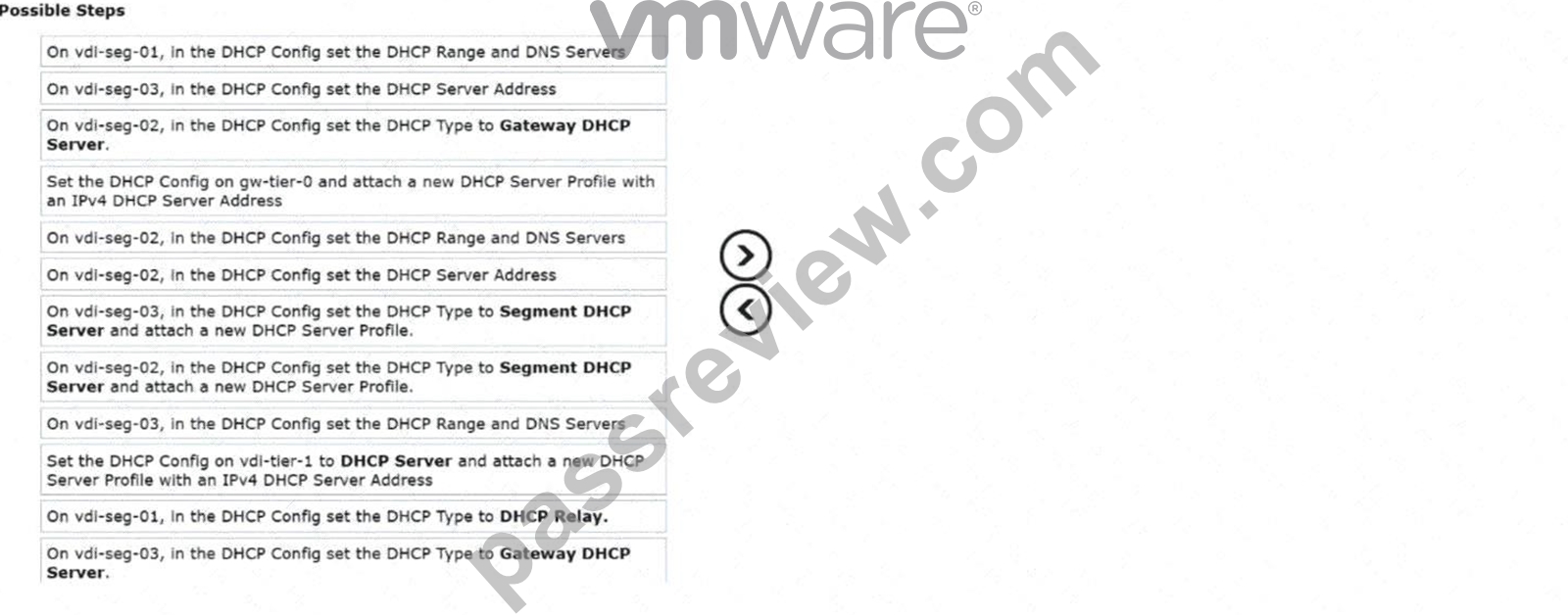
Answer:
Explanation: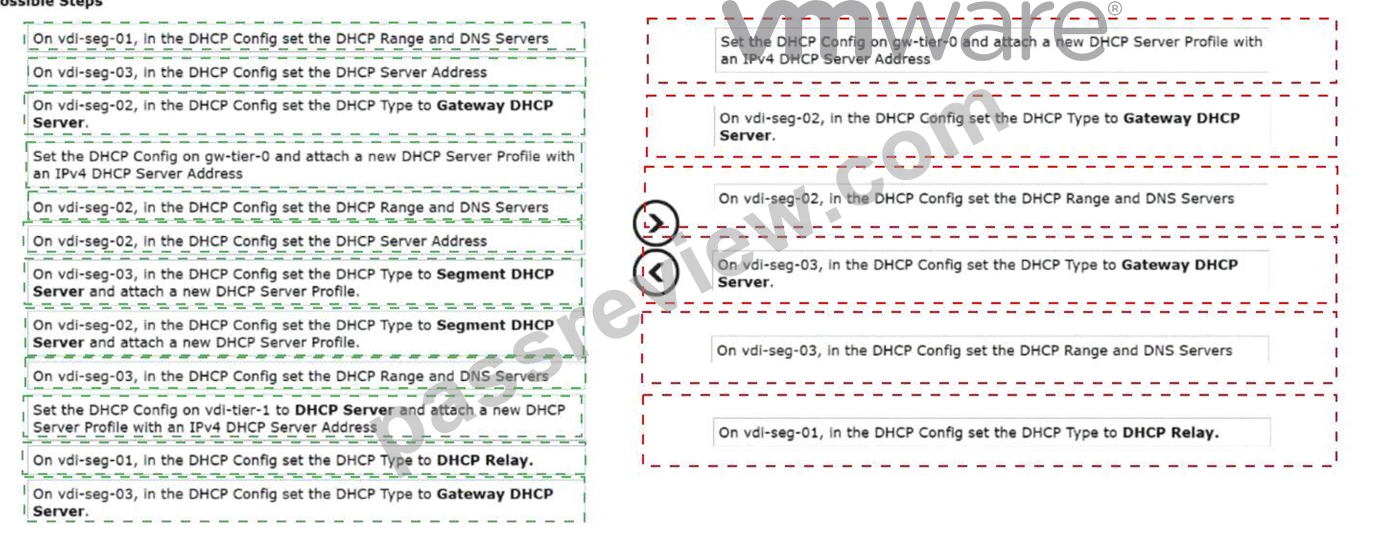
Explanation:
For the VDI solution requiring dedicated DHCP for desktop pool segments and static addresses for management components, the correct sequence of steps to configure DHCP is as follows:
* Set the DHCP Config on vdi-tier-1 to DHCP Server and attach a new DHCP Server Profile with an IPv4 DHCP Server Address.This establishes the Tier-1 gateway as the local DHCP service provider for its attached segments.
* On vdi-seg-02, in the DHCP Config set the DHCP Type to Gateway DHCP Server.This instructs the segment to use the DHCP server service configured on its parent Tier-1 gateway.
* On vdi-seg-02, in the DHCP Config set the DHCP Range and DNS Servers.Defines the specific IP pool and network settings for the first desktop pool.
* On vdi-seg-03, in the DHCP Config set the DHCP Type to Gateway DHCP Server.Instructs the second desktop segment to also leverage the Tier-1 DHCP service.
* On vdi-seg-03, in the DHCP Config set the DHCP Range and DNS Servers.Defines the IP pool for the second desktop pool.
* On vdi-seg-01, in the DHCP Config set the DHCP Type to DHCP Relay.Since management components use static addresses provided by an external mainframe-based solution or dedicated physical infrastructure, a relay is used rather than a local server to ensure proper network isolation and policy enforcement for the physical mainframe application.
NEW QUESTION # 33
An administrator was asked to explain the characteristic and requirements of Centralized Connectivity Mode which is planned to be configured in one of the workload domains in VMware Cloud Foundation (VCF) environment.
Drag and drop four options from the Options list on the left and place them into the Centralized Connectivity Mode on the right in any order. (Choose four.)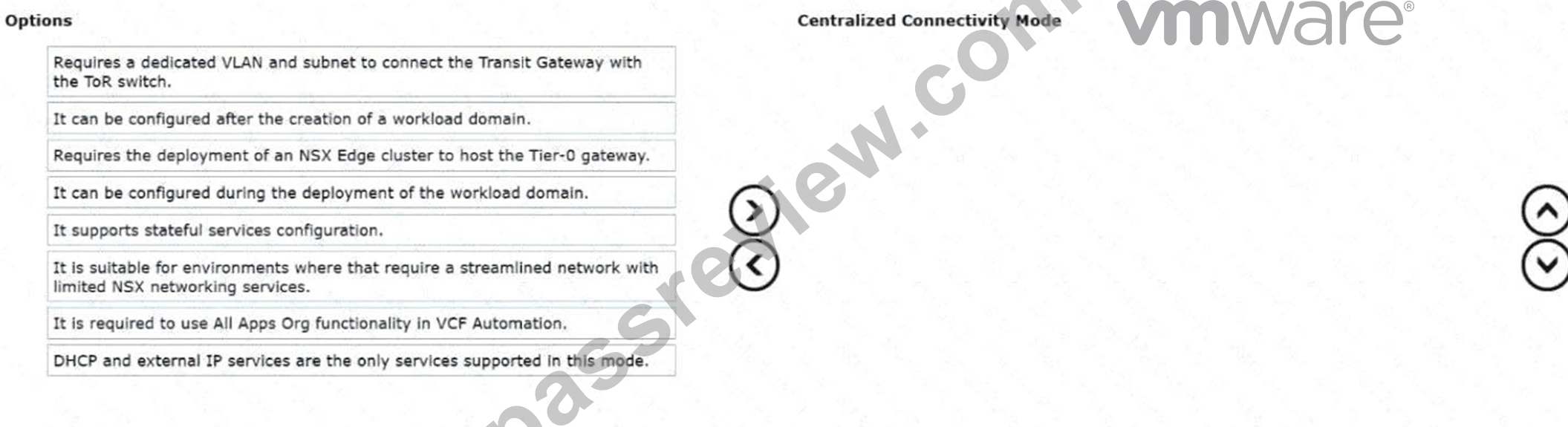
Answer:
Explanation: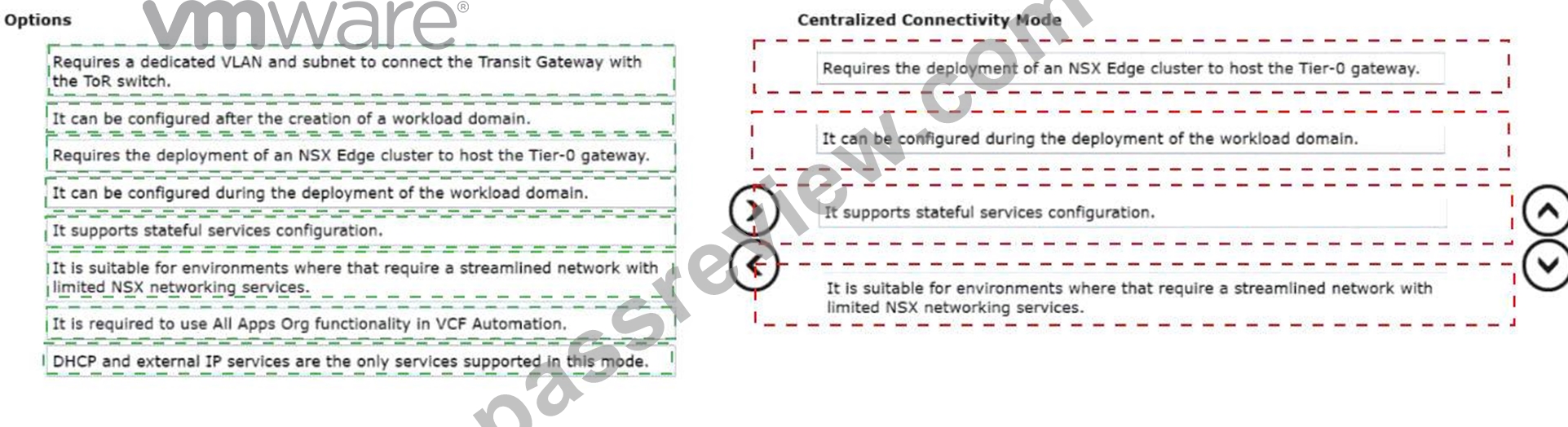
Explanation:
* Requires the deployment of an NSX Edge cluster to host the Tier-0 gateway.
* It can be configured during the deployment of the workload domain.
* It supports stateful services configuration.
* It is suitable for environments that require a streamlined network with limited NSX networking services.
InVMware Cloud Foundation (VCF) 9.0, the networking architecture introduces specialized connectivity modes to cater to different organizational needs, withCentralized Connectivity Modebeing a primary option for streamlined deployments. This mode is fundamentally anchored to the physical infrastructure via localized resources rather than distributed components across the entire cluster.
The most critical technical requirement for this mode is that itrequires the deployment of an NSX Edge cluster to host the Tier-0 gateway. Unlike distributed models, centralized connectivity funnels North-South traffic through specific Edge nodes that serve as the demarcation point between the virtual overlay and the physical Top-of-Rack (ToR) switches. This centralization is what enables the next key characteristic: it supports stateful services configuration. Because traffic is anchored to specific Service Routers (SR) on Edge nodes, stateful operations such as NAT, Load Balancing, and stateful firewalls can maintain session persistence, which is not natively possible in a purely distributed Active/Active ECMP environment without specialized configuration.
From a lifecycle perspective, this mode is highly integrated into the SDDC Manager workflows andcan be configured during the deployment of the workload domain. This allows architects to define the networking posture of a new domain at "Day 0," ensuring that the necessary Edge resources and Tier-0/Tier-1 hierarchies are provisioned automatically to meet the domain's specific requirements.
Finally, Centralized Connectivity Modeis suitable for environments that require a streamlined network with limited NSX networking services. It provides a "cloud-lite" approach to networking, offering the necessary isolation and security of NSX without the complexity of managing a full-scale distributed fabric.
This makes it an ideal choice for smaller workload domains, specialized labs, or legacy application environments that do not require the massive scale of a distributed transit gateway but still need robust stateful security and simplified North-South egress.
NEW QUESTION # 34
The administrator must configure Border Gateway Protocol (BGP) on the Tier-0 Gateway to establish neighbor relationships with upstream routers. Which two statements describe the Border Gateway Routing Protocol (BGP) configuration on a Tier-0 Gateway? (Choose two.)
- A. The network is divided into areas that are logical groups.
- B. EIGRP is configured by default.
- C. It supports a 4-byte autonomous system number.
- D. Can be used as an Exterior Gateway Protocol.
Answer: C,D
Explanation:
Comprehensive and Detailed 250 to 350 words of Explanation From VMware Cloud Foundation (VCF) documents:
In the architecture ofVMware Cloud Foundation (VCF)and its networking component, NSX, theTier-0 Gatewayserves as the critical demarcation point between the virtualized overlay network and the physical infrastructure. To facilitate this communication, BGP is the industry-standard protocol utilized.
BGP is fundamentally designed as anExterior Gateway Protocol (EGP). While it can be used internally (iBGP), its primary role in a VCF deployment is to exchange routing information between the SDDC and the physical Top-of-Rack (ToR) switches or core routers (eBGP). This allows the physical network to learn about the virtual subnets (overlay segments) and allows the virtual environment to receive a default route or specific external prefixes. This confirms that BGP is utilized as an EGP in these designs.
Furthermore, as global IP networking has evolved, the traditional 2-byte Autonomous System (AS) numbers (ranging from 1 to 65,535) were found to be insufficient for the number of organizations requiring them.
Modern NSX versions integrated into VCF 5.x and 9.0 fully support4-byte Autonomous System numbers (ranging from 1 to 4,294,967,295). This support is essential for service providers and large enterprises that have been assigned 4-byte ASNs by regional internet registries.
Option A is incorrect because EIGRP is a proprietary Cisco protocol and is not used by NSX. Option C describes OSPF (Open Shortest Path First), which uses "Areas," whereas BGP uses "Autonomous Systems." Therefore, the ability to act as an EGP and support for 4-byte ASNs are the verified characteristics of BGP within the VCF networking stack.
NEW QUESTION # 35
An administrator is tasked to configure NSX Federation between separate VMware Cloud Foundation (VCF) Fleets. Which requirement must all sites meet before being added to a Global Manager (GM) for NSX Federation?
- A. All Sites must use the same VTEP VLAN and IP pools.
- B. All sites must be managed by the same VCF instance.
- C. All sites must have the same NSX version and build.
- D. All sites must use identical Tier-0 gateway BGP autonomous system numbers.
Answer: C
Explanation:
Comprehensive and Detailed 250 to 350 words of Explanation From VMware Cloud Foundation (VCF) documents:
NSX Federation, a core component of large-scale VCF deployments across multiple sites or "fleets," introduces a hierarchical management model where aGlobal Manager (GM)orchestrates security policies and networking objects across multipleLocal Managers (LMs).
To ensure stability and compatibility in the communication between the Global Manager and the Local Managers, VMware documentation specifies strictversion parityrequirements. When onboarding a site into a Federation, the Local Manager at that site must be running thesame NSX version and buildas the other sites in the Federation and must be compatible with the Global Manager's version. Discrepancies in versions can lead to synchronization failures, as the API schemas and internal database structures for Global Objects (like Global Segments or Groups) may differ between builds.
While Federation allows for geographic and administrative separation, the underlying software-defined networking stack must be synchronized. Option A is incorrect; in fact, VTEP/TEP VLANs and IP poolsshould be unique to each site to avoid IP conflicts in the transport network, though they must have Layer 3 reachability to one another. Option B is incorrect; unique BGP AS numbers are often preferred for multi-site routing to prevent loops. Option C is also incorrect, as Federation is specifically designed to link different VCF instances (sites) together into a single manageable entity.
In aVCF 5.x or 9.0context, the SDDC Manager helps maintain this requirement by ensuring that the "Bill of Materials" (BOM) is consistent across sites intended for Federation. Before the GM can successfully register and "push" configuration to an LM, the handshake process validates the build version to prevent the corruption of the global intended state.
NEW QUESTION # 36
An administrator has noticed that both the active and standby Global Managers have gone offline.
What is the correct sequence of events to restore the Global Managers?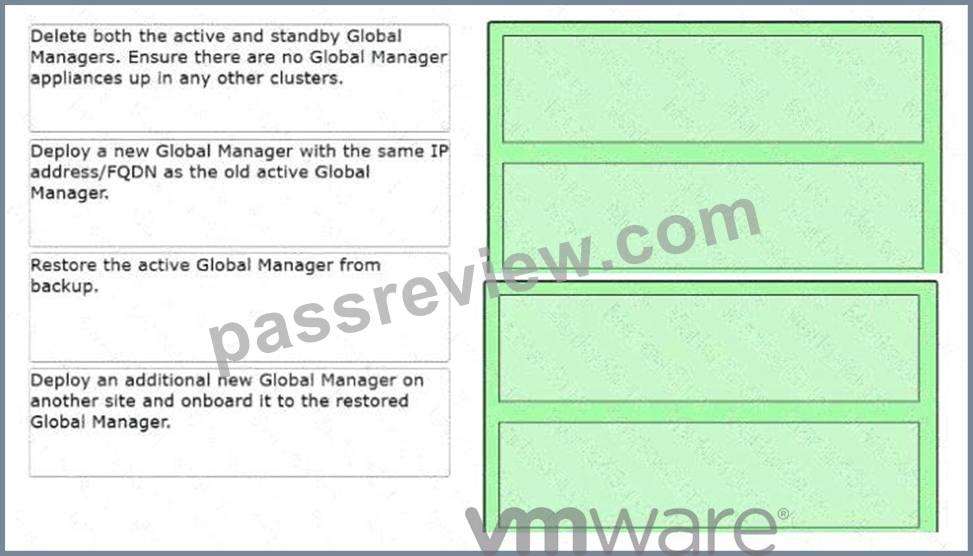
Answer:
Explanation: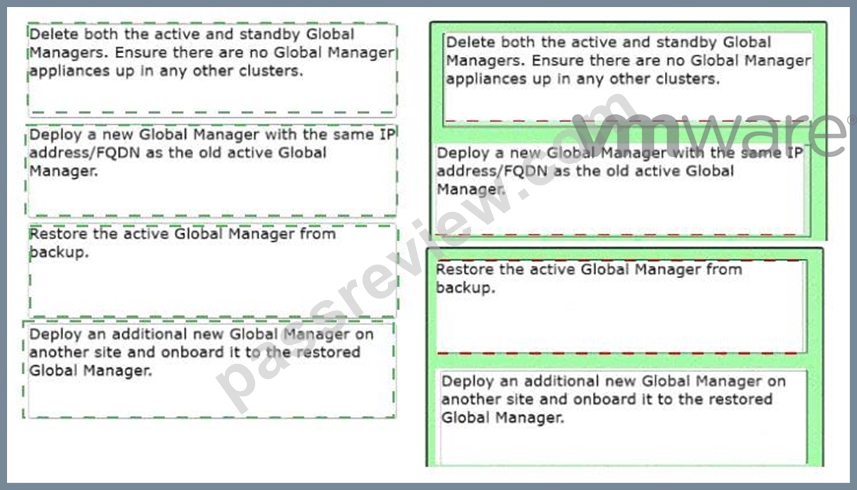
Explanation:
* Step 1: Delete both the active and standby Global Managers. Ensure there are no Global Manager appliances up in any other clusters.
* Step 2: Deploy a new Global Manager with the same IP address/FQDN as the old active Global Manager.
* Step 3: Restore the active Global Manager from backup.
* Step 4: Deploy an additional new Global Manager on another site and onboard it to the restored Global Manager.
In aVMware Cloud Foundationmulti-site deployment usingNSX Federation, the Global Manager (GM) manages the global networking configuration across multiple sites. If the entire GM cluster (Active and Standby) fails, the following architectural principles apply:
* Cleanup (Step 1):Before initiating a restore, the environment must be "cleaned." If old, failed VMs remain in the inventory or on the hosts, they can cause IP address conflicts or UUID mismatches during the deployment of the new appliance. You must ensure the management plane is clear of the original failed nodes.
* Identity Consistency (Step 2):When restoring an NSX appliance (Local or Global) from backup, the new appliancemustbe deployed with the exact sameIP address and FQDNas the original active node.
This is critical because the existing Local Managers (LMs) at each site already have established thumbprints and communication channels tied to that specific identity.
* The Restore Operation (Step 3):Once the "seed" appliance is deployed, the restore process is triggered through the NSX Manager UI/API. This process re-populates the database with the global segments, firewall rules, and Tier-0/Tier-1 configurations.
* Restoring Redundancy (Step 4):The backup only contains the configuration of the cluster. It does not
"restore" the standby VM itself. High Availability (HA) must be manually re-established by deploying a second GM appliance at the secondary site and joining it to the newly restored Global Manager cluster to act as the standby.
NEW QUESTION # 37
An architect has just deployed a new NSX Edge cluster in a VMware Cloud Foundation (VCF) fleet. The BGP peer between the NSX Tier-0 gateway and the top-of-rack routers is successfully up and stable.
* BGP Connection is established, but the NSX Tier-0 is not receiving a default route from the top-of-rack routers.
* Workloads inside NSX have no Internet access.
What could be the solution?
- A. The top-of-rack router receives a default route from Tier-0 gateway.
- B. Tier-0 gateway has a limit set too low for how many routes it can accept.
- C. There is no default route configured on the top-of-rack router for the Tier-0 gateway.
- D. Tier-0 gateway community settings are missing on the top-of-rack router configuration.
Answer: C
Explanation:
Comprehensive and Detailed 250 to 350 words of Explanation From VMware Cloud Foundation (VCF) documents:
In aVMware Cloud Foundation (VCF)deployment, establishing a stable BGP neighborship between the Tier-0 Gatewayand the physicalTop-of-Rack (ToR)switches is only the first step in enabling North-South connectivity. While the BGP state may show as "Established," this only confirms that the control plane handshake is complete and the peers are ready to exchange prefixes.
The primary reason for a lack of external connectivity in this scenario is that norouting informationis being shared. For workloads within the SDDC to reach the internet, the Tier-0 Gateway must have a path to external networks. In most enterprise VCF designs, the physical network (ToR) is expected to provide adefault route (0.0.0.0/0)to the Tier-0 Gateway.
If the Tier-0 is not receiving this route, the issue typically lies in the physical router's configuration. BGP does not automatically "originate" or "redistribute" a default route unless explicitly commanded to do so. On most physical network platforms (like Cisco, Arista, or Juniper), the administrator must specifically configure a
"default-originate" command or ensure a static default route exists in the physical RIB and is allowed to be advertised into the BGP session with the NSX Edge nodes.
Options A and C are unlikely to be the primary cause of a completely missing default route in a fresh deployment. Option B describes the inverse-where the virtual network tells the physical network how to find the internet-which is incorrect for a standard VCF consumer model. Therefore, verifying and enabling the default route advertisement on the physical ToR switchesis the verified solution to provide the Tier-0 with the necessary egress path for internet-bound workload traffic.
NEW QUESTION # 38
An administrator has a vSphere 8 Update 1a with NSX 4.1.0.2 environment. What option can the administrator use to converge this vSphere with NSX environment into a VMware Cloud Foundation (VCF) Workload Domain?
- A. Upgrade the environment and use VCF Operations to converge the vSphere environment into a new VCF Workload Domain.
- B. Use the VCF installer to automatically converge the vSphere with NSX environment into a new VCF Workload Domain.
- C. Upgrade the environment version and use the VCF installer to converge the vSphere environment into a new VCF Workload Domain.
- D. Upgrade NSX to version 9 into the vSphere 8 environment and use the VCF installer to converge the vSphere 8 with NSX environment into a new VCF Workload Domain.
Answer: B
Explanation:
Comprehensive and Detailed 250 to 350 words of Explanation From VMware Cloud Foundation (VCF) documents:
The process of transforming an existing, "brownfield" environment into a VCF-managed infrastructure is known asConvergence. In VCF 5.x and the advancements found in VCF 9.0, VMware provides theVCF Import Tool(often bundled or utilized alongside the VCF Installer/Cloud Builder) specifically for this purpose.
An environment runningvSphere 8 Update 1aandNSX 4.1.0.2is within the supported compatibility matrix for VCF 5.x convergence. The most direct and verified method (Option A) is to use theVCF Installerto "ingest" the existing vCenter and NSX Manager. During this process, the installer validates the current configuration, ensures the hosts are compatible, and then brings them under the management of a newly deployedSDDC Manager.
One of the significant advantages of this approach is that it avoids the need for a "rip and replace" of the existing networking. The VCF Installer identifies the existing NSX Manager and the logical networking constructs. Once the convergence is successful, the environment is treated as a standardVCF Workload Domain.
Options B and C are incorrect because VCF's design principle is to perform the convergence at a known stable and compatible versionbeforeusing the SDDC Manager'sLifecycle Management (LCM)to perform upgrades. Manually upgrading to version 9 prior to convergence can introduce configuration drifts that the VCF Installer may not be able to reconcile. Option D is incorrect asVCF Operations(formerly vRealize Operations) is a monitoring and optimization tool; it does not have the administrative capability to perform the structural convergence of the SDDC stack. Therefore, the automated convergence via the VCF Installer is the correct architectural path.
NEW QUESTION # 39
An architect needs to allow users to deploy multiple copies of a test lab with public access to the internet. The design requires the same machine IPs be used for each deployment. What configuration will allow each lab to connect to the public internet?
- A. Configure firewall rules to isolate the traffic going to the public internet.
- B. Configure DNAT rules on the Tier-1 gateway.
- C. Configure isolation on the NSX segment.
- D. Configure SNAT rules on the Tier-0 gateway.
Answer: D
Explanation:
Comprehensive and Detailed 250 to 350 words of Explanation From VMware Cloud Foundation (VCF) documents:
This scenario describes a classic "Overlapping IP" or "Fenced Network" challenge in a private cloud environment. In many development or lab use cases, users need to deploy identical environments where the internal IP addresses (e.g., 192.168.1.10) are the same across different instances to ensure application consistency.
To allow these identical environments to access the public internet simultaneously without causing an IP conflict on the external physical network,Source Network Address Translation (SNAT)is required.
According to VCF and NSX design best practices, theTier-0 Gatewayis the most appropriate place for this translation when multiple tenants or labs need to share a common pool of external/public IP addresses.
When a VM in Lab A sends traffic to the internet, the Tier-0 Gateway intercepts the packet and replaces the internal source IP with a unique public IP (or a shared public IP with different source ports). When Lab B (which uses the same internal IP) sends traffic, the Tier-0 Gateway translates it to adifferentunique public IP (or the same shared public IP with different ports). This ensures that return traffic from the internet can be correctly routed back to the specific lab instance that initiated the request.
Option A (DNAT) is used for inbound traffic (allowing the internet to reach the lab), which doesn't solve the outbound connectivity requirement for overlapping IPs. Option B (Isolation) would prevent communication entirely. Option C (Firewall) controls access but does not solve the routing conflict caused by identical IP addresses. Thus,SNAT rules on the Tier-0 gatewayare the verified solution for providing internet access to overlapping lab environments.
NEW QUESTION # 40
An administrator is tasked to create a development environment with a Tier-1 gateway to host overlay segments for only East/West workload communication. North/South communication is also required. The solution will not include the following services: NAT, DHCP, VPN. Which step must the administrator take when creating the Tier-1 gateway?
- A. Configure a Service Interface on the Tier-1 gateway to connect each overlay segment to provide the East
/West communication. - B. Enable route advertisement and connect the Tier-1 gateway to the Tier-0 gateway.
- C. Assign the Tier-1 gateway to an Edge Cluster before any segments are created.
- D. Keep route advertisement disabled and leave the Tier-1 gateway disconnected from any Tier-0 gateway.
Answer: B
Explanation:
Comprehensive and Detailed 250 to 350 words of Explanation From VMware Cloud Foundation (VCF) documents:
In anNSX-based VCFenvironment, theTier-1 Gatewayis designed to provide localized routing for a specific tenant, department, or environment (like "Development"). Even if the requirements exclude stateful services like NAT or VPN, the gateway must still be logically connected to the higher-tier routing fabric to facilitate North/Southcommunication.
East-West communication-traffic between VMs on the same or different overlay segments attached to the same Tier-1-is handled by theDistributed Router (DR)component of the Tier-1 gateway. This happens automatically as soon as segments are attached to the gateway. However, for a VM on one of these segments to reach an "external" destination (such as a shared service in the Management Domain or the public internet), the Tier-1 must have a path to theTier-0 Gateway.
To satisfy the North/South requirement, the administrator mustconnect the Tier-1 gateway to a Tier-0 gatewayand, crucially,enable Route Advertisement. Without route advertisement, the Tier-0 gateway will not know that the subnets (prefixes) behind the Tier-1 gateway even exist. Consequently, while the Tier-1 might have a default route pointing up to the Tier-0, the physical network will have no return path to the VMs, breaking external connectivity.
Option C is incorrect because a Tier-1 gateway onlyrequiresan Edge Cluster if it needs to provide stateful services (NAT, LB, VPN). Since this design explicitly excludes them, the Tier-1 can remain a purely Distributed Router, which is more efficient and does not consume Edge node resources. Option D would isolate the environment, preventing the required North/South communication. Therefore, the logical link and the enabling ofAll Connected Segmentsin the advertisement settings are the verified steps to ensure full connectivity.
NEW QUESTION # 41
An administrator is investigating packet loss reported by workloads connected to VLAN segments in an NSX environment. Initial checks confirm:
* All VMs are powered on
* VLAN segment IDs are consistent across transport nodes
* Physical switch configurations are correct.
Which two NSX tools can be used to troubleshoot packet loss on VLAN Segments? (Choose two.)
- A. Traceflow
- B. Activity Monitoring
- C. Live Flow
- D. Packet Capture
- E. Flow Monitoring
Answer: A,D
Explanation:
Comprehensive and Detailed 250 to 350 words of Explanation From VMware Cloud Foundation (VCF) documents:
In a VMware Cloud Foundation (VCF) environment, troubleshooting packet loss requires tools that can provide visibility into both the logical and physical paths of a packet. When dealing specifically withVLAN segments(as opposed to Overlay segments), the traffic does not leave the host encapsulated in Geneve; instead, it is tagged with a standard 802.1Q header.
Traceflowis the primary diagnostic tool within NSX for identifying where a packet is being dropped. It allows an administrator to inject a synthetic packet into the data plane from a source (such as a VM vNIC) to a destination. The tool then reports back every "observation point" along the path, including switching, routing, and firewalling. If a packet is dropped by a Distributed Firewall (DFW) rule or a physical misconfiguration that wasn't caught initially, Traceflow will explicitly state at which stage the packet was lost.
Packet Captureis the second essential tool. NSX provides a robust, distributed packet capture utility that can be executed from the NSX Manager CLI or UI. This tool allows administrators to capture traffic at various points, such as the vNIC, the switch port, or the physical uplink (vmnic) of the ESXi Transport Node. By comparing captures from different points, an administrator can determine if a packet is reaching the virtual switch but failing to exit the physical NIC, or if return traffic is reaching the host but not the VM.
Options likeFlow MonitoringandLive Floware excellent for observing traffic patterns and session statistics (IPFIX), but they are less effective for pinpointing the exact cause of "packet loss" compared to the granular, packet-level analysis provided by Traceflow and Packet Capture.Activity Monitoringis typically used for endpoint introspection and user-level activity, which is irrelevant to Layer 2/3 packet loss troubleshooting.
NEW QUESTION # 42
An administrator is configuring Border Gateway Protocol (BGP) routing on a Tier-0 Gateway to optimize north-south traffic flow between the NSX environment and multiple upstream physical routers. The environment includes two external connections that advertise overlapping routes to the same destination networks. To ensure predictable and efficient routing behavior, the administrator decides to manipulate specific BGP attributes on outbound advertisements and inbound route updates. What are two valid BGP Attributes that can be used to influence the route path traffic will take? (Choose two.)
- A. Cost
- B. MED
- C. BFD
- D. AS-Path Prepend
Answer: B,D
Explanation:
Comprehensive and Detailed 250 to 350 words of Explanation From VMware Cloud Foundation (VCF) documents:
In aVMware Cloud Foundation (VCF)architecture, theTier-0 Gatewayis the primary point of integration between the virtualized network and the physical world. When dealing with multiple upstream routers (multi- homing), administrators must influence the BGP path selection process to ensure traffic follows the desired path and avoids suboptimal routing or asymmetric flows.
AS-Path Prependis a common technique used to influenceinbound traffic(traffic coming from the physical network into the NSX environment). By repeating its own Autonomous System (AS) number multiple times in the BGP advertisement, the Tier-0 Gateway makes a specific path look "longer" and therefore less desirable to the upstream physical routers. Since BGP prefers the shortest AS-Path, the routers will favor the alternate link that does not have the prepended AS numbers. This is a critical tool in VCF designs to ensure that a primary link is utilized unless a failure occurs.
MED (Multi-Exit Discriminator)is an attribute that suggests to an adjacent external AS which path to take among multiple entry points to the same AS. Like AS-Path Prepend, it influences inbound traffic. A lower MED value is preferred over a higher one. In a VCF environment with multiple Edge Nodes or multiple Tier-
0 uplinks, setting different MED values allows the administrator to prioritize specific entry points for traffic entering the SDDC.
BFD (Bidirectional Forwarding Detection)is not a BGP attribute; it is a detection protocol used to provide fast failure detection of the link between BGP neighbors. While it triggers faster convergence, it does not influence path selection based on attributes.Costis an OSPF attribute, not a native BGP attribute. Therefore, in the context of NSX Tier-0 BGP configuration, AS-Path Prepend and MED are the verified methods for path manipulation.
NEW QUESTION # 43
An NSX Manager cluster has failed. The administrator deployed a new NSX Manager using the latest version and attempted to restore from a backup, but the restore operation failed. What would an administrator do to recover the cluster?
- A. Deploy an NSX Manager that matches the backup's build.
- B. Use the NSX restore API instead of the UI.
- C. Edit the backup passphrase to match the new build.
- D. Use SDDC Manager to replace NSX Manager.
Answer: A
Explanation:
Comprehensive and Detailed 250 to 350 words of Explanation From VMware Cloud Foundation (VCF) documents:
A critical requirement for the backup and restore process inVMware NSX(and by extension, VCF) is version parity. The NSX Manager backup contains the database schema, configuration files, and state information specific to the version of the software that was running at the time the backup was taken.
When performing a restore into a "clean" environment, the NSX documentation explicitly states that the target NSX Manager appliancemust be of the exact same build versionas the appliance that generated the backup.
If an administrator attempts to restore a backup from version 4.1.x onto a newly deployed manager running version 4.2.x or 9.0 (as implies by "latest version"), the restore process will fail because the database schema of the newer version is incompatible with the older data structure.
In aVCF environment, whileSDDC Manager(Option B) handles the lifecycle and replacement of failed nodes, the actual "Restore from Backup" workflow is an NSX-native operation. If the entire cluster is lost, the recovery procedure involves:
* Identifying the build number from the backup metadata.
* Deploying a single "Discovery" node of that exact build.
* Pointing that node to the backup repository (SFTP/FTP).
* Executing the restore.
Once the primary node is restored to the correct version, the administrator can then add additional nodes to reform the cluster. Attempting to use the API (Option C) or changing the passphrase (Option A) will not bypass the fundamental requirement for version alignment between the backup file and the installed binary.
NEW QUESTION # 44
The administrator is implementing a multi-location VMware Cloud Foundation (VCF) environment. The design requires centralized security and networking policies across multiple VCF instances. What action must the administrator take to satisfy the requirements?
- A. Use SDDC Manager to deploy a Global Manager cluster.
- B. Use VCF Installer to deploy a Local Manager (LM) cluster.
- C. Deploy a Local Manager (LM) cluster using VCF Operations.
- D. Deploy a Global Manager cluster manually.
Answer: A
Explanation:
Comprehensive and Detailed 250 to 350 words of Explanation From VMware Cloud Foundation (VCF) documents:
In aVMware Cloud Foundation (VCF)Multi-Site or Multi-Instance design, the requirement for "centralized security and networking policies" is fulfilled byNSX Federation. Federation introduces theGlobal Manager (GM), which provides a single pane of glass to manage objects that span across different VCF sites.
Historically, in early versions of NSX-T, Global Managers were deployed manually. However, within the VCF framework (VCF 4.x, 5.x, and 9.0), the deployment and lifecycle management of theGlobal Manager clusterare fully integrated intoSDDC Manager. According to the VCF Design Guide and "Deploying and Configuring NSX Federation" documents, the verified best practice is to use the SDDC Manager UI or API to trigger the GM deployment.
When an administrator usesSDDC Manager(Option C), the process is automated: SDDC Manager deploys the appliances, configures the virtual IP (VIP), handles the certificate management, and ensures that the GM is properly integrated into the VCF Bill of Materials (BOM). This automation is critical for maintaining supportability, as it ensures the GM version is perfectly aligned with the Local Managers (LMs) already present in the Management and Workload domains.
Option A is discouraged because manual deployments lead to configuration drift and issues with future automated upgrades. Option B is incorrect as VCF Operations is for monitoring, not deployment. Option D is incorrect because theVCF Installeris primarily used for the initial "bring-up" of the Management Domain; subsequent management components like GMs are handled by the SDDC Manager once the initial site is active. Thus, SDDC Manager is the authoritative tool for deploying the Global Manager cluster in a VCF multi-location environment.
NEW QUESTION # 45
An administrator is preparing to deploy a new workload domain that will host vSphere Kubernetes Service (VKS) clusters. Before configuring the network for the Kubernetes clusters, the administrator needs to create a Tier-0 Gateway to handle North/South connectivity. What is the requirement for creating a Tier-0 Gateway for use with a workload domain that is running the vSphere Kubernetes service (VKS) with VPC?
- A. The Tier-0 Gateway must have IPv6 enabled.
- B. The Tier-0 Gateway route map must contain an IP prefix with only a deny rule.
- C. The Tier-0 Gateway must be configured in Non-Preemptive failover mode.
- D. The Tier-0 Gateway must be configured in Active/Standby mode.
Answer: D
Explanation:
Comprehensive and Detailed 250 to 350 words of Explanation From VMware Cloud Foundation (VCF) documents:
When deployingvSphere Kubernetes Service (VKS)-often referred to as Tanzu with VCF-within a Virtual Private Cloud (VPC)consumption model, the networking requirements are more stringent than a standard VM-only environment. This is because VKS relies on stateful services such asLoad Balancing(via the NSX Advanced Load Balancer or the native NSX LB) andNATto provide ingress and egress for Kubernetes pods and services.
In NSX architecture, any gateway that providesstateful servicesmust be configured inActive/Standbymode.
While an Active/Active Tier-0 gateway is excellent for high-throughput ECMP routing, it cannot support stateful features because return traffic might arrive at the "Standby" (or alternative Active) node which does not share the same session state table, resulting in dropped connections.
Specifically, for VKS clusters integrated with the VPC model in VCF 5.x and 9.0, the Tier-0 gateway acts as the provider-side gateway. To ensure that the KubernetesLoadBalancerservice types andSNAT/DNATfor pods function correctly and maintain session persistence, the gateway must be anchored to a specific Service Router (SR) on an Edge node. This is only possible in anActive/Standbyconfiguration.
Option B (Non-Preemptive) is a failoversettingbut not the primary architectural requirement. Option D (IPv6) may be used depending on the specific network design, but it is not a mandatory requirement for VKS functionality. Option A is incorrect as route maps usually require "Permit" rules to actually function. Thus, the verified architectural prerequisite for a VKS/VPC-enabled workload domain is anActive/Standby Tier-0 Gateway.
NEW QUESTION # 46
An administrator encountered a failure with one of the NSX Managers in a VCF Fleet. The administrator has successfully re-deployed an NSX Manager from SFTP backups. However, after replacing the failed manager node, the new node joins successfully, but the cluster status remains "Degraded".
* The get cluster status command on the leader still shows the old UUID with state "REMOVED".
What is the command to resolve the issue?
- A. detach node <old-uuid>
- B. detach node <new-uuid>
- C. detach node <old-uuid> then delete node <old-uuid>
- D. delete node <old-uuid>
Answer: A
Explanation:
Comprehensive and Detailed 250 to 350 words of Explanation From VMware Cloud Foundation (VCF) documents:
In aVMware Cloud Foundation (VCF)environment, the NSX Management Cluster consists of three nodes to ensure high availability and quorum. When a single node fails and is subsequently replaced-either through a manual deployment or an orchestrated recovery viaSDDC Manager-the internal database (Corfu) and the cluster manager must be updated to reflect the current members of the cluster.
When a node is lost or manually deleted from vCenter without being properly decommissioned through the NSX API or CLI, the remaining "Leader" node retains the metadata and theUUIDof that missing member.
Even after a new node joins the cluster and synchronizes data, the cluster state often remains in a"Degraded" status because the control plane still expects a response from the original, failed UUID.
According to NSX troubleshooting and recovery guides, the specific command to purge a stale or defunct member from the cluster configuration isdetach node <UUID>. This command must be executed from the CLI of the current Cluster Leader. By running detach node <old-uuid>, the administrator instructs the cluster manager to permanently remove the record of the failed node from the management plane's membership list.
Option B and C are incorrect because "delete node" is not the primary CLI command used for cluster membership cleanup; "detach" is the specific primitive required to break the logical association. Option A would remove the healthy new node, worsening the situation. Once the stale UUID is detached, the cluster status should transition from "Degraded" to "Stable" as it no longer tries to communicate with the non- existent entity. This process is essential in VCF operations to maintain a healthy "green" status in both the NSX Manager and the SDDC Manager dashboard.
NEW QUESTION # 47
Which two requirements are part of the registration process for Local Manager (LM) to a Global Manager (GM) in NSX for centralized management of network and security services across different workload domains deployed in separate locations? (Choose two.)
- A. The external load balancer VIP is used for NSX Managers without requiring node API certificate updates.
- B. The GM-Active requests the LM IP / FQDN and admin credentials for registration.
- C. The LM Cluster VIP / FQDN is provided for GM-LM communication.
- D. The IP / FQDN of any of the 3 LM must be used for registration.
- E. The LM will validate the GM license to perform the GM registration.
Answer: B,C
Explanation:
Comprehensive and Detailed 250 to 350 words of Explanation From VMware Cloud Foundation (VCF) documents:
NSX Federationis the architectural framework used withinVMware Cloud Foundation (VCF)to provide consistent networking and security across multiple sites. The core of this framework is the relationship between theGlobal Manager (GM)and one or moreLocal Managers (LMs).
The registration process is the critical first step in establishing this "parent-child" relationship. According to the "NSX-T Data Center Administration Guide" and Federation-specific documentation, the registration is initiated from theActive Global Manager.
* Initiation and Credentials (Requirement E):The administrator logs into the Global Manager UI and navigates to the "System > Fabric > Locations" section. To add a new site, the GM-Active requires the IP address or FQDNof the target Local Manager and theAdmin credentials. This allows the GM to authenticate with the LM, exchange security certificates, and establish a secure thumbprint-verified connection.
* Stable Communication Endpoint (Requirement C):For the ongoing management and synchronization of "Global Objects" (like Tier-0s or Security Groups), the GM must communicate with the LM cluster as a whole rather than a single individual node. Therefore, theLM Cluster Virtual IP (VIP)or aFQDNpointing to that VIP is provided. Using the VIP ensures that if the specific LM node that initially handled the registration fails, the GM can continue to communicate with the remaining nodes in the LM cluster without administrative intervention.
Option A is incorrect because the Global Manager typically manages the licensing for the federation, not the LM validating the GM. Option B is incorrect as an external load balancer is not a prerequisite for the native GM-LM registration handshake. Option D is incorrect because providing the IP of an individual node (one of the three) does not provide the high availability required for a production Federation environment. Thus, the use of theCluster VIPand theGM-Active's request for LM credentialsare the verified procedural requirements.
NEW QUESTION # 48
Which of the following statements is true when configuring Remote Tunnel End Points (RTEPs) with NSX Federation?
- A. DHCP must be used to assign IP addresses to the RTEP.
- B. TEP and RTEP networks must use separate physical NICs.
- C. The default MTU for the RTEP network is 1500.
- D. RTEP needs to be configured on only one edge node.
Answer: C
Explanation:
Comprehensive and Detailed 250 to 350 words of Explanation From VMware Cloud Foundation (VCF) documents:
In anNSX Federationdeployment, which is a key component of multi-siteVMware Cloud Foundation (VCF)architectures, theRemote Tunnel End Point (RTEP)is used specifically for inter-site communication.
While standard TEPs (Tunnel End Points) handle overlay traffic within a single site (East-West), RTEPs facilitate the encapsulation of traffic that needs to traverse the Layer 3 network between different geographical locations.
A critical design consideration for RTEP is theMaximum Transmission Unit (MTU). Within a local VCF site, jumbo frames (MTU 1600 or 9000) are highly recommended and often required for the Geneve overlay to account for encapsulation overhead. However, when traffic leaves a site to travel over a WAN or a provider's long-haul network, it often encounters physical infrastructure that only supports the standard internet MTU of1500 bytes.
According to VMware's "NSX Federation Design Guide," the default MTU setting for the RTEP configuration is1500. This ensures that inter-site traffic can pass through standard routers and VPNs without being dropped due to size constraints. If the inter-site physical links support larger frames, this value can be increased, but 1500 remains the baseline compatible default.
Regarding the other options:Ais incorrect because TEP and RTEP can share the same physical N-VDS and physical NICs (pNICs) by using different VLANs or subnets.Bis incorrect because every Edge node within a cluster that is participating in the Federation must have an RTEP configured to ensure high availability and proper traffic processing for global segments.Dis incorrect as IP addresses for RTEPs are typically assigned viaStatic IP Poolsmanaged within NSX to ensure consistency and ease of tracking across sites, rather than relying on DHCP which is less common in data center backbone configurations.
NEW QUESTION # 49
An administrator is configuring NSX resource sharing to allow shared access to multiple resources in the default space.
By default, which user role owns the shared resources for the default space?
- A. Enterprise Admin
- B. Project Admin
- C. Network Admin
- D. Security Admin
Answer: A
Explanation:
In NSX Multi-Tenancy (Projects), theEnterprise Adminacts as the provider-level administrator who owns global objects in the default space. This ensures central control over resources that are shared across different projects.
NEW QUESTION # 50
A sovereign cloud provider has a VMware Cloud Foundation (VCF) stretched Workload Domain across two data centers (AZ1 and AZ2), where site connectivity via Layer 3 is provided by the underlay. The following NSX details are included in the design:
* Each site must host its own local NSX Edge Cluster for availability zones.
* Tier-0 gateways must be configured in active/active mode with BGP ECMP to local top-of-rack switches.
* Inter-site Edge TEP traffic must not cross the inter-DC link.
* SDDC Manager is used to automate NSX deployment.
During deployment of the Edge Cluster for AZ2, the SDDC Manager workflow fails because the Edge transport nodes' TEP IPs are not reachable from the ESXi transport nodes. Which step ensures correct Edge Cluster deployment in multi-site stretched domains?
- A. Create an AZ2-specific Edge TEP IP pool and map it to the AZ2 uplink profile before deploying the Edge Cluster.
- B. Reuse the TEP IP pool from AZ1.
- C. Configure BGP neighbors before deploying the Edge Cluster.
- D. Disable the liveness check during Edge deployment in SDDC Manager.
Answer: A
Explanation:
Comprehensive and Detailed 250 to 350 words of Explanation From VMware Cloud Foundation (VCF) documents:
In aVMware Cloud Foundation (VCF)stretched cluster or Multi-Availability Zone (Multi-AZ) architecture, the networking design must account for the fact that AZ1 and AZ2 typically reside in different Layer 3 subnets. While the NSX Overlay provides Layer 2 adjacency for virtual machines across sites, the underlying Tunnel Endpoints (TEPs)must be able to communicate over the physical Layer 3 network.
According to the VCF Design Guide for Multi-AZ deployments, when stretching a workload domain, each availability zone should have its own dedicatedTEP IP Pool. This is because TEP traffic is encapsulated (Geneve) and routed via the physical underlay. If the Edge nodes in AZ2 were to use the same IP pool as AZ1 (Option C), the physical routers would likely encounter routing conflicts or reachability issues, as the subnet for AZ1 would not be natively routable or "local" to the AZ2 Top-of-Rack (ToR) switches.
The failure during the SDDC Manager workflow occurs because the automated "Liveness Check" or "Pre- validation" step attempts to verify that the newly assigned TEP IPs in AZ2 can reach the existing TEPs in the environment. To resolve this and ensure a successful deployment, the administrator must define a uniqueAZ2- specific IP Poolin NSX. Furthermore, this pool must be associated with anUplink Profile(or a Sub-Transport Node Profile in VCF 5.x/9.0) that uses the specific VLAN tagged for TEP traffic in the second data center.
This ensures that the Edge Nodes in AZ2 are assigned IPs that are valid and routable within the AZ2 underlay, allowing Geneve tunnels to establish correctly to the ESXi hosts in both sites without requiring a stretched Layer 2 physical network for the TEP infrastructure.
NEW QUESTION # 51
An administrator has observed an NSX Local Manager (LM) outage at the secondary Site. However, the NSX Global Manager (GM) in secondary Site remains operational. What happens to data plane operations and policy enforcement at the secondary site?
- A. Secondary site must failover all workloads to Primary site.
- B. The data plane operates normally until LM recovery and reconnection.
- C. All traffic is blocked until secondary site LM recovers.
- D. Only local policies work; global policies cease to apply on the secondary site.
Answer: B
Explanation:
Comprehensive and Detailed 250 to 350 words of Explanation From VMware Cloud Foundation (VCF) documents:
The architecture ofNSX Federationwithin a VCF Multi-Site design is built upon a separation of theControl Planeand theData Plane. This "decoupled" architecture ensures high availability and resiliency even when management components become unavailable.
In NSX Federation, theGlobal Manager (GM)handles the configuration of objects that span multiple locations, while theLocal Manager (LM)is responsible for pushing those configurations down to the local Transport Nodes (ESXi hosts and Edges) within its specific site. When a configuration is pushed, the Local Manager communicates with theCentral Control Plane (CCP)and subsequently theLocal Control Plane (LCP)on the hosts.
If an NSX Local Manager goes offline, the "Management Plane" for that site is lost. This means no new segments, routers, or firewall rules can be created or modified at that site. However, the existing configuration is already programmed into theData Plane(the kernels of the ESXi hosts and the DPDK process of the Edge nodes).
According to VMware's "NSX Multi-Location Design Guide," the data plane remains fully operational during a Management Plane outage. Existing VMs will continue to communicate, BGP sessions on the Edges will remain established, and Distributed Firewall (DFW) rules will continue to be enforced based on the last known good configuration state cached on the hosts. The data plane does not require constant heartbeats from the Local Manager to forward traffic. Therefore, operations continue normally "headless" until the LM is restored and can resume synchronization with the Global Manager and local hosts. Failover to a primary site (Option D) is only necessary if the actual data plane (hosts/storage) fails, not just the management components.
NEW QUESTION # 52
......
3V0-25.25 dumps Free Test Engine Verified By It Certified Experts: https://getfreedumps.passreview.com/3V0-25.25-exam-questions.html