

2025 Updated Verified Pass EMEA-Advanced-Support Exam - Real Questions and Answers
Dumps Moneyack Guarantee - EMEA-Advanced-Support Dumps Approved Dumps
NEW QUESTION # 17
Which FortiGate feature allows for dynamic routing protocol updates to be propagated through an IPsec VPN tunnel?
- A. Auto Discovery VPN (ADVPN)
- B. Dynamic Routing Gateway
- C. Virtual Routing and Forwarding (VRF)
- D. Route-based VPN
Answer: A
Explanation:
Auto Discovery VPN (ADVPN) in FortiGate enables dynamic routing protocols (e.g., OSPF, BGP) to propagate updates through IPsec VPN tunnels by automatically creating shortcut paths between spokes. This simplifies configuration and enhances scalability in hub-and-spoke topologies. Route-based VPN (D) supports routing but not dynamic discovery, VRF (C) is for segmentation, and Dynamic Routing Gateway (B) is not a standard Fortinet feature. Exact extract: "ADVPN allows dynamic routing protocols to be used over IPsec VPN tunnels, enabling spokes to discover and communicate directly via shortcuts, improving efficiency in hub-and-spoke setups."
NEW QUESTION # 18
What does the below route indicate?
- A. The destination network is locally connected on that interface
- B. It is a dummy route in the routing table
- C. The destination network can be reached via any gates
- D. The device does not know the destination
Answer: A
Explanation:
A route with a directly connected interface (no gateway) indicates the destination network is locally attached to that interface on the FortiGate. This is common for networks directly connected to the device's interfaces.
Option A is vague, B is incorrect as it's not a dummy route, and D suggests an unknown route, which isn't the case. Exact extract: "A directly connected route indicates that the destination network is locally attached to the interface specified in the routing table... No gateway is required for such routes as the FortiGate is directly connected to the network."
NEW QUESTION # 19
Which protocols are used by an email client to retrieve emails?
- A. IMAP4
- B. POP3
- C. SNMP
- D. SMTP
Answer: A,B
Explanation:
Email clients use POP3 (Post Office Protocol) and IMAP4 (Internet Message Access Protocol) to retrieve emails from a server. POP3 downloads emails and typically removes them from the server, while IMAP4 allows synchronized access. SMTP is used for sending emails, and SNMP is for network monitoring, not email retrieval. Exact extract: "Email clients use POP3 or IMAP to retrieve email messages from a mail server... IMAP allows users to access and manage email directly on the server, while POP3 typically downloads messages to the client."
NEW QUESTION # 20
Firewall is performing stateful inspection for TCP traffic between Client 10.0.0.21 and Server 172.16.1.200.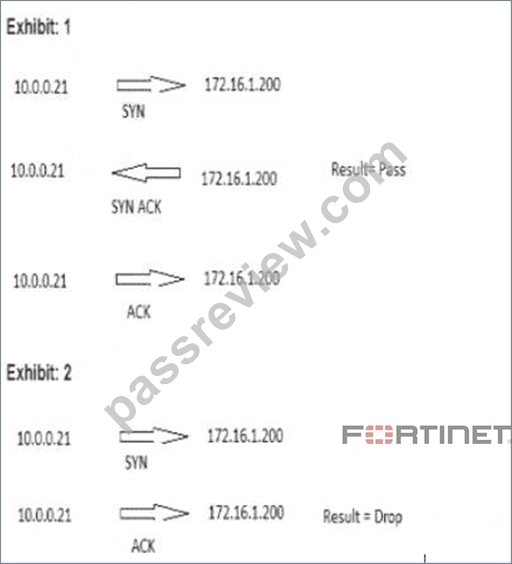
- A. Three way handshake was not completed
- B. Traffic is Asymmetric and not allowed by the Firewall
- C. The ACK was not supposed to be sent to client 10.0.0.21
- D. Traffic should be allowed
Answer: A
Explanation:
Stateful inspection requires a complete TCP three-way handshake (SYN, SYN-ACK, ACK) to establish a session in the firewall's state table. If the handshake is incomplete (e.g., missing ACK), the session is not established, and traffic is dropped. The question implies a stateful firewall scenario where traffic is blocked, likely due to an incomplete handshake. Asymmetric traffic (B) or incorrect ACK (A) are not indicated without further context, and C is incorrect if the handshake fails. Exact extract: "Stateful inspection ensures that a TCP three-way handshake is completed before allowing traffic... If the handshake is not completed, FortiGate drops the packets as invalid."
NEW QUESTION # 21
Which FortiGate feature allows for policy-based routing?
- A. SD-WAN Rules
- B. Static Routes
- C. Policy Routes
- D. Dynamic Routes
Answer: C
Explanation:
Policy Routes in FortiGate allow routing decisions based on criteria like source, destination, or service, overriding the default routing table. SD-WAN Rules (A) are for WAN optimization, Static Routes (C) are fixed, and Dynamic Routes (D) are protocol-based, not policy-based. Exact extract: "Policy Routes allow FortiGate to make routing decisions based on user-defined criteria, such as source/destination IPs or services, overriding standard routing."
NEW QUESTION # 22
Link aggregation allows network devices to________
- A. Restrict the bandwidth
- B. Increase bandwidth of an interface
- C. None of the above
- D. Increase bandwidth by binding physical interfaces into a single channel
Answer: D
Explanation:
Link aggregation, also known as IEEE 802.3ad or 802.1ax, enables the binding of multiple physical interfaces to form a single logical interface, which increases the overall bandwidth and provides redundancy. This is achieved by combining the bandwidth of the individual links into one aggregated link. For example, if two
1Gbps interfaces are aggregated, the logical link can provide up to 2Gbps bandwidth. This configuration is commonly used in FortiGate devices to enhance network performance without replacing hardware. The option B correctly describes this by stating "Increase bandwidth by binding physical interfaces into a single channel," which aligns with the official description. Incorrect options include A, which is vague and does not specify the method of binding multiple interfaces; C, which is the opposite of the purpose; and D, which is invalid.
Exact extract: Link aggregation (IEEE 802.3ad/802.1ax) enables you to bind two or more physical interfaces together to form an aggregated (combined) link. This new link ... Link aggregation combines multiple physical interfaces into a single logical interface, increasing bandwidth and link redundancy. Traffic is distributed evenly.
NEW QUESTION # 23
What happens when a FortiGate's CPU enters conserve mode?
- A. Routing protocols are disabled
- B. All traffic is blocked
- C. Proxy-based inspection is disabled
- D. New sessions are dropped
Answer: C
Explanation:
When a FortiGate's CPU enters conserve mode due to high load, proxy-based inspection (e.g., web filtering, DLP) is disabled to reduce resource usage, while flow-based inspection continues. Traffic isn't fully blocked (A), new sessions may still be processed (C), and routing protocols (D) are unaffected. Exact extract: "In conserve mode, FortiGate disables proxy-based inspection to reduce CPU and memory load, switching to flow-based inspection to maintain performance."
NEW QUESTION # 24
What is the default FortiGate behavior when a packet matches no firewall policy?
- A. The packet is forwarded to the default gateway
- B. The packet is dropped
- C. The packet is logged and allowed
- D. The packet is sent to the IPS engine
Answer: B
Explanation:
FortiGate operates on a default-deny principle; if a packet does not match any firewall policy, it is dropped to ensure security. No forwarding (A), IPS processing (C), or automatic allowing (D) occurs without a matching policy. Exact extract: "FortiGate uses a default-deny approach; packets that do not match any configured firewall policy are dropped to prevent unauthorized traffic."
NEW QUESTION # 25
Which of the following protocols operates at Layer 4
- A. BGP
- B. ARP
- C. IPSEC
- D. OSPF
Answer: C
Explanation:
IPsec operates at Layer 4 (Transport Layer) in the OSI model, providing secure communication via protocols like ESP and AH, which work with TCP or UDP. BGP and OSPF are Layer 3 (Network Layer) routing protocols, and ARP operates at Layer 2 (Data Link Layer). Fortinet's FortiGate uses IPsec for VPNs at Layer
4. Exact extract: "IPsec operates at the Transport Layer (Layer 4) to secure communications, encapsulating TCP or UDP packets... BGP and OSPF function at the Network Layer, while ARP resolves IP to MAC addresses at the Data Link Layer."
NEW QUESTION # 26
Which of the following is a benefit of using FortiGate's Security Fabric?
- A. It increases the speed of IPsec VPN tunnels
- B. It enables centralized management of multiple Fortinet devices
- C. It reduces the need for firewall policies
- D. It automatically configures VLANs on FortiSwitches
Answer: B
Explanation:
The Fortinet Security Fabric provides a centralized management platform for multiple Fortinet devices (e.g., FortiGate, FortiSwitch, FortiAP), enabling coordinated security policies, telemetry sharing, and simplified administration. It does not directly speed up VPNs (B), reduce firewall policies (C), or auto-configure VLANs (D). Exact extract: "The Fortinet Security Fabric enables centralized management and visibility across Fortinet devices, allowing coordinated security policies and telemetry sharing for enhanced protection."
NEW QUESTION # 27
In Active FTP who sends the PORT command?
- A. Both
- B. The FTP Server
- C. There is no PORT command in Active FTP
- D. The FTP Client
Answer: D
Explanation:
In Active FTP, the client sends the PORT command to the server, specifying an ephemeral port for the server to initiate the data connection back to the client. This distinguishes Active FTP from Passive FTP, where the server provides the port. The server does not send PORT, and the command is a key part of Active FTP. Exact extract: "In Active FTP, the client sends a PORT command to the server, specifying the IP address and port number for the data connection... The server then initiates the data connection to the client's specified port."
NEW QUESTION # 28
What is the role of the FortiGate 'set srcintf' command in a firewall policy?
- A. Specifies the source interface for traffic matching
- B. Sets the source IP address range
- C. Configures the source NAT interface
- D. Defines the destination interface for traffic
Answer: A
Explanation:
The 'set srcintf' command in a FortiGate firewall policy specifies the source interface from which traffic originates, helping define the policy's scope. It does not set the destination interface (B), source IP range (C), or NAT interface (D). Exact extract: "The 'set srcintf' command in a firewall policy specifies the source interface for incoming traffic, allowing FortiGate to match packets based on their entry interface."
NEW QUESTION # 29
Which Router in an OSPF Domain sends a Type-4 Summary LSA
- A. ASBR
- B. ABR
- C. All OSPF Routers
- D. Stub Routers only
Answer: B
Explanation:
In OSPF, the Area Border Router (ABR) generates Type-4 Summary LSAs to advertise the location of an Autonomous System Boundary Router (ASBR) to other areas. This LSA informs routers in different areas how to reach the ASBR for external routes. ASBR generates Type-5 LSAs for external routes, but ABR summarizes them with Type-4. Not all routers or stub routers do this. Exact extract: This article describes the basic steps to configure FortiGates in an OSPF scenario where the FortiGates will be ABR and ASBR OSPF routers across 3 areas. Router3 is the Autonomous System Border Router (ASBR). It routes all traffic to the ISP BGP router for internet access. It redistributes routes from BGP and ... Type 4 LSAs exist to let the area know the router-id of the ASBR, so the routers can look at the type 5 route, find advertising-router, and map
... An ASBR summary LSA is generated by an ABR and describes the location of an ASBR (Autonomous System Boundary Router) that connects to an external network. The FortiGate in the middle shall be a ABR between the two areas. But I don't want R2 in area 0.0.0.0 to have every /32 route for every VPN client. So I tried ...
NEW QUESTION # 30
In FortiGate, what is the purpose of the 'set webfilter-profile' command in a firewall policy?
- A. Sets the web server authentication profile
- B. Applies a web filtering profile to block or allow URLs
- C. Enables deep packet inspection for web traffic
- D. Configures the web proxy settings
Answer: B
Explanation:
The 'set webfilter-profile' command applies a web filtering profile to a firewall policy, enabling URL blocking or allowing based on categories or specific URLs. It does not enable DPI (B), configure proxies (C), or set authentication (D). Exact extract: "The 'set webfilter-profile' command applies a web filtering profile to a firewall policy, controlling access to websites based on URL categories or specific URLs."
NEW QUESTION # 31
In a FortiGate high availability (HA) cluster, what happens if the primary unit fails?
- A. The cluster switches to active-passive mode
- B. A secondary unit takes over as the primary unit
- C. The cluster is disabled, and traffic stops
- D. Traffic is rerouted through an external gateway
Answer: B
Explanation:
In a FortiGate HA cluster (active-active or active-passive), if the primary unit fails, a secondary unit automatically takes over as the primary, ensuring continuity of traffic with minimal disruption. Option A is incorrect as traffic continues, C is incorrect as the mode doesn't change post-failure, and D is unrelated. Exact extract: "In a FortiGate HA cluster, if the primary unit fails, a secondary unit is elected as the new primary, taking over all roles to maintain traffic flow and session continuity."
NEW QUESTION # 32
Which FortiGate feature allows inspection of encrypted SSL/TLS traffic?
- A. SSL Inspection
- B. Web Filtering
- C. Application Control
- D. Deep Packet Inspection
Answer: A
Explanation:
FortiGate's SSL Inspection feature decrypts and inspects SSL/TLS traffic to detect threats or enforce policies, using techniques like full SSL inspection or certificate inspection. Deep Packet Inspection (A) is a broader term, Application Control (C) identifies apps, and Web Filtering (D) blocks URLs, not specific to SSL. Exact extract: "SSL Inspection allows FortiGate to decrypt and inspect SSL/TLS traffic to detect hidden threats or enforce security policies, supporting full or certificate-based inspection."
NEW QUESTION # 33
What are source and destination MAC addresses of an ARP request?
- A. The source MAC is that of the sending device and the destination is a multicast address
- B. The source MAC is that of the forwarding switch and destination of the targeted device
- C. The source MAC is that of the sending device and the destination of the targeted device
- D. The source MAC is that of the sending device and the destination MAC is a broadcast address
Answer: D
Explanation:
An ARP (Address Resolution Protocol) request is broadcast to resolve an IP address to a MAC address. The source MAC is the sender's MAC address, and the destination MAC is the broadcast address (FF:FF:FF:FF:
FF:FF) to reach all devices on the local network. Fortinet devices handle ARP for Layer 2 communication.
Options B, C, and D are incorrect as switches don't originate ARP requests, the target's MAC is unknown, and ARP uses broadcast, not multicast. Exact extract: "In an ARP request, the source MAC address is that of the sending device, and the destination MAC address is the broadcast address (FF:FF:FF:FF:FF:FF), sent to all devices in the local network segment."
NEW QUESTION # 34
A firewall receives an out-of-order packet in a TCP session after the FIN/ACK and the packet is dropped as expected. What parameter can be changed to prevent such drops?
- A. TCP time-wait timer
- B. TCPMSS
- C. TCP close-wait timer
- D. Enable TCP option
Answer: A
Explanation:
Out-of-order packets after FIN/ACK indicate a packet arriving in the TIME_WAIT state, where the session is closing. The TCP time-wait timer controls how long the firewall keeps the session in the TIME_WAIT state to handle late packets. Increasing this timer allows the firewall to accept such packets instead of dropping them. Close-wait timer relates to a different state, TCPMSS affects packet size, and "Enable TCP option" is not a standard parameter. Exact extract: "The TCP time-wait timer determines how long a session remains in the TIME_WAIT state to handle out-of-order or retransmitted packets after FIN/ACK... Adjusting this timer can prevent drops of late-arriving packets."
NEW QUESTION # 35
What does the FortiGate 'set nat enable' command do in a firewall policy?
- A. Forces NAT to use a specific IP pool
- B. Enables NAT for incoming traffic only
- C. Disables NAT for the policy
- D. Enables NAT for outgoing traffic
Answer: D
Explanation:
The 'set nat enable' command in a FortiGate firewall policy enables Source NAT (SNAT) for outgoing traffic, typically rewriting the source IP to the FortiGate's interface IP or an IP pool. It does not disable NAT (B), force a specific pool (C), or limit to incoming traffic (D). Exact extract: "The 'set nat enable' command in a firewall policy enables Source NAT, rewriting the source IP address of outgoing traffic to the egress interface IP or a configured NAT pool."
NEW QUESTION # 36
......
Updated PDF (New 2025) Actual Fortinet EMEA-Advanced-Support Exam Questions: https://getfreedumps.passreview.com/EMEA-Advanced-Support-exam-questions.html