

2025 Updated CWNP CWAP-404 Dumps PDF - Want To Pass CWAP-404 Fast
CWAP-404 Practice Exam Dumps - 99% Marks In CWNP Exam
CWNP CWAP-404 Exam Certification Details:
| Passing Score | 70% |
| Exam Price | $275 USD |
| Duration | 90 minutes |
| Recommended Training | CWAP self-paced training kit, Training Class |
| Exam Name | Wireless Analysis Professional |
| Exam Code | CWAP-404 CWAP |
CWNP CWAP-404 Exam Topics:
| Section | Objectives |
|---|---|
Protocol Analysis - 15% | |
| Capture 802.11 frames using the appropriate methods | - Select capture devices
- Install monitor mode drivers |
| Understand and apply the common capture configuration parameters available in protocol analysis tools | - Save to disk - Packet slicing - Event triggers - Buffer options - Channels and channel widths - Capture filters - Channel scanning and dwell time |
| Analyze 802.11 frame captures to discover problems and find solutions | - Use appropriate display filters to view relevant frames and packets - Use colorization to highlight important frames and packets - Configure and display columns for analysis purposes - View frame and packet decodes while understanding the information shown and applying it to the analysis process - Use multiple adapters and channel aggregation to view captures from multiple channels - Implement protocol analyzer decryption procedures - View and use a capture’s statistical information for analysis - Use expert mode for analysis - View and understand peer maps as they relate to communications analysis |
| Utilize additional tools that capture 802.11 frames for analysis and troubleshooting | - WLAN scanners and discovery tools - Protocol capture visualization and analysis tools - Centralized monitoring, alerting, and forensic tools |
| Ensure appropriate troubleshooting methods are used with all analysis types | - Define the problem - Determine the scale of the problem - Identify probable causes - Capture and analyze the data - Observe the problem - Choose appropriate remediation steps - Document the problem and resolution |
Spectrum Analysis - 10% | |
| Capture RF spectrum data and understand the common views available in spectrum analyzers | - Install, configure, and use spectrum analysis software and hardware - Capture RF spectrum data using handheld, laptop-based, and infrastructure spectrum capture solutions - Understand and use spectrum analyzer views
|
| Analyze spectrum captures to identify relevant RF information and issues | - RF noise floor in an environment - Signal-to-Noise Ratio (SNR) for a given signal - Sources of RF interference and their locations - RF channel utilization - Non-Wi-Fi transmitters and their impact on WLAN communications - Overlapping and non-overlapping adjacent channel interference - Poor performing or faulty radios |
| Analyze spectrum captures to identify various device signatures | - Identify various 802.11 PHYs
- Identify non-802.11 devices based on RF behaviors and signatures
|
| Use centralized spectrum analysis solutions | - AP-based spectrum analysis - Sensor-based spectrum analysis |
PHY Layers and Technologies - 10% | |
| Understand and describe the functions of the PHY layer and the PHY protocol data units (PPDUs) | - DSSS (Direct Sequence Spread Spectrum) - HR/DSSS (High Rate/Direct Sequence Spread Spectrum) - OFDM (Orthogonal Frequency Division Multiplexing) - ERP (Extended Rate PHY) - HT (High Throughput) - VHT (Very High Throughput) - HE (High Efficiency)
|
| Apply the understanding of PHY technologies, including PHY headers, preambles, training fields, frame aggregation, and data rates, to captured data | |
| Identify and use PHY information provided within pseudo-headers in protocol analyzers | - Pseudo-Header formats
- Key pseudo-header content
|
| Recognize the limits of protocol analyzers to capture PHY information including NULL data packets and PHY headers | |
NEW QUESTION # 76
When a data frame is encrypted with WPA2, to which portion of the frame is the encryption applied?
- A. Frame body excluding the LLCPDU
- B. Frame body including the LLCPDU
- C. The whole MPDU
- D. Frame body and MAC Header
Answer: B
Explanation:
Explanation
When a data frame is encrypted with WPA2, the encryption is applied to the frame body including the LLCPDU. The LLCPDU (Logical Link Control Protocol Data Unit) is a part of the frame body that contains information such as protocol type, source and destination service access points (SAPs), and control fields. The LLCPDU is added by the LLC (Logical Link Control) sublayer to provide multiplexing and flow control functions for different upper layer protocols. When a data frame is encrypted with WPA2, which uses AES-CCMP as its encryption algorithm, both the payload and the LLCPDU are encrypted as a single unit. The MAC header and FCS are not encrypted, as they are needed for addressing and error detection purposes. References: [Wireless Analysis Professional Study Guide CWAP-404], Chapter 5: 802.11 MAC Sublayer, page 115-116
NEW QUESTION # 77
How many frames are exchanged for 802.11 authentication in the 6 GHz band when WPA3-Enterprise is not used, and a passphrase is used instead?
- A. 0
- B. 1
- C. 2
- D. 3
Answer: C
Explanation:
Explanation
Two frames are exchanged for 802.11 authentication in the 6 GHz band when WPA3-Enterprise is not used, and a passphrase is used instead. Authentication is a process that establishes an identity relationship between a STA (station) and an AP (access point) before joining a BSS (Basic Service Set). There are two types of authentication methods defined by 802.11: Open System Authentication and Shared Key Authentication. Open System Authentication does not require any credentials or security information from a STA to join a BSS, and it consists of two frames: an Authentication Request frame sent by the STA to the AP, and an Authentication Response frame sent by the AP to the STA. Shared Key Authentication requires a shared secret key from a STA to join a BSS, and it consists of four frames: two challenge-response frames in addition to the request-response frames. However, Shared Key Authentication uses WEP (Wired Equivalent Privacy) as its encryption algorithm, which is insecure and deprecated. In the 6 GHz band, which is a newly available frequency band for WLANs, Shared Key Authentication is prohibited by the 802.11 standard, as it poses security and interference risks for other users and services in the band. The 6 GHz band requires all WLANs to use WPA3-Personal or WPA3-Enterprise encryption methods, which are more secure and robust than previous encryption methods such as WPA2 or WEP. WPA3-Personal uses a passphrase to derive a PMK (Pairwise Master Key), while WPA3-Enterprise uses an authentication server to obtain a PMK. Both methods use SAE (Simultaneous Authentication of Equals) as their authentication protocol, which replaces PSK (Pre-Shared Key) or EAP (Extensible Authentication Protocol). SAE consists of two frames: an SAE Commit frame sent by both parties to exchange elliptic curve parameters and nonces, and an SAE Confirm frame sent by both parties to verify each other's identities and generate a PMK. Therefore, when WPA3-Enterprise is not used, and a passphrase is used instead in the 6 GHz band, only two frames are exchanged for 802.11 authentication:
an SAECommit frame and an SAE Confirm frame. References: [Wireless Analysis Professional Study Guide CWAP-404], Chapter 8: Security Analysis, page 220-221
NEW QUESTION # 78
What is used to respond with an uplink transmission to an MU-RTS trigger frame in the 802.11ax PHY?
- A. HE TB PPDU
- B. HE MU PPDU
- C. VHT PPDU
- D. HE SU PPDU
Answer: A
Explanation:
An HE TB PPDU (High Efficiency Trigger-Based Packet Data Unit) is used to respond with an uplink transmission to an MU-RTS trigger frame in the 802.11ax PHY (Physical Layer). An MU- RTS trigger frame is a frame that initiates a multi-user transmission opportunity (MU-TXOP) by requesting multiple stations (STAs) to send clear-to-send (CTS) frames on different spatial streams or resource units (RUs). An HE TB PPDU is a frame that contains data from multiple STAs that have been allocated RUs by an MU-RTS trigger frame or another type of trigger frame.
An HE SU PPDU (High Efficiency Single User Packet Data Unit) is a frame that contains data from a single STA using all available spatial streams or RUs. An HE MU PPDU (High Efficiency Multi User Packet Data Unit) is a frame that contains data from multiple STAs using different spatial streams or RUs without being triggered by another frame. A VHT PPDU (Very High Throughput Packet Data Unit) is a frame that uses the 802.11ac PHY and does not support multi- user transmissions.
NEW QUESTION # 79
Which parameters accurately describe the Beacon Interval field in the Beacon frame? (Choose 2)
- A. Measured in time units of 1024 ms
- B. Indicates the exact time interval between Beacon transmissions
- C. Indicates the desired time interval between TBTTs
- D. Value can range from 0 to 2007
- E. 4-octet length
Answer: A,C
NEW QUESTION # 80
A manager at a retail outlet has complained that an incident occurred allowing a STA to launch an attack against another STA connected to their public Wi-Fi hotspot. He has asked you to troubleshoot the situation and verify that all possible measured are being taken to prevent this.
What configuration should you check in the AP?
- A. Captive portal Internet gateway
- B. DNS settings
- C. Inter-VAP filtering
- D. Client-to-client direct communications
Answer: C
NEW QUESTION # 81
Given a protocol analyzer can decrypt WPA2-PSK data packets providing the PSK and SSID are configured in the analyzer software. When performing packet capture (in a non-FT environment) which frames are required in order for PSK frame decryption to be possible?
- A. Probe Response
- B. Authentication
- C. 4-Way Handshake
- D. Reassociation
Answer: C
Explanation:
Explanation
The 4-way handshake is the process that establishes the pairwise transient key (PTK) between the client and the AP in WPA2-PSK. The PTK is derived from the PSK, the SSID, and some random numbers exchanged in the handshake frames. The PTK is used to encrypt and decrypt the data frames between the client and the AP. Therefore, in order to decrypt WPA2-PSK data packets, a protocol analyzer needs to capture the 4-way handshake frames and have the PSK and SSID configured in the analyzer software12 References:
CWAP-404 Study Guide, Chapter 3: 802.11 MAC Layer Frame Formats and Technologies, page 87 CWAP-404 Objectives, Section 3.5: Analyze security exchanges
NEW QUESTION # 82
How many frames make up the Group Key Handshake excluding any Ack frames that may be required?
- A. 0
- B. 1
- C. 2
- D. 3
Answer: C
Explanation:
The Group Key Handshake consists of two frames excluding any Ack frames that may be required. The Group Key Handshake is used to distribute and update the Group Temporal Key (GTK) for encrypting broadcast and multicast traffic. The AP initiates the Group Key Handshake by sending a Group Key Message 1 frame to a STA, which contains the new GTK and other information. The STA responds with a Group Key Message 2 frame to the AP, which confirms the receipt of the GTK and other information. After this, both the AP and the STA can use the new GTK for encryption and decryption of broadcast and multicast traffic.
NEW QUESTION # 83
During a VHT Transmit Beamforming sounding exchange, the beamformee transmits a Compressed Beamforming frame to the beamformer. What is communicated within this Compressed Beamforming frame?
- A. Beamforming Matrix
- B. Steering Matrix
- C. Feedback Matrix
- D. Beamformee Matrix
Answer: C
Explanation:
Explanation
The beamformee transmits a Feedback Matrix within the Compressed Beamforming frame to the beamformer.
The Feedback Matrix contains information about the channel state between the beamformee and each spatial stream of the beamformer. This information is used by the beamformer to adjust its transmit weights and optimize its signal for the beamformee34. References: CWAP-404 Certified Wireless Analysis Professional Study and Reference Guide, Chapter 11: 802.11n/ac/ax PHYsical Layer Frame Exchanges, page 4033; CWAP-404 Certified Wireless Analysis Professional Study and Reference Guide, Chapter 11: 802.11n/ac/ax PHYsical Layer Frame Exchanges, page 4064.
NEW QUESTION # 84
After examining a Beacon frame decode you see the SSID Element has a length of 0. What do you conclude about this frame?
- A. The frame is corrupted
- B. SSID elements always have a length of 0
- C. This is a common attack on WISP backend SQL databases
- D. The beacon is from a BSS configured to hide the SSID
Answer: D
Explanation:
If the SSID element has a length of 0 in a Beacon frame decode, it means that the beacon is from a BSS configured to hide the SSID. The SSID element is a part of the Beacon frame that contains the name or identifier of the BSS. The SSID element has two fields: length and value. The length field indicates how many bytes are used for the value field, which contains the actual SSID string.
If the length field is 0, it means that there is no value field or SSID string in the element. This is a common technique used by some APs to hide their SSID from passive scanning clients or potential attackers. However, this technique does not provide much security, as there are other ways to discover or reveal the hidden SSID, such as active scanning or capturing probe response or association frames.
NEW QUESTION # 85
A manufacturing facility has installed a new automation system which incorporates an 802.11 wireless network. The automation system is controlled from tablet computers connected via the WLAN. However, the automation system has not gone live due to problem with the tablets connecting to the WLAN. The WLAN vendor has been onsite to perform a survey and confirmed good primary and secondary coverage across the facility. As a CWAP you are called in to perform Spectrum Analysis to identify any interference sources. From the spectrum analysis, you did not identify any interference sources but were able to correctly identify the issue. Which of the following issues did you identify from the spectrum analysis?
- A. A high noise floor has resulted in a SNR of less than 20%
- B. There is a power mismatch between the APs and the clients
- C. The tablets are connecting to the wrong SSID
- D. The tablets are entering power save mode and failing to wake up to receive the access points transmissions
Answer: B
Explanation:
The most likely issue that can be identified from the spectrum analysis is a power mismatch between the APs and the clients. A power mismatch occurs when the APs transmit at a higher power level than the clients, or vice versa. This can cause asymmetric communication, where one side can hear the other, but not vice versa. This can result in poor performance, disconnections, or packet loss. A spectrum analysis can reveal a power mismatch by showing different signal amplitudes or RSSI values for the APs and the clients on the same channel or frequency. The other options are not correct, as they cannot be identified from the spectrum analysis alone. The tablets' SSID, power save mode, and noise floor can be determined by using other tools or methods, such as protocol analysis, site survey, or device configuration.
NEW QUESTION # 86
In which element of a Beacon frame would you look to identify the current HT protection mode in which an AP is operating?
- A. HT Information Element
- B. HT Capabilities Element
- C. HT Protection Element
- D. HT Operations Element
Answer: A
Explanation:
The HT Information Element in a Beacon frame contains information about the current HT (High Throughput) protection mode in which an access point (AP) is operating. This element is used to ensure backward compatibility between HT (802.11n) and non-HT stations.
NEW QUESTION # 87
You are troubleshooting a connection problem with a client STA. Regardless of the AP to which it attempts to connect, the connection fails.
Using a wired protocol analyzer, you determine that the problem is with the 802.1X/EAP authentication to the RADIUS server.
What layer or range of layers of the OSI model revealed this information?
- A. Above Layer 4
- B. Below Layer 3
- C. Layer 2
- D. Layer 3
Answer: D
NEW QUESTION # 88
You require 802.11ac capture solution.
You want to capture using native operating system tools if possible.
What operating system has built-in ability to capture 802.11ac frames assuming it is running on the appropriate laptop hardware?
- A. Windows 10
- B. Windows 8.1
- C. Mac OS X
- D. Windows 7
Answer: C
NEW QUESTION # 89
As a WLAN consultant, you have been asked to troubleshoot a problem with a single wireless client station (Station-Z). Your customer informs you that other wireless client stations are not having problems with wireless connectivity, and that Station-Z is configured in the same manner as all other wireless client stations on the network. Station-Z is showing an unusually high retransmission count in its client utility statistics. Using a wireless protocol analyzer, where and how should you begin troubleshooting this problem? (Choose 2)
- A. Position the analyzer near the access point. See if Station-Z's frames are reaching the access point and if so, analyze their signal strength.
- B. Position the analyzer near Station-Z. Analyze Station-Z's transmissions and acknowledgements.
Look for RF and obstacle-induced interference. - C. Position the analyzer halfway between Station-Z and the access point. Analyze the data rate at which frames are sent and how long they take to be received.
- D. Position the analyzer near Station-Z. Analyze the frames Station-Z is receiving, looking for delayed ACK frames.
- E. Position the analyzer halfway between Station-Z and the access point. Measure the distance between Station-Z and the access point.
Answer: A,B
NEW QUESTION # 90
Which statement accurately describes IEEE 802.11 Power Save operation in a Basic Service Set that does not support the QoS facility?
- A. After waking from a low power state, client stations listen for the next Beacon to determine if sending a PS-Poll frame to the access point is necessary.
- B. Following a period of time in a low power state, client stations wake themselves and automatically poll the access point for traffic using a PS-Poll frame.
- C. When the access point's buffer is full, the access point wakes all client stations using a PS-Poll frame so that they can receive the data.
- D. After waking at a scheduled TBTT, client stations send Null Function frames to the access point with the Power Management bit set back to zero.
- E. Upon receiving traffic for a dozing station, the access point wakes the client station using a PS- Poll frame so that the client station can receive the data.
Answer: A
NEW QUESTION # 91
Why would a STA that supports 802.11k Radio Measurement send a Neighbor Request to an AP?
- A. To request a list of neighboring APs which the STA can use as roaming candidates
- B. To inform the current AP about the STA's intent to roam to a neighboring AP, ensuring a seamless handover
- C. To learn about neighboring interference sources and tune its RF radio accordingly
- D. To request a list of neighboring STAs which enables the STA to better pick the right protection mechanisms
Answer: A
Explanation:
A STA that supports 802.11k Radio Measurement would send a Neighbor Request to an AP to request a list of neighboring APs which the STA can use as roaming candidates. A Neighbor Request is an Action frame that contains a subelement specifying the type of information that the STA wants to receive from the AP. A Neighbor Report is an Action frame that contains a subelement with a list of neighboring APs that match the criteria specified in the Neighbor Request. The Neighbor Report provides information such as BSSID, channel, operating class, and PHY type of each neighboring AP. This information helps the STA to perform intelligent roaming decisions based on signal quality, load, and compatibility.
NEW QUESTION # 92
iPerf is a tool used in what category of testing?
- A. Connection
- B. Name resolution
- C. Configuration
- D. Throughput
Answer: D
NEW QUESTION # 93
Using the exhibit as a reference, which spectrum plots display, in real time, the value of RF amplitude as a function of radio frequency?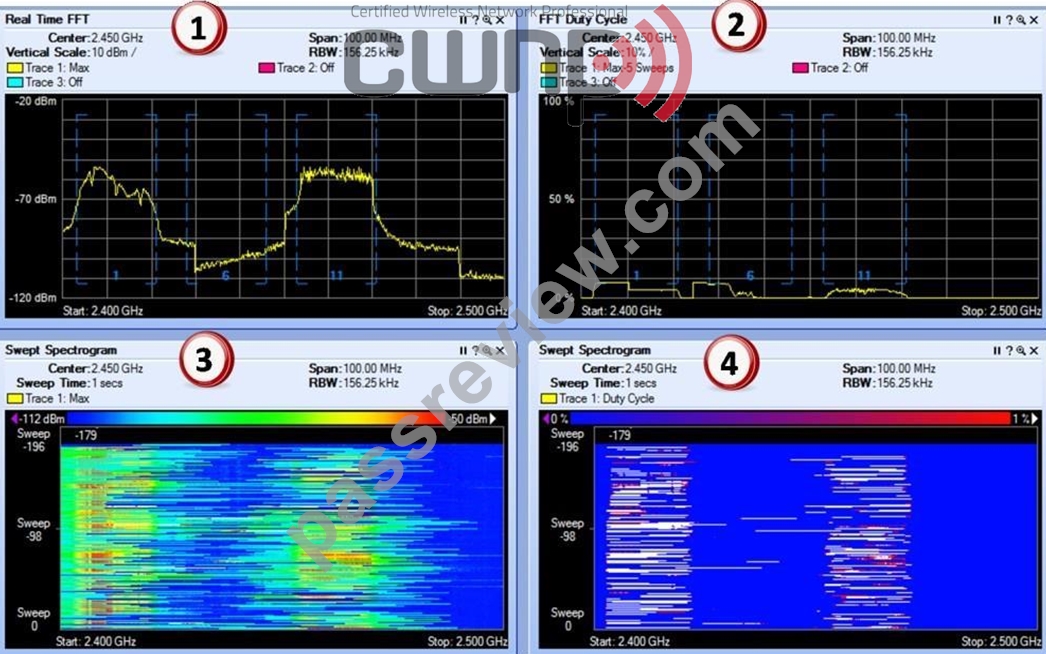
- A. 1, 3, and 4
- B. 3 and 4
- C. 1 and 3
- D. All of the plots
- E. 1 and 2
Answer: C
NEW QUESTION # 94
You are using a laptop-based protocol analyzer to scan all channels and determine the basic configuration of the WLAN Basic Service Set in your facility.
You are scanning all channels. All configured with default settings.
What can you change to cause the scan to run faster while still APs are capturing beacon frames on all the channels?
- A. Configure the RBW to more than 120 kHz
- B. Configure the scan time for channels to <100 ms
- C. Configure the scan time for channels to 300-500 ms
- D. Configure the fragmentation threshold to 1500 bytes
Answer: A
NEW QUESTION # 95
Which statements are true regarding frame acknowledgement in an IEEE 802.11 WLAN? (Choose 3)
- A. Data frame fragments are acknowledged individually (with an ACK frame).
- B. Following non-QoS Data frames with the More Fragments bit set to 1, the Duration/ID field of the ACK frame is set to a value equal to two SIFS plus the next Data fragment and its ACK.
- C. Probe request acknowledgement (sending of a Probe Response frame) is configurable in the access point and is always linked to SSID broadcast configuration in Beacons.
- D. The RA field of ACK frames is always obtained from the Address 2 field in the corresponding frame being acknowledged.
- E. A client station's Reassociation Request frames are only acknowledged with a Reassociation Response from the access point and not with an ACK frame.
- F. In an EDCA BSS, encrypted Data frames are only acknowledged by client stations, never by access points.
Answer: A,B,D
NEW QUESTION # 96
You are analyzing a packet decode of a Probe Request and notice the SSID element has a length of zero.
What do you conclude about transmitting STA?
- A. The STA is operating in Ad-Hoc mode
- B. The WLAN adaptor is configured in promiscuous mode
- C. The STA is discovering a list of available BSSs
- D. The STA's WLAN adaptor is disabled
Answer: C
Explanation:
The STA is discovering a list of available BSSs by sending a Probe Request with an empty SSID element. This is also known as a broadcast Probe Request, as it does not specify any particular SSID to probe for. Any AP that receives this Probe Request will respond with a Probe Response containing its own SSID and other information about its BSS. This way, the STA can learn about all the BSSs in its vicinity and choose which one to associate with.
NEW QUESTION # 97
Where, in a protocol analyzer, would you find an indication that a frame was transmitted as part of an A-MPDU?
- A. A-MPDU flag in the QoS Control Field
- B. The HT Operation Element
- C. The Aggregation flag in the Radio Tap Header
- D. A-MPDU flag in the Frame Control Field
Answer: C
Explanation:
Explanation
In a protocol analyzer, you would find an indication that a frame was transmitted as part of an A-MPDU by looking at the Aggregation flag in the Radio Tap Header. The Radio Tap Header is a pseudo-header that is added by some wireless capture devices to provide additional information about the physical layer characteristics of a frame. The Aggregation flag is one of the fields in this header, and it indicates whether the frame belongs to an A-MPDU or not. If the flag is set to 1, it means that the frame is part of an A-MPDU; if it is set to 0, it means that the frame is not part of an A-MPDU . References: CWAP-404 Certified Wireless Analysis Professional Study and Reference Guide, Chapter 9: PHY Layer Frame Formats andTechnologies, page 303; CWAP-404 Certified Wireless Analysis Professional Study and Reference Guide, Chapter 9: PHY Layer Frame Formats and Technologies, page 304.
NEW QUESTION # 98
......
Updated Verified CWAP-404 Q&As - Pass Guarantee: https://getfreedumps.passreview.com/CWAP-404-exam-questions.html